Intravenous lidocaine with propofol-based sedation for colonoscopy: a systematic review and meta-analysis with trial sequential analysis
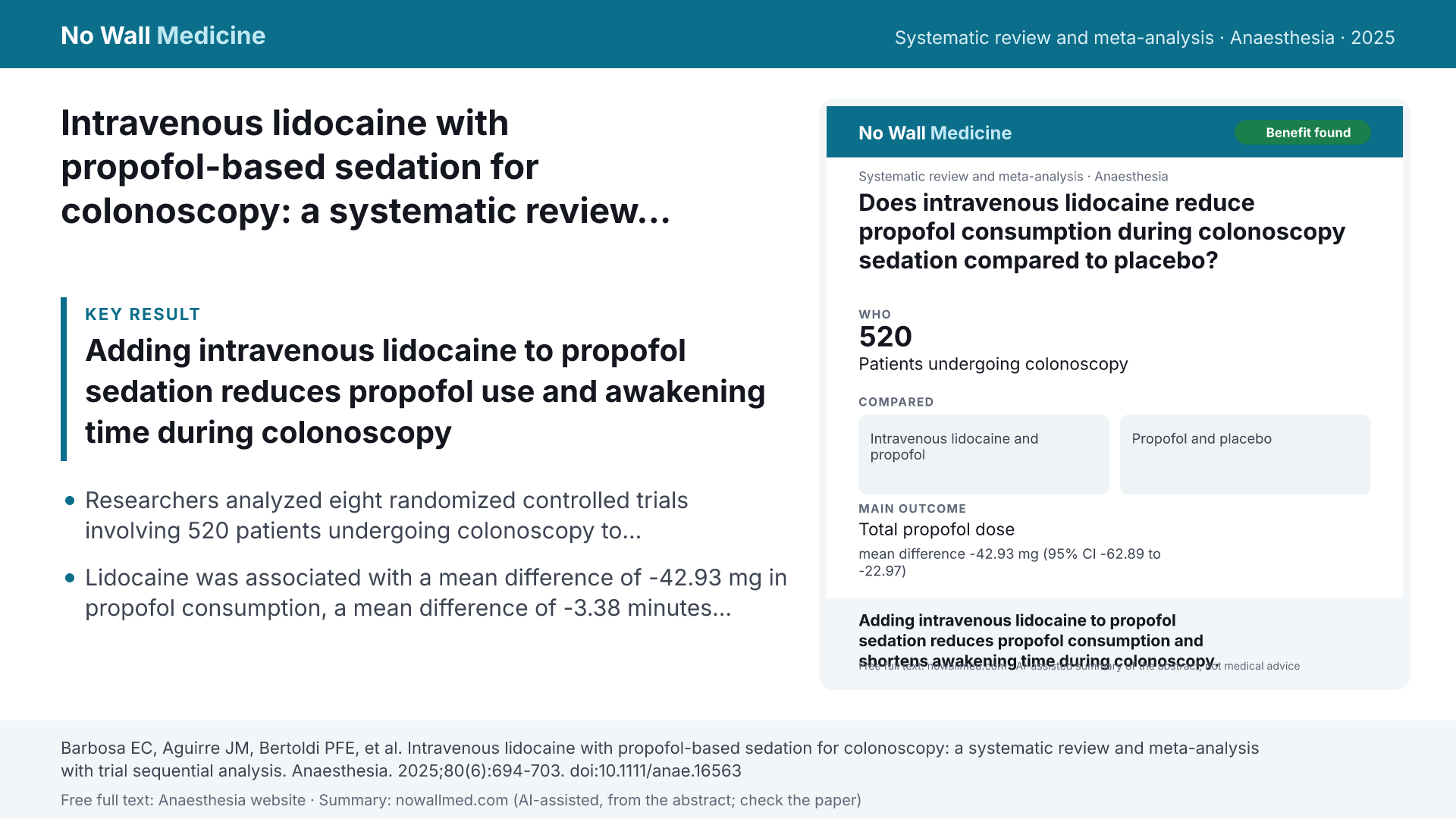
Key result: Adding intravenous lidocaine to propofol sedation reduces propofol use and awakening time during colonoscopy
Systematic review and meta-analysisBenefit found
Does intravenous lidocaine reduce propofol consumption during colonoscopy sedation compared to placebo?
Who
520
Patients undergoing colonoscopy
Compared
Intravenous lidocaine and propofol
Propofol and placebo
Main outcome
Total propofol dose
Result: mean difference -42.93 mg (95% CI -62.89 to -22.97)
Bottom line: Adding intravenous lidocaine to propofol sedation reduces propofol consumption and shortens awakening time during colonoscopy.
Anaesthesia · 2025-03-18
Key points
- Researchers analyzed eight randomized controlled trials involving 520 patients undergoing colonoscopy to compare lidocaine plus propofol against propofol plus a placebo.
- Lidocaine was associated with a mean difference of -42.93 mg in propofol consumption, a mean difference of -3.38 minutes in awakening time, and lower post-procedural pain scores.
- The addition of lidocaine was associated with increased patient satisfaction scores of 0.50 (0.30 to 0.70) but showed no significant difference in procedure duration or risk of low oxygen or low blood pressure.
Discussion prompts
- Would these patients look like yours? Who was left out?
- Is the main outcome one that matters to patients?
- Is the difference large enough to change what you do?
Cite: Barbosa EC, Aguirre JM, Bertoldi PFE, et al. Intravenous lidocaine with propofol-based sedation for colonoscopy: a systematic review and meta-analysis with trial sequential analysis. Anaesthesia. 2025;80(6):694-703. doi:10.1111/anae.16563
Free full text: Anaesthesia website · Summary and visual abstract: nowallmed.com/a/intravenous-lidocaine-with-propofol-based-sedation-for-colonoscopy-a-h4w32x/ (AI-assisted from the abstract; check the paper before relying on it).