Adding methylprednisolone to intravenous immunoglobulin did not significantly increase remission rates in CIDP patients
Intravenous methylprednisolone as add-on induction therapy for chronic inflammatory demyelinating polyradiculoneuropathy: a randomised controlled trial
Randomised, double-blind, placebo-controlled studyNo clear difference
Does adding intravenous methylprednisolone to intravenous immunoglobulin increase remission rates in CIDP?
Who
77
Adults with chronic inflammatory demyelinating polyradiculoneuropathy
Compared
38%Intravenous immunoglobulin and intravenous methylprednisolone (14/37)
28%Intravenous immunoglobulin and placebo (11/40)
Main outcome
Remission at 52 weeks
Result: difference of 10% (95% CI -11 to 31; p=0.47)
Bottom line: Adding intravenous methylprednisolone to intravenous immunoglobulin did not significantly increase remission rates compared to intravenous immunoglobulin alone.
J Neurol Neurosurg Psychiatry · 2026-05-14Download image
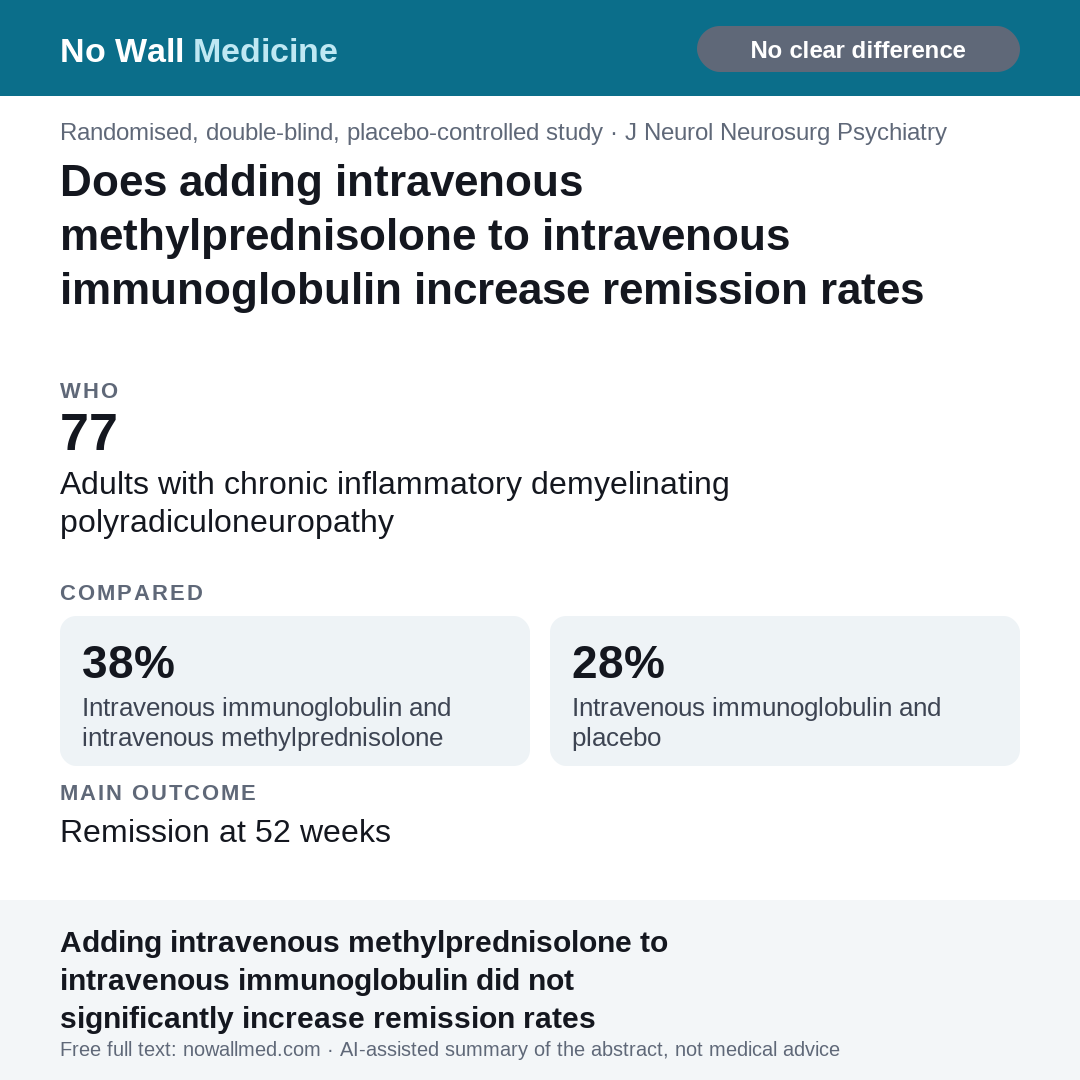
Clinical question: Does adding intravenous methylprednisolone to intravenous immunoglobulin increase remission rates in CIDP?
Why it matters: Doctors do not know if adding methylprednisolone to intravenous immunoglobulin increases remission rates for patients with chronic inflammatory demyelinating polyradiculoneuropathy.
Key points
- Researchers studied 77 adults with chronic inflammatory demyelinating polyradiculoneuropathy receiving either intravenous immunoglobulin plus methylprednisolone or intravenous immunoglobulin plus a placebo.
- At 52 weeks, 38% of the methylprednisolone group were in remission compared to 28% in the placebo group, which was not a statistically significant difference.
- The trial was stopped early because four thromboembolic events, such as blood clots, occurred in the methylprednisolone group while none occurred in the placebo group.
Headline and key points written with AI from the paper’s abstract, with every number checked against it. Read the paper before relying on them.
Abstract
Background
Most patients with chronic inflammatory demyelinating polyradiculoneuropathy (CIDP) require maintenance treatment. We aimed to determine whether combined treatment with intravenous immunoglobulin (IVIg) and intravenous methylprednisolone (IVMP) increases remission rates compared with IVIg and placebo. Methods
We performed a randomised, double-blind, placebo-controlled study. Adults with CIDP who were treatment naive, relapsed after a remission or required continued treatment after a single IVIg dose were included. Participants were treated with IVMP (1000 mg) or placebo (sodium chloride) every 3 weeks for 18 weeks. All participants received IVIg treatment consisting of a loading dose (2 g/kg) and serial maintenance treatments (1 g/kg). The primary outcome was remission, defined as sustained improvement on disability scales at 52 weeks without need for further treatment. Results
Enrolment was halted after the inclusion of 77 of the 96 planned participants because of safety concerns: four thromboembolic events occurred in the IVIg/IVMP group compared with none in the IVIg/placebo group. 14 of 37 (38%) participants in the IVIg/IVMP group were in remission at 52 weeks compared with 11 out of 40 (28%) in the IVIg/placebo group, with a difference of 10% (95% CI -11 to 31; p=0.47). Several secondary outcomes showed a greater magnitude of improvement in disability and impairment at 18 and 52 weeks in the IVIg/IVMP group. Conclusions
The study was prematurely stopped due to safety concerns after four thromboembolic events in the IVIg plus IVMP group. Combined treatment did not lead to significantly more frequent remissions than IVIg alone in the doses used in this study. Trial registration number
ISRCTN15893334.
Abstract reproduced under the article’s CC BY NC licence.
Topics
Spotted a mistake? Suggest a correction