Intravenous clot-dissolving therapy improves functional outcomes in stroke patients treated after 4.5 hours
Intravenous Thrombolysis Beyond the Conventional Time Window for Acute Ischemic Stroke: A Systematic Review and Meta-Analysis
Systematic review and meta-analysis of 14 randomized clinical trialsMixed results
Does intravenous thrombolysis beyond 4.5 hours improve outcomes in acute ischemic stroke?
Who
4174
Adults with acute ischemic stroke treated 4.5 hours or more after onset
Compared
Thrombolysis
Placebo or standard medical care
Main outcome
Functional outcome and symptomatic intracerebral hemorrhage
Result: RR 1.22 (95% CI 1.14-1.31) for excellent functional outcome
Bottom line: Intravenous thrombolysis beyond 4.5 hours improves functional outcomes but increases the risk of symptomatic intracerebral hemorrhage.
JAMA Netw Open · 2026-08-03Download image
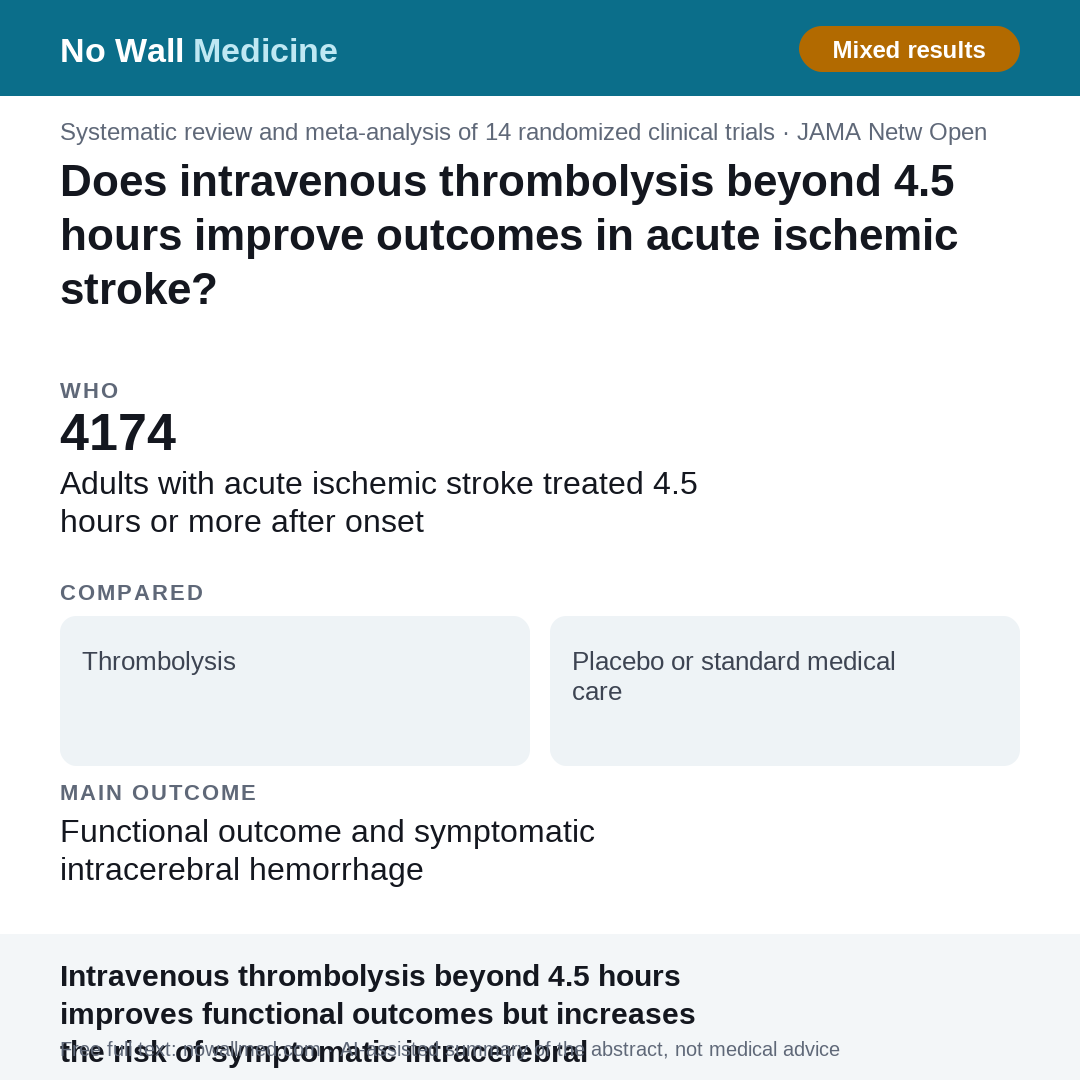
Clinical question: Does intravenous thrombolysis beyond 4.5 hours improve outcomes in acute ischemic stroke?
Why it matters: Many patients present for treatment beyond the conventional 4.5 hour window or have an unknown time of symptom onset.
Key points
- Researchers analyzed 14 randomized clinical trials involving 4174 patients to compare intravenous thrombolysis, or clot-dissolving medication, against placebo or standard care.
- Thrombolysis was associated with a higher likelihood of excellent functional outcome (RR, 1.22; 95% CI, 1.14-1.31) and good functional outcome (RR, 1.12; 95% CI, 1.06-1.18) at 90 days.
- The treatment was associated with an increased risk of symptomatic intracerebral hemorrhage (RR, 2.44; 95% CI, 1.45-4.09), though mortality did not differ between groups (RR, 1.13; 95% CI, 0.93-1.38).
Headline and key points written with AI from the paper’s abstract, with every number checked against it. Read the paper before relying on them.
Topics
Spotted a mistake? Suggest a correction
More in Cardiology
Clonal hematopoiesis mutations linked to higher atrial fibrillation risk in cancer populations
Association of Clonal Hematopoiesis Mutations With Incident Atrial Fibrillation: A Systematic Review and Meta-Analysis
Deep learning model detects aortic stenosis from finger-cuff pressure waveforms accurately
Aortic Valve Stenosis Screening Using Deep Learning on Noninvasive Arterial Pressure Waveforms
Spontaneous coronary artery dissection affects younger women more often than expected
Spontaneous coronary artery dissection: implications for women's health, clinical care, and future research
Early lipid-lowering strategies may reduce atherosclerotic cardiovascular disease risk
Lipid-Lowering Strategies in the Era of Early Atherosclerosis Detection: 2026 ACC Scientific Statement: A Report of the American College of Cardiology