Intravitreal bevacizumab increased surgical success rates 12 months after glaucoma filtration surgery
Intravitreal bevacizumab improves trabeculectomy survival at 12 months: the bevacizumab in trabeculectomy study-a randomised clinical trial
Single centre, parallel, double-blinded randomised, placebo-controlled trialBenefit found
Does intraoperative intravitreal bevacizumab improve surgical success following trabeculectomy with mitomycin-C?
Who
131
Patients requiring trabeculectomy for progressing glaucoma · Single centre
Compared
intravitreal bevacizumab: complete success: 94%
placebo: complete success: 83%
Main outcome
surgical success at 12 months
Bottom line: Intravitreal bevacizumab improves surgical success rates and reduces medication requirements after trabeculectomy at 12 months.
Br J Ophthalmol · 2024-05-21Download image
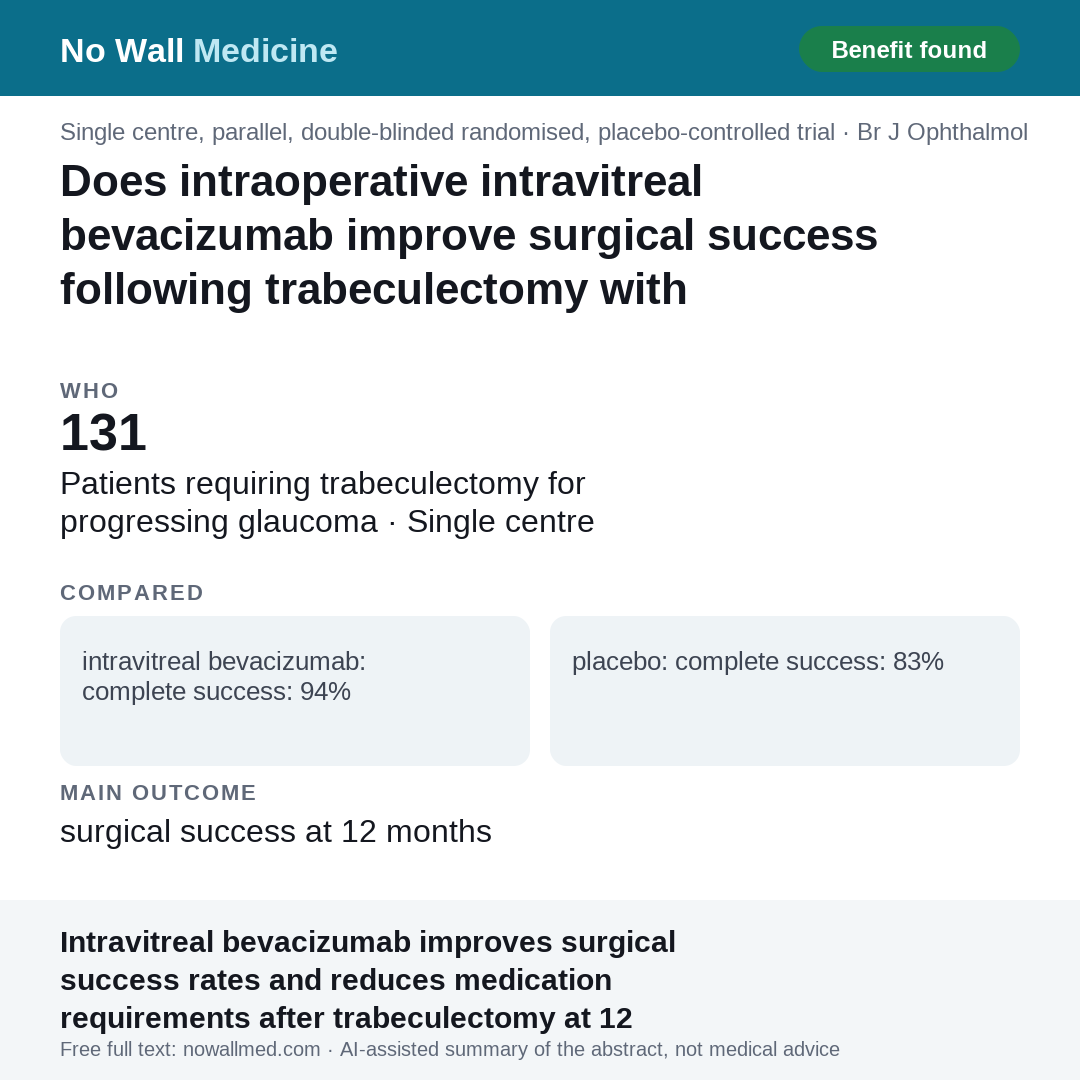
Clinical question: Does intraoperative intravitreal bevacizumab improve surgical success following trabeculectomy with mitomycin-C?
Why it matters: It was unknown if adding a single dose of bevacizumab during trabeculectomy with mitomycin-C improves surgical success or reduces the need for additional medications.
Key points
- Researchers conducted a randomized trial with 131 patients receiving either bevacizumab or a placebo during trabeculectomy, a surgery to create a drainage site for glaucoma.
- At 12 months, complete success rates were 94% for bevacizumab compared to 83% for placebo, and qualified success rates were 98% versus 90%.
- The bevacizumab group had larger drainage blebs with less vessel inflammation at 1 month compared to the placebo group.
Headline and key points written with AI from the paper’s abstract, with every number checked against it. Read the paper before relying on them.
Was this summary helpful?
Abstract
Aims
To evaluate the effect of an intraoperative dose of intravitreal bevacizumab (Avastin) on surgical success following trabeculectomy with mitomycin-C (MMC) over 12 months. Methods
A single centre, parallel, double-blinded randomised, placebo-controlled trial recruiting patients requiring trabeculectomy for progressing glaucoma. Patients were randomised to intravitreal bevacizumab or placebo. Main outcome measure
The primary outcome of treatment success was defined by 'complete success' when intraocular pressure (IOP) remained less than a predefined target IOP without the requirement of topical medication, or 'qualified success' where topical medication was required to meet the predefined target IOP threshold. Secondary outcomes included the need for subsequent IOP-lowering interventions, and structural parameters associated with bleb function. Results
From 131 patients randomised to bevacizumab (n=65) or placebo (n=66), 128 patients completed 12 months of follow-up (98%). At 12 months, success rates were higher in the bevacizumab group (complete success: 94% vs 83%; p=0.015; qualified success: 98% vs 90%; p=0.033). Within the placebo group, the requirement for topical therapy was higher at 6 months (p=0.045) and 12 months (p=0.045), and the requirement for bleb needling was higher at 1 month (p=0.035). Blebs within the bevacizumab group were larger at 1 month (p<0.001) and demonstrated less vessel inflammation (p<0.0001). Conclusion
Bevacizumab given as a single intravitreal dose during trabeculectomy with MMC resulted in improved surgical success as 12 months. Furthermore, bevacizumab was associated with a significant reduction in the need for additional medication or further surgery to achieve target IOP. Bevacizumab was also associated with larger blebs that were less inflamed and required fewer subsequent interventions. Trial registration number
ACTRN12614000375651.
Abstract reproduced under the article’s CC BY licence.
Subject terms
Cite this article
Landers JA, Mullany S, Craig JE. Intravitreal bevacizumab improves trabeculectomy survival at 12 months: the bevacizumab in trabeculectomy study-a randomised clinical trial. Br J Ophthalmol. 2024. doi:10.1136/bjo-2023-323526
Spotted a mistake? Suggest a correction
Top studies every Monday
The week’s key trials and guidelines in your specialties, plus any topics you follow. By email, free.
Get the weekly digest