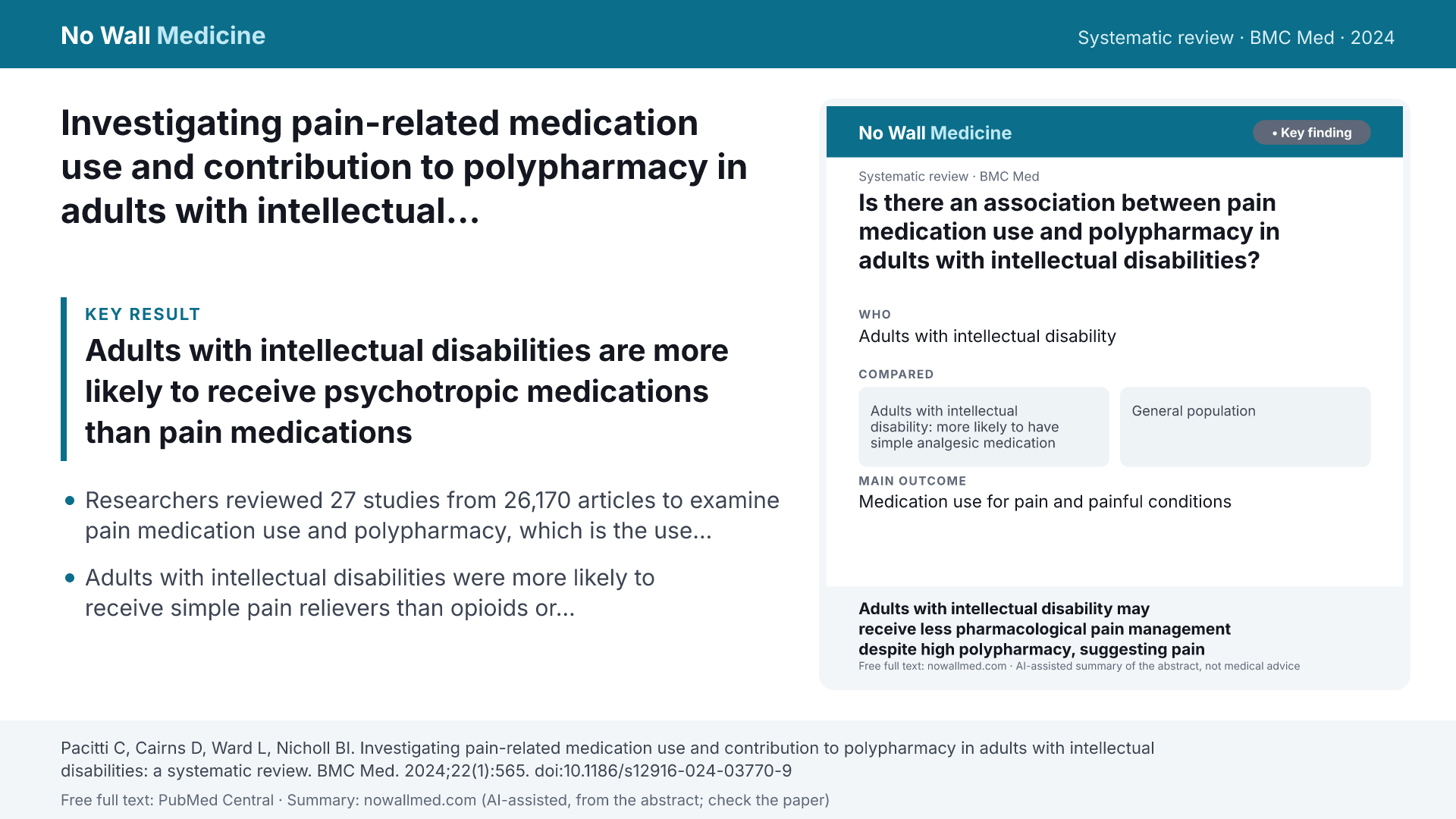
Investigating pain-related medication use and contribution to polypharmacy in adults with intellectual disabilities: a systematic review
Key result: Adults with intellectual disabilities are more likely to receive psychotropic medications than pain medications
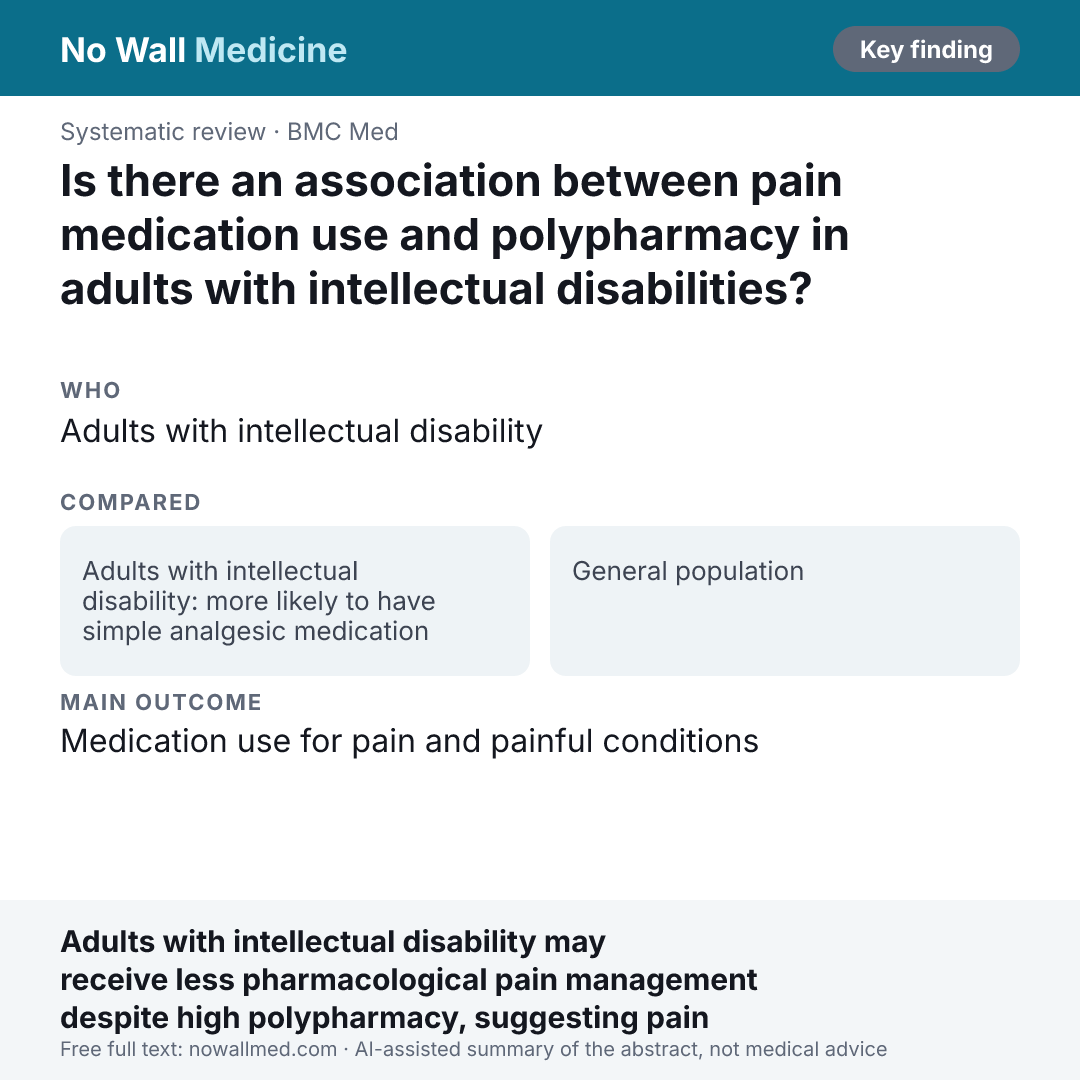
Systematic reviewKey finding
Is there an association between pain medication use and polypharmacy in adults with intellectual disabilities?
Who
Adults with intellectual disability
Compared
Adults with intellectual disability: more likely to have simple analgesic medication
General population
Main outcome
Medication use for pain and painful conditions
Bottom line: Adults with intellectual disability may receive less pharmacological pain management despite high polypharmacy, suggesting pain is under-treated.
BMC Med · 2024-12-02 · Save PNG
Key points
- Researchers reviewed 27 studies from 26,170 articles to examine pain medication use and polypharmacy, which is the use of multiple medications, in adults with intellectual disabilities.
- Adults with intellectual disabilities were more likely to receive simple pain relievers than opioids or non-steroidal anti-inflammatory drugs, and psychotropic medications were more common than pain medications.
- Both adults with intellectual disabilities and their caregivers reported that pain is often under-recognized and most likely under-treated.
Discussion prompts
- Would these patients look like yours? Who was left out?
- Is the main outcome one that matters to patients?
- Is the difference large enough to change what you do?
Cite: Pacitti C, Cairns D, Ward L, Nicholl BI. Investigating pain-related medication use and contribution to polypharmacy in adults with intellectual disabilities: a systematic review. BMC Med. 2024;22(1):565. doi:10.1186/s12916-024-03770-9
Free full text: PubMed Central · Summary and visual abstract: nowallmed.com/a/investigating-pain-related-medication-use-and-contribution-to-q4uvs/ (AI-assisted from the abstract; check the paper before relying on it).