Trial to test if machine learning software improves outcomes after high-risk abdominal surgery
Investigating the effectiveness of an intraoperative decision support guided fluid therapy intervention on postoperative outcome of high-risk patients undergoing high-risk abdominal surgery: protocol for an international multicentre stepped-wedge cluster-randomised implementation trial
Stepped-wedge cluster-randomised implementation trialUnclear result
Does implementing Acumen Assisted Fluid Management improve postoperative outcomes in high-risk abdominal surgery?
Who
2000
High-risk patients undergoing high-risk abdominal surgery · 16 academic hospitals in France, Belgium, Canada, and the USA
Compared
Routine care
Acumen Assisted Fluid Management
Main outcome
Composite of major complications and death 30 days after surgery
Bottom line: This ongoing trial aims to test if machine learning decision support improves postoperative outcomes in high-risk abdominal surgery.
BJA Open · 2025-06-05Download image
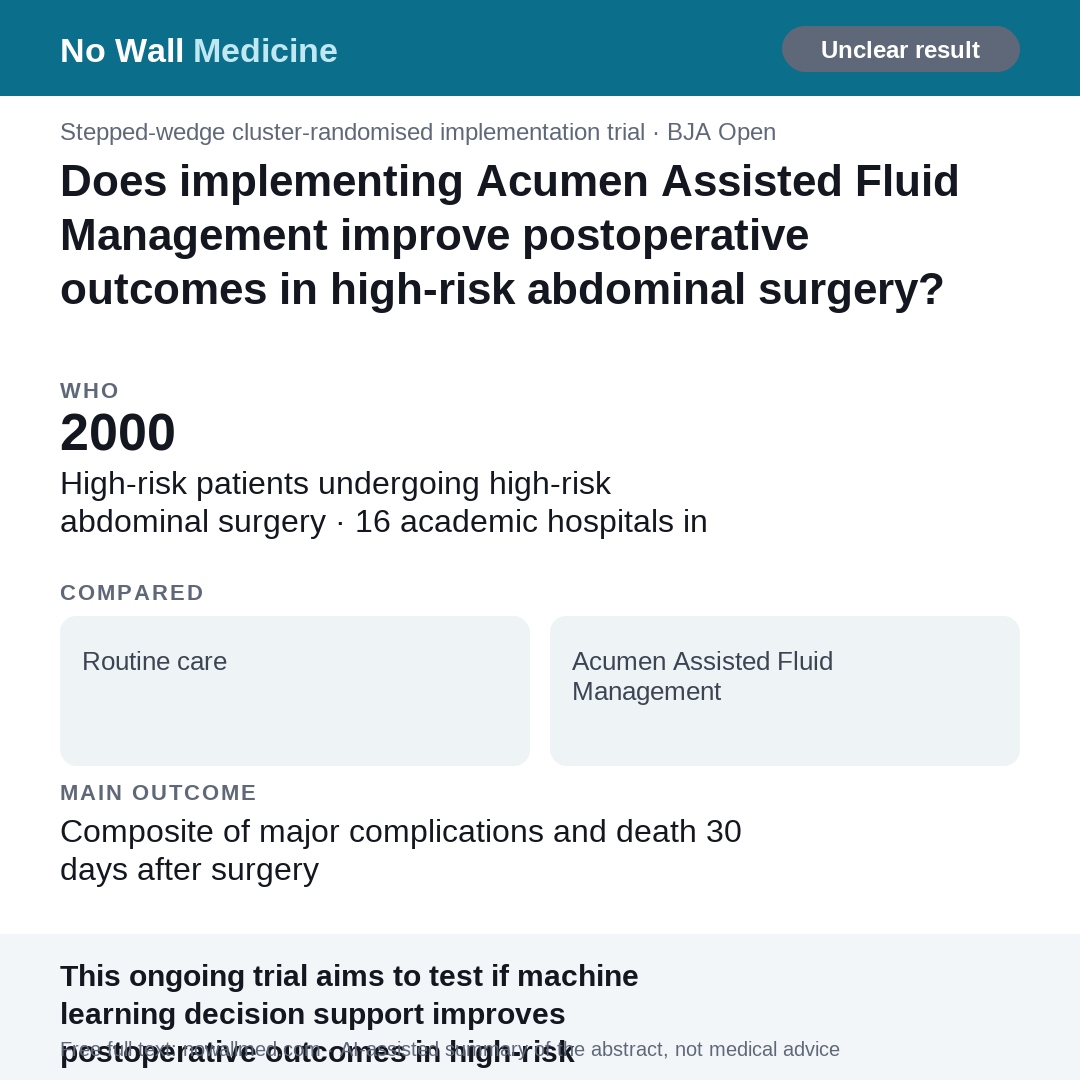
Clinical question: Does implementing Acumen Assisted Fluid Management improve postoperative outcomes in high-risk abdominal surgery?
Why it matters: Current fluid management protocols are complex and compliance is often poor despite recommendations from anesthesia societies.
Key points
- Researchers are conducting an international multicentre trial across 16 academic hospitals in France, Belgium, Canada, and the USA.
- The study compares routine care to fluid therapy guided by Acumen Assisted Fluid Management software in 2000 patients.
- The primary outcome is a composite measure of death and major complications occurring 30 days after surgery.
Headline and key points written with AI from the paper’s abstract, with every number checked against it. Read the paper before relying on them.
Was this summary helpful?

Abstract
Background
Inappropriate fluid administration can impact patient outcome. Intraoperative advanced haemodynamic monitoring coupled with a treatment protocol based on stroke volume optimisation can help determine the appropriate timing for fluid boluses. Although recommended by several anaesthesia societies, this strategy is rarely implemented because protocols are complex and compliance is often poor. The Acumen Assisted Fluid Management (AFM) software is a decision support system that uses machine learning to predict fluid responsiveness and individualise fluid therapy. AFM reportedly predicts fluid responsiveness better than clinicians, decreases preload-dependent states, and improves both macro- and microcirculatory variables. The goal of this international multicentre stepped-wedge cluster randomised trial is to test whether implementing AFM during high-risk surgery improves patient outcome.Methods
The trial is ongoing in 16 academic hospitals in France, Belgium, Canada, and the USA. All centres (clusters) deliver routine care (control arm) at the start of the study and crossed over (one way) to AFM-guided fluid therapy (intervention arm). The time when different centres switch to AFM is randomised by an independent statistician. At the end of the trial, all centres will cross over to the intervention group. The primary outcome is a composite of major complications and death 30 days after surgery that will be analysed as intention-to-treat. A total of 2000 patients are required to detect a relative 20% differences in the primary outcome between groups.Conclusions
This trial is powered to provide evidence on whether implementing AFM is effective in reducing postoperative complications in high-risk patients after high-risk abdominal surgery.Clinical trial registration
NCT06011187.
Abstract reproduced under the article’s CC BY licence.
Cite this article
Coeckelenbergh S, Delaporte A, Rousseleau D, De Montblanc J, Roullet S, Ramadan J. Investigating the effectiveness of an intraoperative decision support guided fluid therapy intervention on postoperative outcome of high-risk patients undergoing high-risk abdominal surgery: protocol for an international multicentre stepped-wedge cluster-randomised implementation trial. BJA Open. 2025. doi:10.1016/j.bjao.2025.100421
Spotted a mistake? Suggest a correction
Top studies every Monday
The week’s key trials and guidelines in your specialties, plus any topics you follow. By email, free.
Get the weekly digest