Autistic individuals show a reduced difference in face recognition between upright and inverted faces
Investigating the Face Inversion Effect in Autism Across Behavioral and Neural Measures of Face Processing: A Systematic Review and Bayesian Meta-Analysis
Systematic review and Bayesian meta-analysisBenefit found
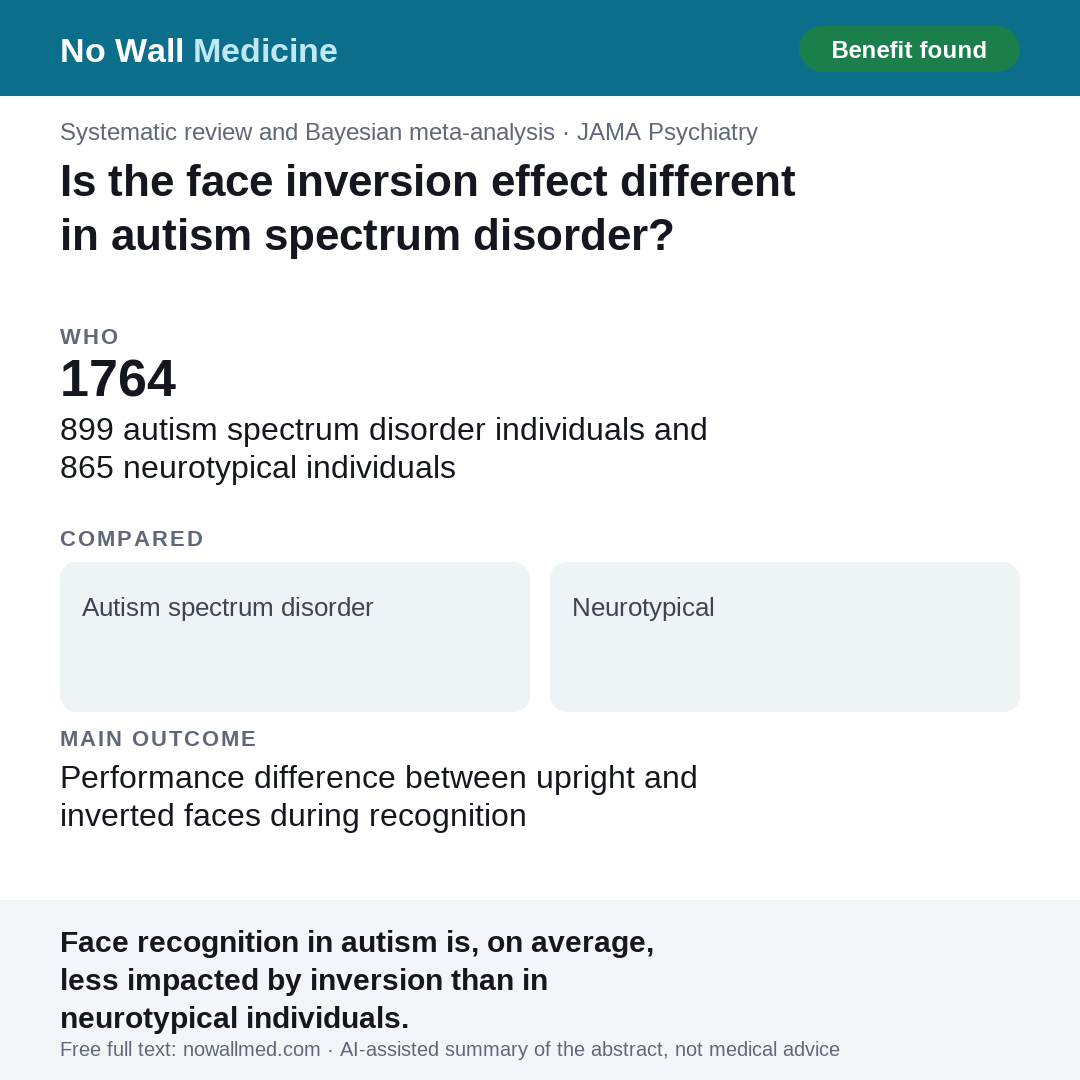
Is the face inversion effect different in autism spectrum disorder?
Who
1764
899 autism spectrum disorder individuals and 865 neurotypical individuals
Compared
Autism spectrum disorder
Neurotypical
Main outcome
Performance difference between upright and inverted faces during recognition
Result: g = -0.41 (95% credible interval -0.63 to -0.18)
Bottom line: Face recognition in autism is, on average, less impacted by inversion than in neurotypical individuals.
Limitation: There was considerable heterogeneity among effect sizes.
JAMA Psychiatry · 2023-07-05Download image
Clinical question: Is the face inversion effect different in autism spectrum disorder?
Why it matters: It is unknown at which mechanistic level the face processing system in autism differs from neurotypical systems regarding the face inversion effect.
Key points
- Researchers analyzed 122 effect sizes from 38 studies involving 899 autistic individuals and 865 neurotypical individuals.
- The face inversion effect, or the drop in recognition accuracy when faces are upside down, was reduced in autistic individuals (g = -0.41; 95% CrI, -0.63 to -0.18).
- This reduced effect was more prominent in emotion recognition compared to identity recognition (b = 0.46; 95% CrI, -0.08 to 0.95).
Headline and key points written with AI from the paper’s abstract, with every number checked against it. Read the paper before relying on them.
Was this summary helpful?
Subject terms
Cite this article
Griffin JW, Azu MA, Cramer-Benjamin S, Franke CJ, Herman N, Iqbal R. Investigating the Face Inversion Effect in Autism Across Behavioral and Neural Measures of Face Processing: A Systematic Review and Bayesian Meta-Analysis. JAMA Psychiatry. 2023. doi:10.1001/jamapsychiatry.2023.2105
Spotted a mistake? Suggest a correction
Top studies every Monday
The week’s key trials and guidelines in your specialties, plus any topics you follow. By email, free.
Get the weekly digest