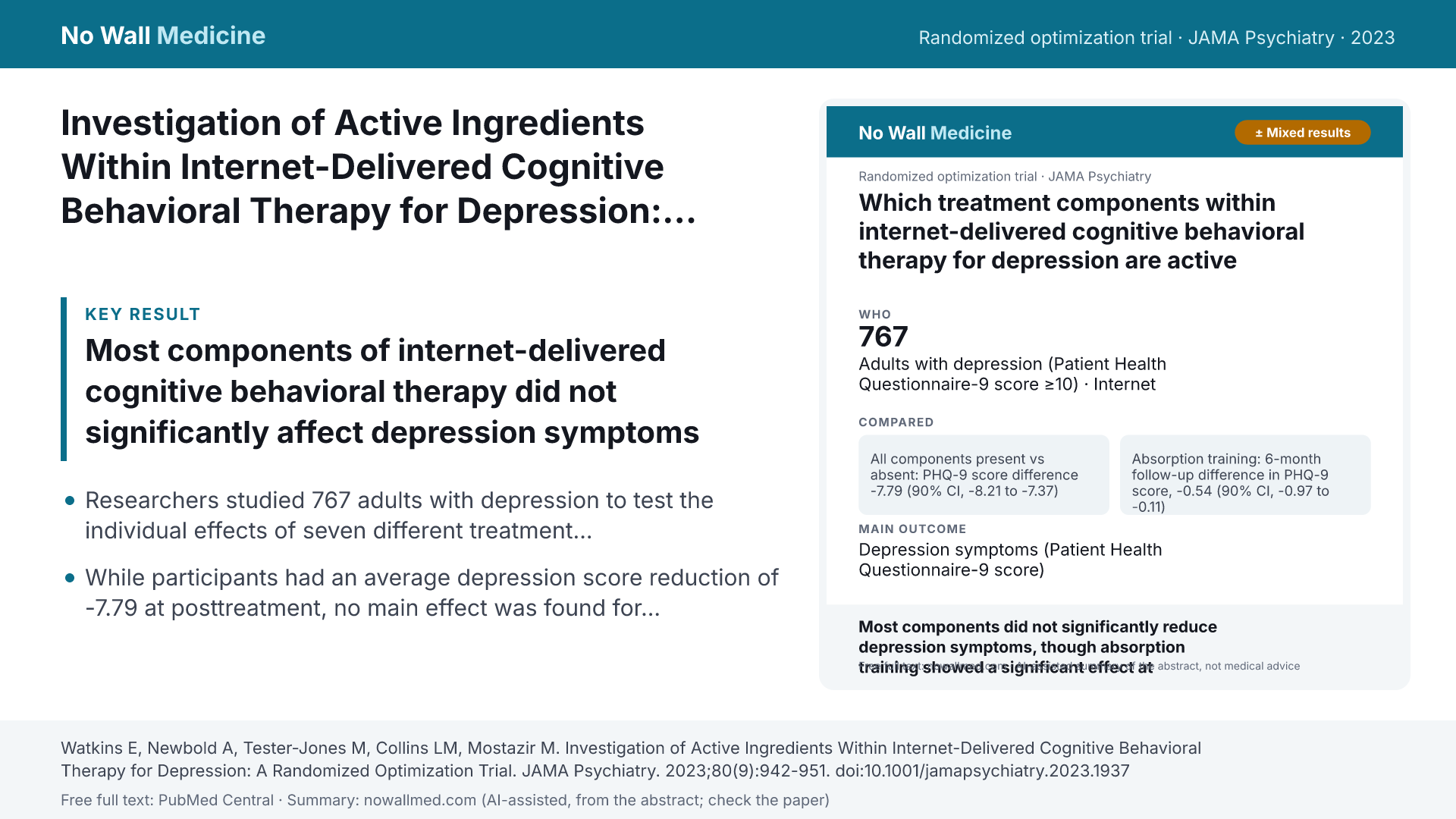
Most components of internet-delivered cognitive behavioral therapy did not significantly affect depression symptoms
Investigation of Active Ingredients Within Internet-Delivered Cognitive Behavioral Therapy for Depression: A Randomized Optimization Trial
Psychiatry & Mental HealthAdult and pediatric
Randomized optimization trialMixed results
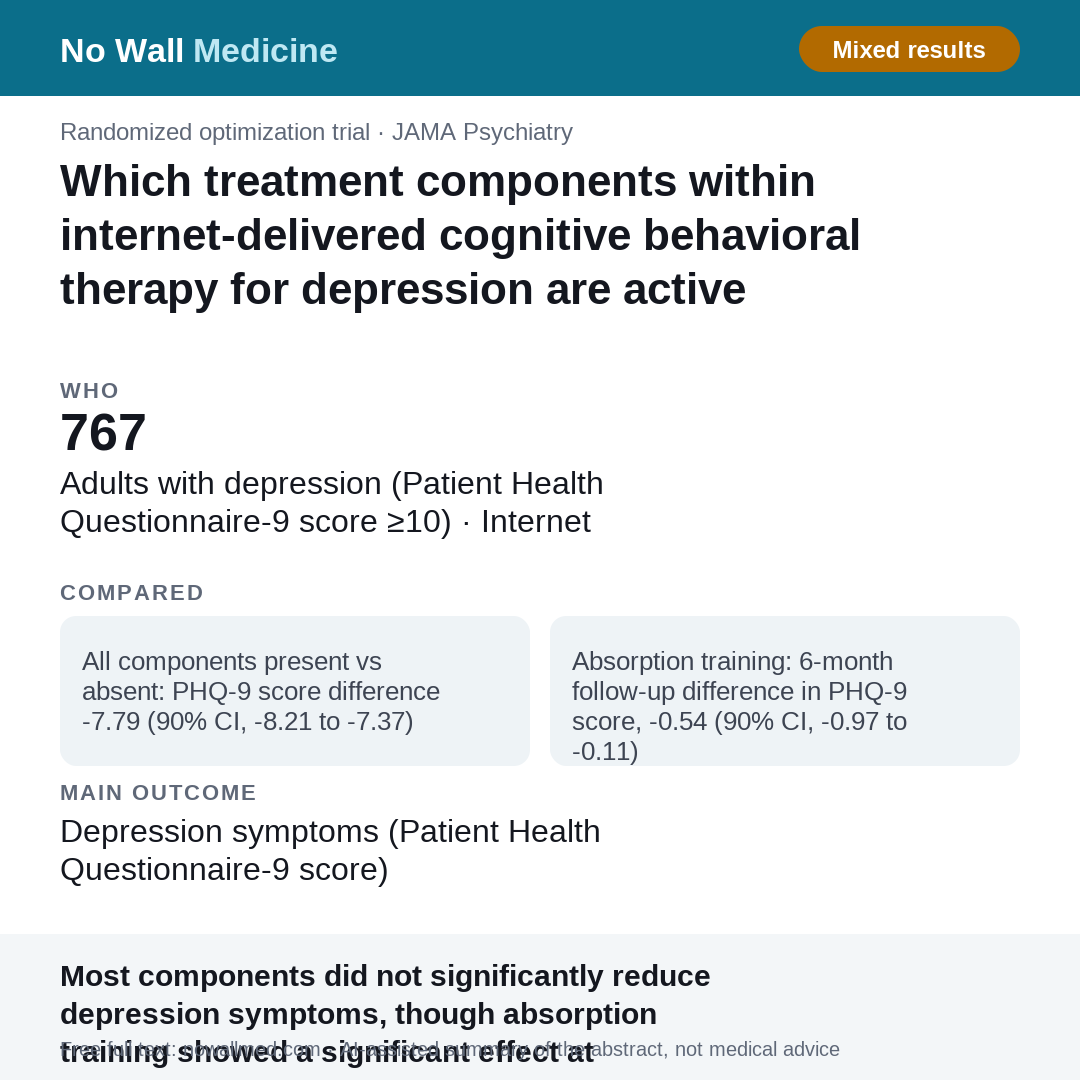
Which treatment components within internet-delivered cognitive behavioral therapy for depression are active ingredients?
Who
767
Adults with depression (Patient Health Questionnaire-9 score ≥10) · Internet advertising and UK National Health Service
Compared
All components present vs absent: PHQ-9 score difference -7.79 (90% CI, -8.21 to -7.37)
Absorption training: 6-month follow-up difference in PHQ-9 score, -0.54 (90% CI, -0.97 to -0.11)
Main outcome
Depression symptoms (Patient Health Questionnaire-9 score)
Result: 6-month follow-up difference in PHQ-9 score, -0.54 (90% CI, -0.97 to -0.11)
Bottom line: Most components did not significantly reduce depression symptoms, though absorption training showed a significant effect at 6-month follow-up.
JAMA Psychiatry · 2023-06-28Download image
Clinical question: Which treatment components within internet-delivered cognitive behavioral therapy for depression are active ingredients?
Key points
- Researchers studied 767 adults with depression to test the individual effects of seven different treatment components within an internet-based cognitive behavioral therapy platform.
- While participants had an average depression score reduction of -7.79 at posttreatment, no main effect was found for activity scheduling, functional analysis, thought challenging, relaxation, concreteness training, or self-compassion training.
- Only absorption training, which focuses on direct contact with positive reinforcers, showed a significant main effect on depression symptoms at the 6-month follow-up with a difference of -0.54.
Headline and key points written with AI from the paper’s abstract, with every number checked against it. Read the paper before relying on them.
Was this summary helpful?
Subject terms
Headline, design, result, key points, caveat and citation as plain text.
Cite this article
Watkins E, Newbold A, Tester-Jones M, Collins LM, Mostazir M. Investigation of Active Ingredients Within Internet-Delivered Cognitive Behavioral Therapy for Depression: A Randomized Optimization Trial. JAMA Psychiatry. 2023;80(9):942-951. doi:10.1001/jamapsychiatry.2023.1937
Spotted a mistake? Suggest a correction