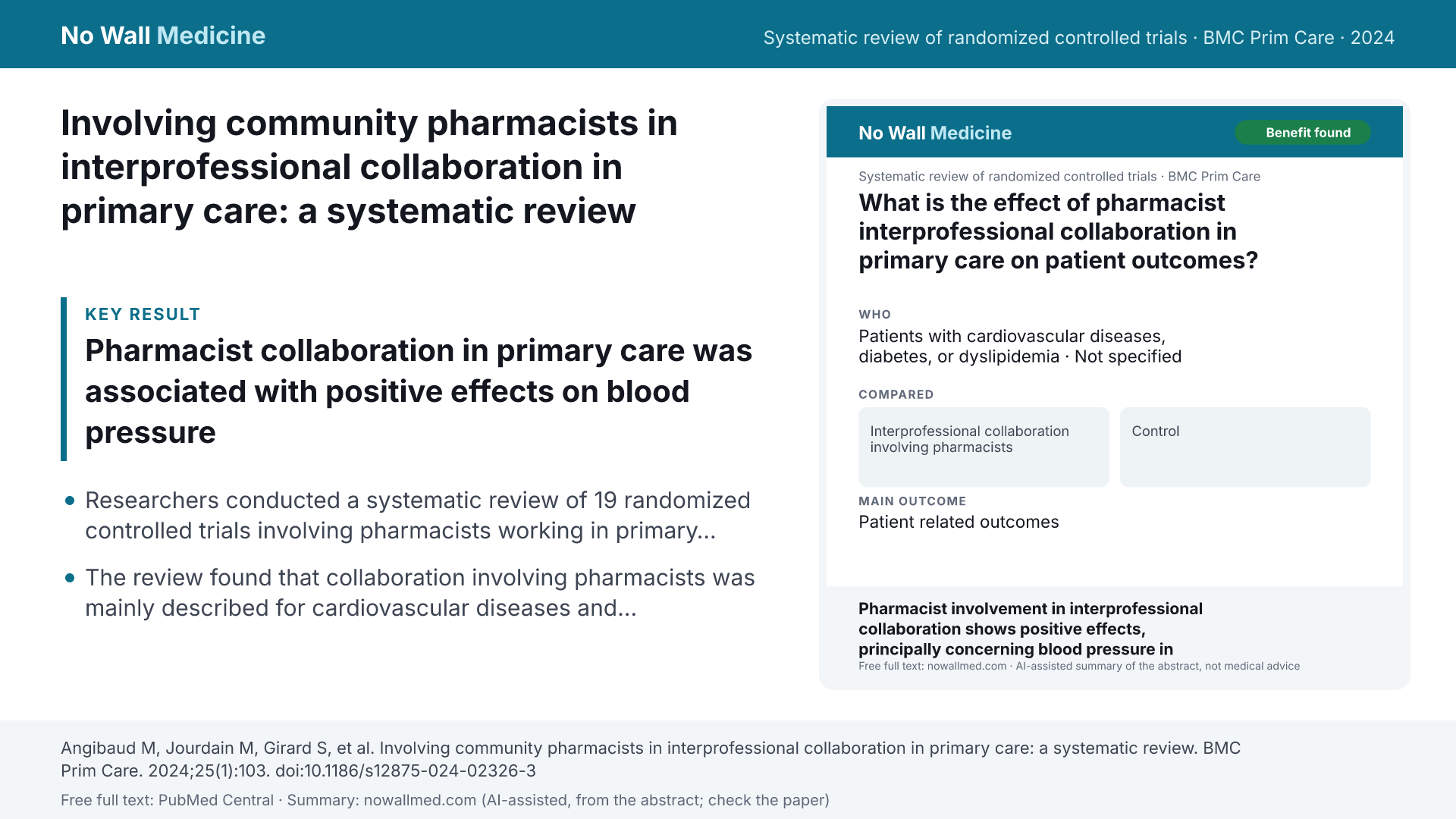
Involving community pharmacists in interprofessional collaboration in primary care: a systematic review
Key result: Pharmacist collaboration in primary care was associated with positive effects on blood pressure
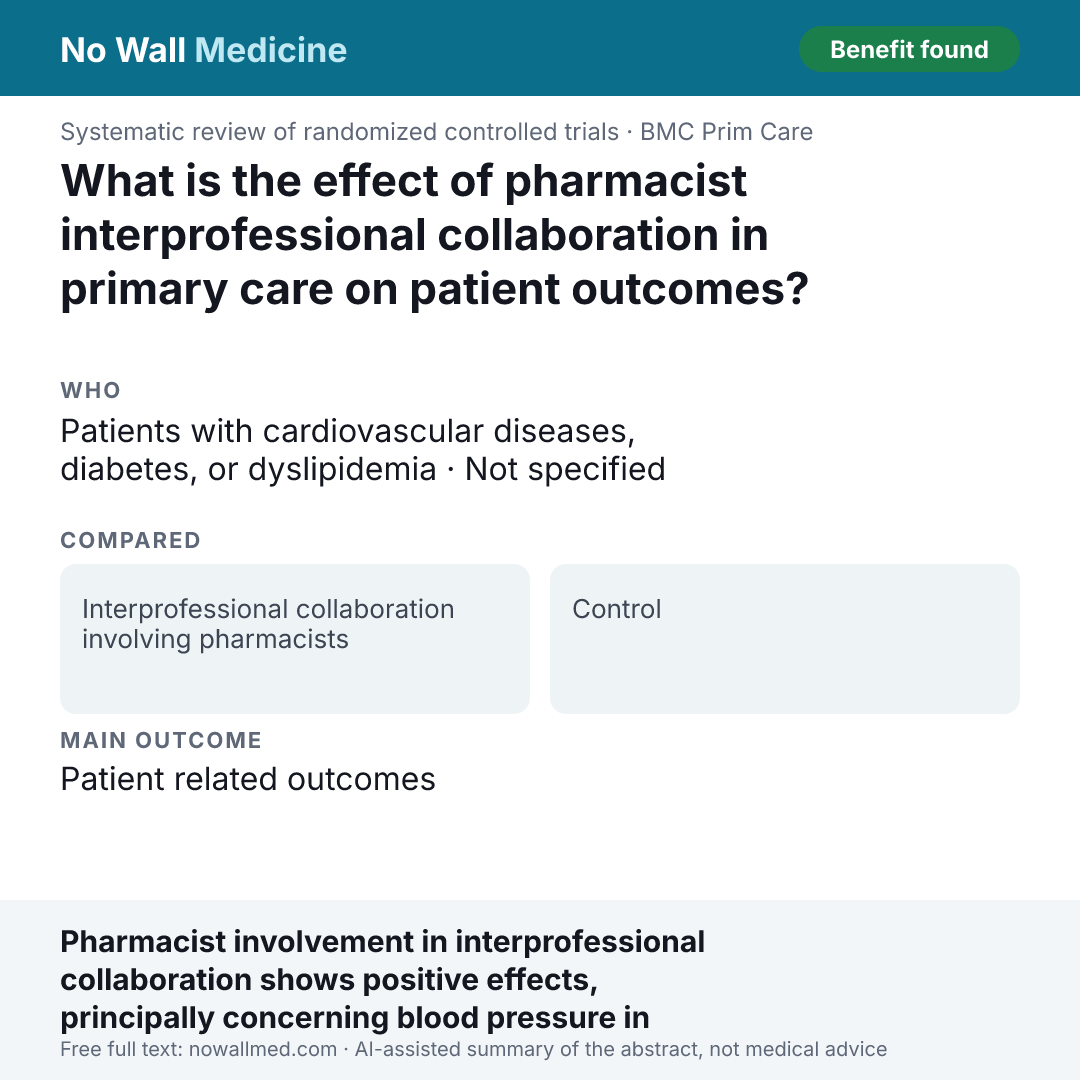
Systematic review of randomized controlled trialsBenefit found
What is the effect of pharmacist interprofessional collaboration in primary care on patient outcomes?
Who
Patients with cardiovascular diseases, diabetes, or dyslipidemia · Not specified
Compared
Interprofessional collaboration involving pharmacists
Control
Main outcome
Patient related outcomes
Bottom line: Pharmacist involvement in interprofessional collaboration shows positive effects, principally concerning blood pressure in cardiovascular diseases.
BMC Prim Care · 2024-04-01 · Save PNG
Key points
- Researchers conducted a systematic review of 19 randomized controlled trials involving pharmacists working in primary care settings.
- The review found that collaboration involving pharmacists was mainly described for cardiovascular diseases and showed positive effects principally for blood pressure.
- In 14 studies, pharmacists followed a three-step model consisting of a medication review, a patient interview, and recommendations to a physician.
Discussion prompts
- Would these patients look like yours? Who was left out?
- Is the main outcome one that matters to patients?
- Is the difference large enough to change what you do?
Cite: Angibaud M, Jourdain M, Girard S, et al. Involving community pharmacists in interprofessional collaboration in primary care: a systematic review. BMC Prim Care. 2024;25(1):103. doi:10.1186/s12875-024-02326-3
Free full text: PubMed Central · Summary and visual abstract: nowallmed.com/a/involving-community-pharmacists-in-interprofessional-collaboration-in-uycrv0/ (AI-assisted from the abstract; check the paper before relying on it).