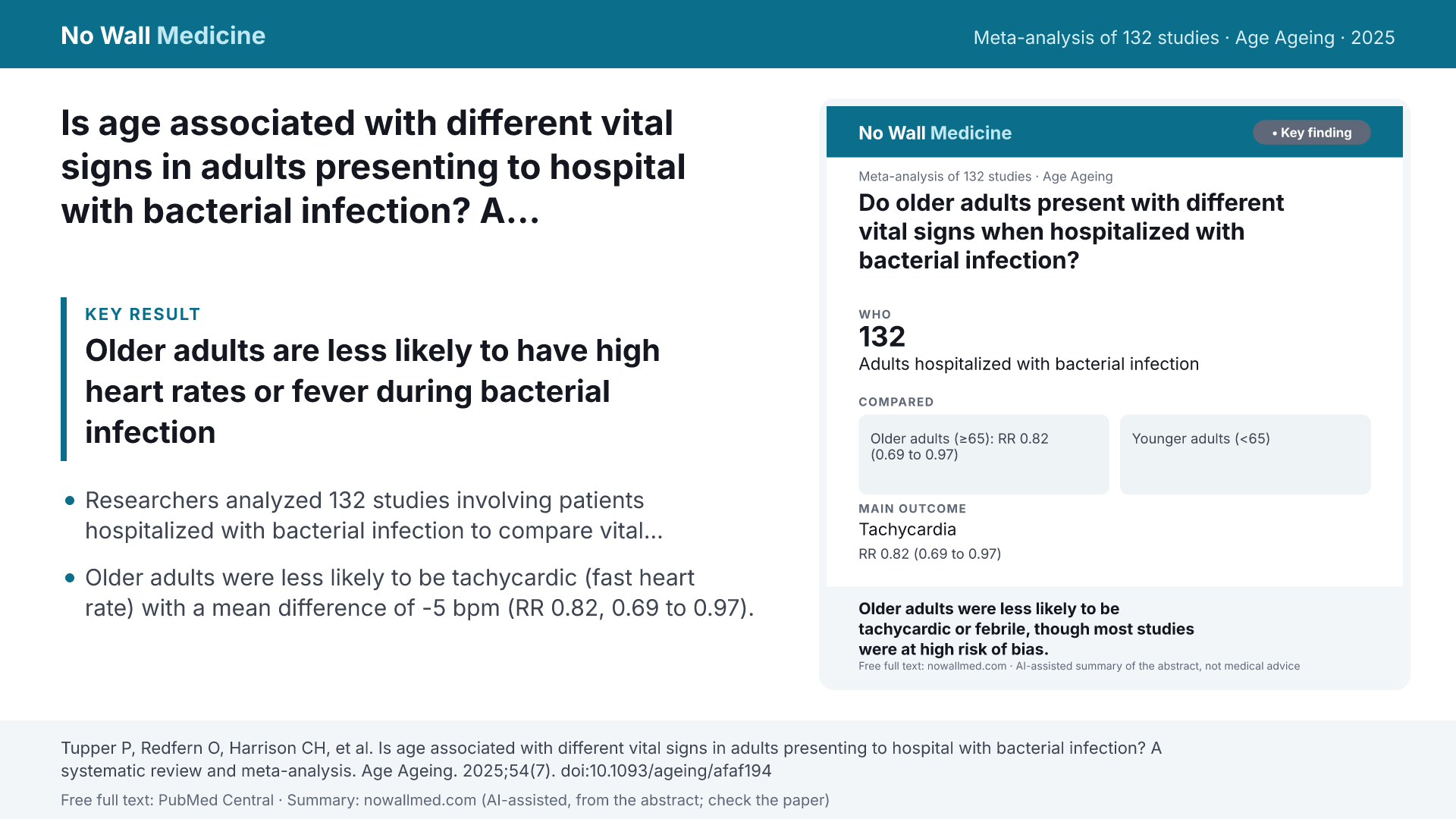
Older adults are less likely to have high heart rates or fever during bacterial infection
Is age associated with different vital signs in adults presenting to hospital with bacterial infection? A systematic review and meta-analysis
Why it matters: It is suspected that the vital sign abnormalities accompanying bacterial infection may be subtle or absent in older adults.
Key points
- Researchers analyzed 132 studies involving patients hospitalized with bacterial infection to compare vital signs between younger and older adults.
- Older adults were less likely to be tachycardic (fast heart rate) with a mean difference of -5 bpm (RR 0.82, 0.69 to 0.97).
- Older adults were also less likely to be febrile (fever) with a mean temperature difference of 0.14°C (RR 0.89, 0.83 to 0.95).
Limitation the authors note: Most of the included studies (129/132) were at high risk of bias.
Headline and key points written with AI from the paper’s abstract, with every number checked against it. Read the paper before relying on them.
Was this summary helpful?
Subject terms
Headline, design, result, key points, caveat and citation as plain text.
Cite this article
Tupper P, Redfern O, Harrison CH, et al. Is age associated with different vital signs in adults presenting to hospital with bacterial infection? A systematic review and meta-analysis. Age Ageing. 2025;54(7). doi:10.1093/ageing/afaf194
Spotted a mistake? Suggest a correction