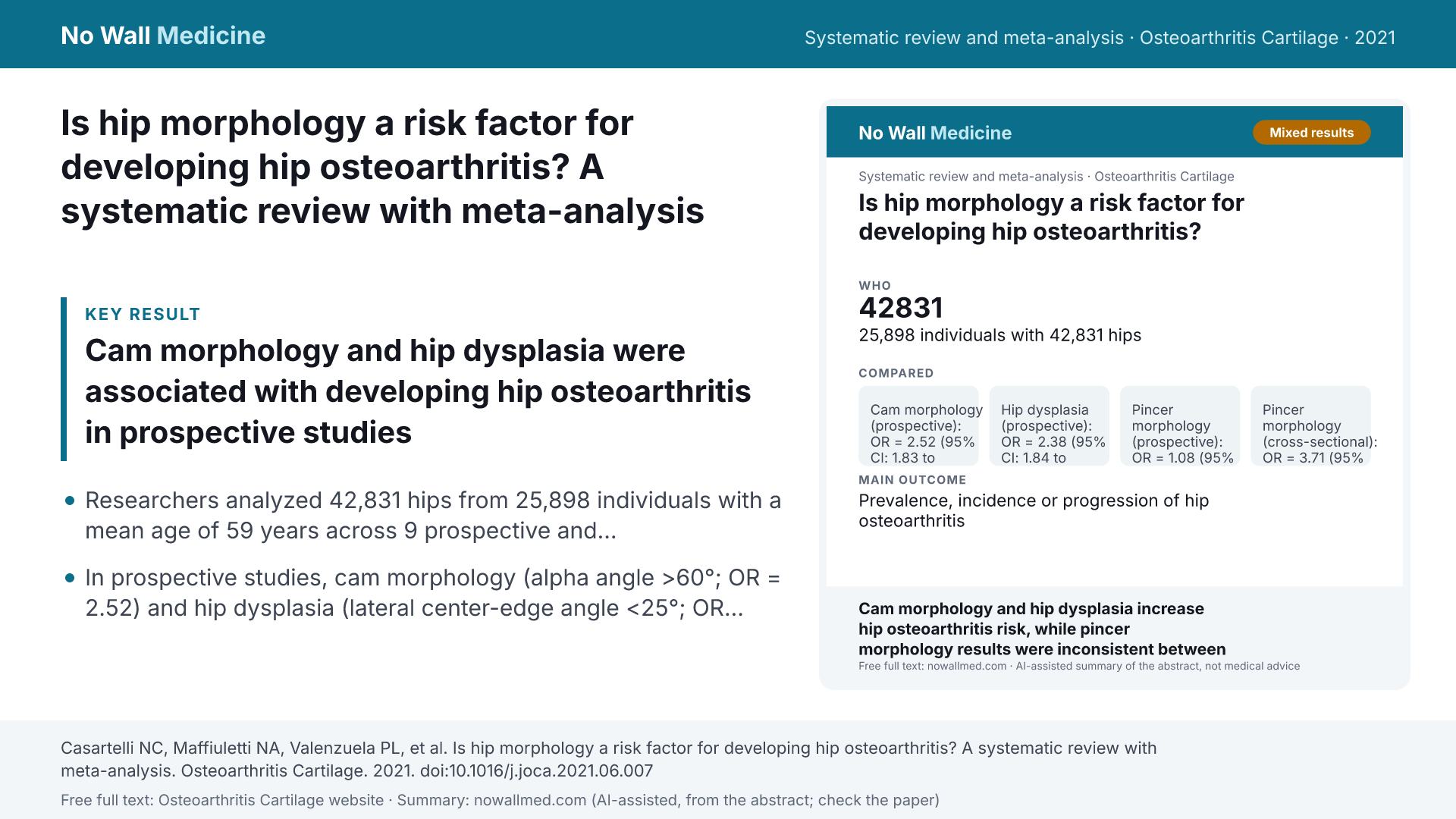
Cam morphology and hip dysplasia were associated with developing hip osteoarthritis in prospective studies
Is hip morphology a risk factor for developing hip osteoarthritis? A systematic review with meta-analysis
Systematic review and meta-analysisMixed results
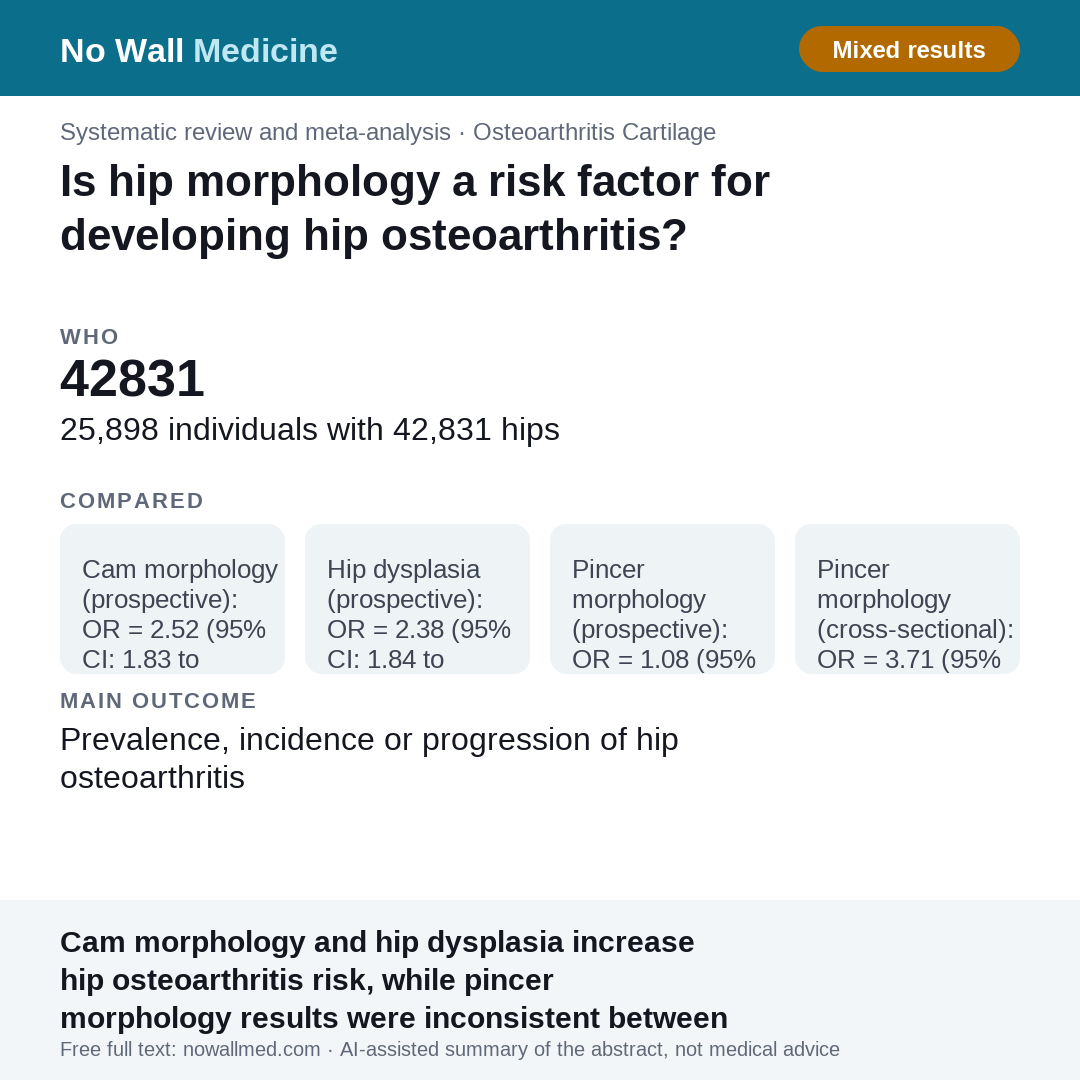
Is hip morphology a risk factor for developing hip osteoarthritis?
Who
42831
25,898 individuals with 42,831 hips
Compared
Cam morphology (prospective): OR = 2.52 (95% CI: 1.83 to 3.46)
Hip dysplasia (prospective): OR = 2.38 (95% CI: 1.84 to 3.07)
Pincer morphology (prospective): OR = 1.08 (95% CI: 0.57 to 2.07)
Pincer morphology (cross-sectional): OR = 3.71 (95% CI: 2.98 to 4.61)
Main outcome
Prevalence, incidence or progression of hip osteoarthritis
Bottom line: Cam morphology and hip dysplasia increase hip osteoarthritis risk, while pincer morphology results were inconsistent between study types.
Osteoarthritis Cartilage · 2021-06-23Download image
Clinical question: Is hip morphology a risk factor for developing hip osteoarthritis?
Why it matters: It was unknown how different radiological shapes of the hip joint relate to the development or presence of hip osteoarthritis.
Key points
- Researchers analyzed 42,831 hips from 25,898 individuals with a mean age of 59 years across 9 prospective and 21 cross-sectional studies.
- In prospective studies, cam morphology (alpha angle >60°; OR = 2.52) and hip dysplasia (lateral center-edge angle <25°; OR = 2.38) were associated with developing hip osteoarthritis.
- Cross-sectional studies showed pincer morphology (lateral center-edge angle >39°; OR = 3.71) and acetabular retroversion (crossover sign; OR = 2.65) were associated with a higher prevalence of hip osteoarthritis.
Headline and key points written with AI from the paper’s abstract, with every number checked against it. Read the paper before relying on them.
Was this summary helpful?
Subject terms
Cite this article
Casartelli NC, Maffiuletti NA, Valenzuela PL, et al. Is hip morphology a risk factor for developing hip osteoarthritis? A systematic review with meta-analysis. Osteoarthritis Cartilage. 2021. doi:10.1016/j.joca.2021.06.007
Spotted a mistake? Suggest a correction