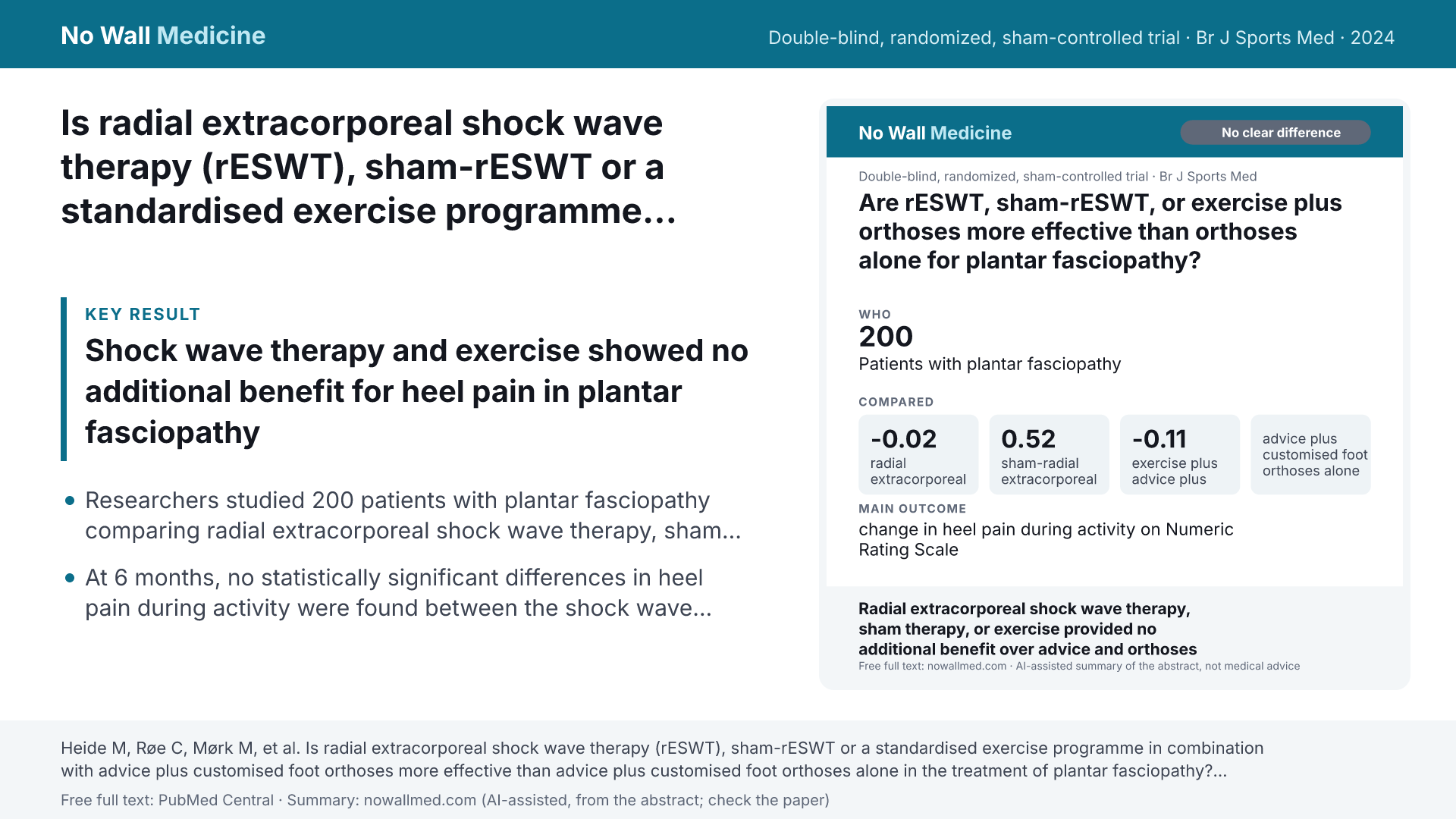
Shock wave therapy and exercise showed no additional benefit for heel pain in plantar fasciopathy
Is radial extracorporeal shock wave therapy (rESWT), sham-rESWT or a standardised exercise programme in combination with advice plus customised foot orthoses more effective than advice plus customised foot orthoses alone in the treatment of plantar fasciopathy? A double-blind, randomised, sham-controlled trial
Double-blind, randomized, sham-controlled trialNo clear difference
Are rESWT, sham-rESWT, or exercise plus orthoses more effective than orthoses alone for plantar fasciopathy?
Who
200
Patients with plantar fasciopathy
Compared
-0.02radial extracorporeal shock wave therapy (95% CI -1.01 to 0.96)
0.52sham-radial extracorporeal shock wave therapy (95% CI -0.49 to 1.53)
-0.11exercise plus advice plus customised foot orthoses (95% CI -1.11 to 0.89)
advice plus customised foot orthoses alone
Main outcome
change in heel pain during activity on Numeric Rating Scale
Bottom line: Radial extracorporeal shock wave therapy, sham therapy, or exercise provided no additional benefit over advice and orthoses alone.
Br J Sports Med · 2024-07-31Download image
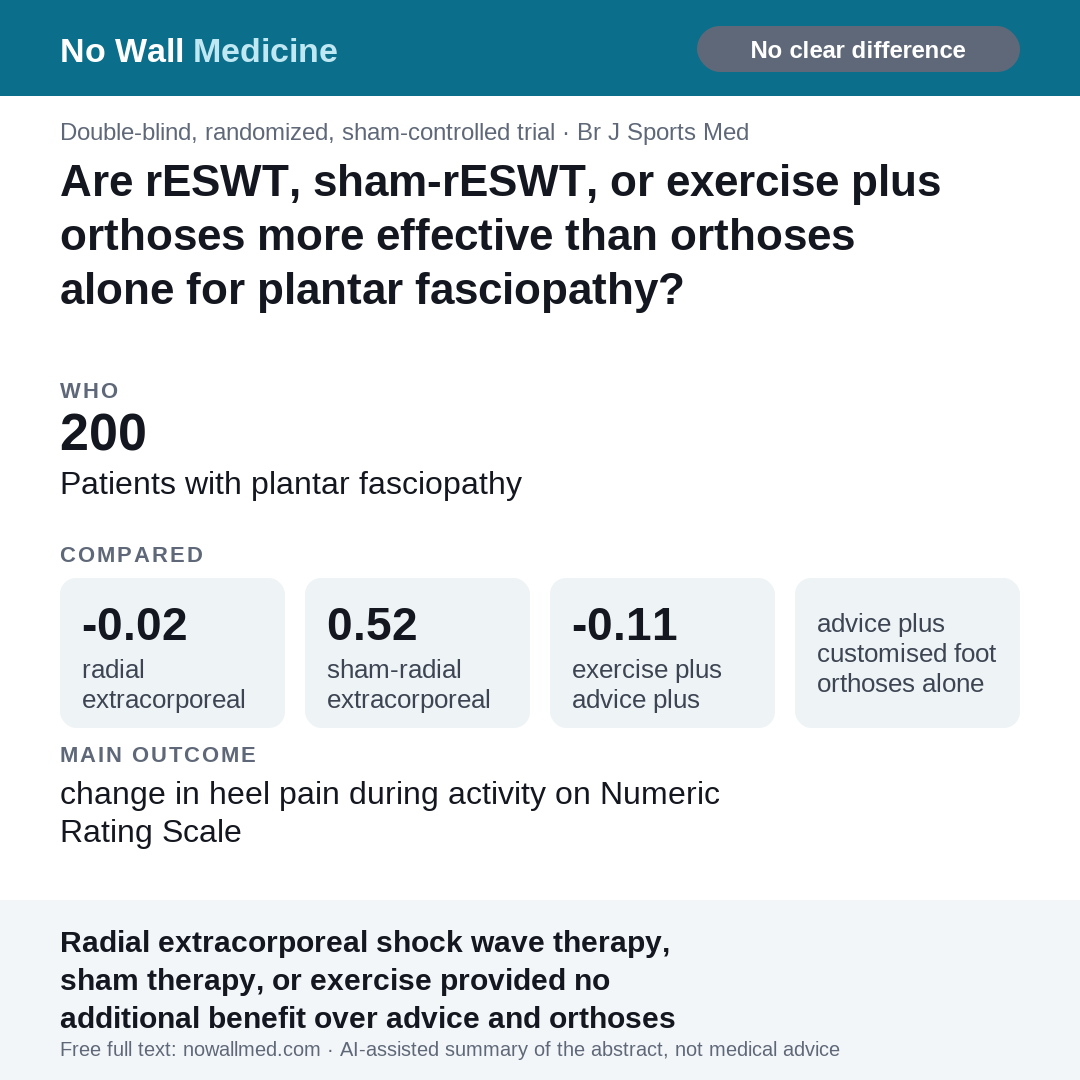
Clinical question: Are rESWT, sham-rESWT, or exercise plus orthoses more effective than orthoses alone for plantar fasciopathy?
Why it matters: It was unknown if adding radial extracorporeal shock wave therapy or a standardized exercise program to advice and foot orthoses provides more relief for plantar fasciopathy heel pain.
Key points
- Researchers studied 200 patients with plantar fasciopathy comparing radial extracorporeal shock wave therapy, sham shock wave therapy, or exercise plus orthoses against orthoses and advice alone.
- At 6 months, no statistically significant differences in heel pain during activity were found between the shock wave therapy, sham therapy, or exercise groups and the advice plus orthoses group.
- The primary outcome measured the change in heel pain using a 0-10 Numeric Rating Scale from baseline to a 6-month follow-up.
Headline and key points written with AI from the paper’s abstract, with every number checked against it. Read the paper before relying on them.
Was this summary helpful?
Abstract
Objectives
To assess whether radial extracorporeal shock wave therapy (rESWT), sham-rESWT or a standardised exercise programme in combination with advice plus customised foot orthoses is more effective than advice plus customised foot orthoses alone in alleviating heel pain in patients with plantar fasciopathy. Methods
200 patients with plantar fasciopathy were included in a four-arm, parallel-group, sham-controlled, observer-blinded, partly patient-blinded trial. At baseline, before randomisation, all patients received advice plus customised foot orthoses. Patients were randomised to rESWT (n=50), sham-rESWT (n=50), exercise (n=50) or advice plus customised foot orthoses alone (n=50). Patients in the rESWT and sham-rESWT groups received three treatments. The exercise programme comprised two exercises performed three times a week for 12 weeks, including eight supervised sessions with a physiotherapist. Patients allocated to advice plus customised foot orthoses did not receive additional treatment. The primary outcome was change in heel pain during activity in the previous week per Numeric Rating Scale (0-10) from baseline to 6-month follow-up. The outcome was collected at baseline, and 3, 6 and 12 months. Results
The primary analysis showed no statistically significant between-group differences in mean change in heel pain during activity for rESWT versus advice plus customised foot orthoses (-0.02, 95% CI -1.01 to 0.96), sham-rESWT versus advice plus customised foot orthoses (0.52, 95% CI -0.49 to 1.53) and exercise versus advice plus customised foot orthoses (-0.11, 95% CI -1.11 to 0.89) at 6 months. Conclusion
In patients with plantar fasciopathy, there was no additional benefit of rESWT, sham-rESWT or a standardised exercise programme over advice plus customised foot orthoses in alleviating heel pain. Trial registration number
NCT03472989.
Abstract reproduced under the article’s CC BY NC licence.
Subject terms
Cite this article
Heide M, Røe C, Mørk M, et al. Is radial extracorporeal shock wave therapy (rESWT), sham-rESWT or a standardised exercise programme in combination with advice plus customised foot orthoses more effective than advice plus customised foot orthoses alone in the treatment of plantar fasciopathy? A double-blind, randomised, sham-controlled trial. Br J Sports Med. 2024. doi:10.1136/bjsports-2024-108139
Spotted a mistake? Suggest a correction