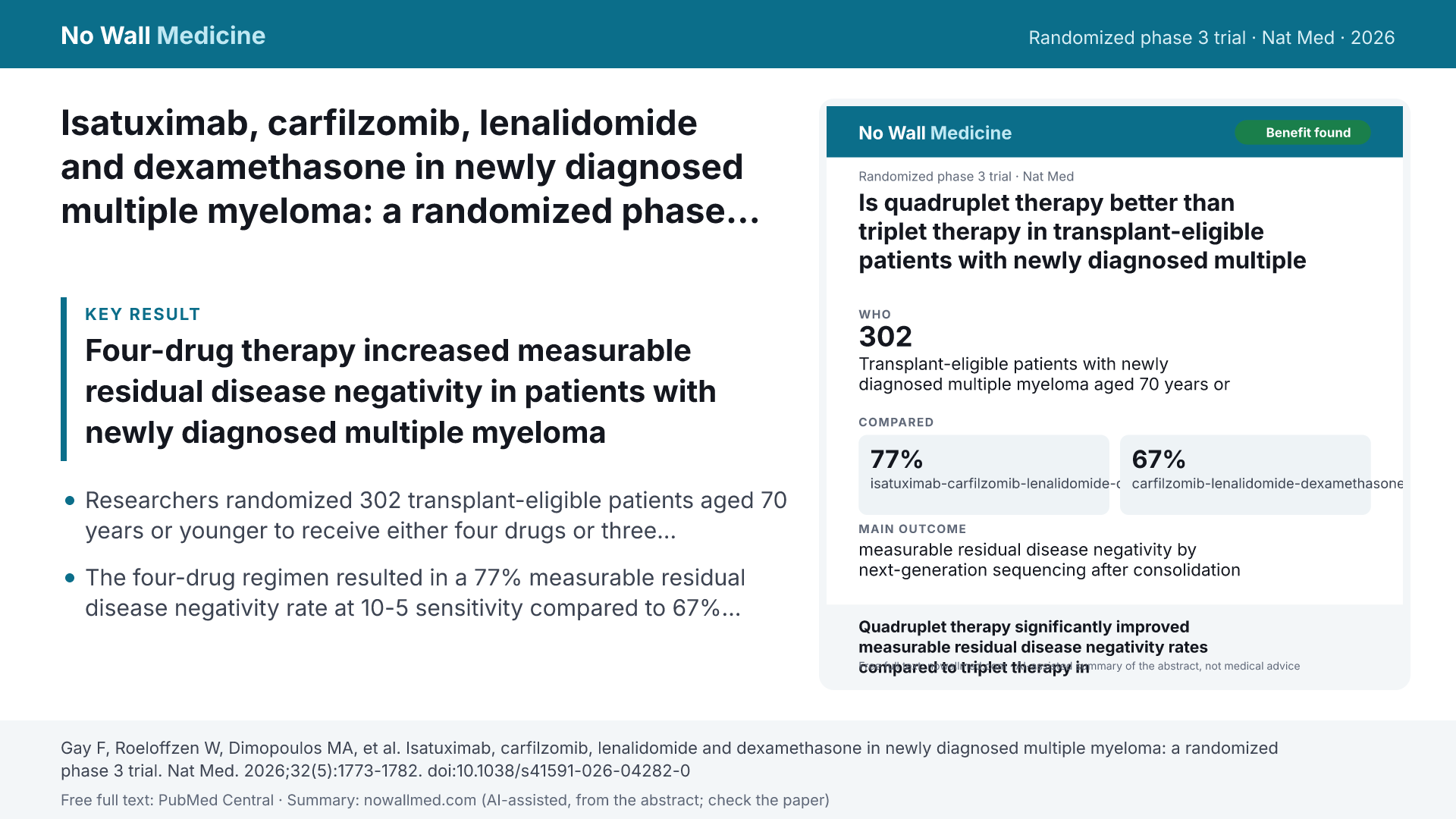
Four-drug therapy increased measurable residual disease negativity in patients with newly diagnosed multiple myeloma
Isatuximab, carfilzomib, lenalidomide and dexamethasone in newly diagnosed multiple myeloma: a randomized phase 3 trial
Randomized phase 3 trialBenefit found
Is quadruplet therapy better than triplet therapy in transplant-eligible patients with newly diagnosed multiple myeloma?
Who
302
Transplant-eligible patients with newly diagnosed multiple myeloma aged 70 years or younger
Compared
77%isatuximab-carfilzomib-lenalidomide-dexamethasone (10-5 sensitivity)
67%carfilzomib-lenalidomide-dexamethasone (10-5 sensitivity)
Main outcome
measurable residual disease negativity by next-generation sequencing after consolidation
Result: odds ratio 1.67 (P = 0.049)
Bottom line: Quadruplet therapy significantly improved measurable residual disease negativity rates compared to triplet therapy in transplant-eligible patients.
Nat Med · 2026-04-06 · Save PNG

Clinical question: Is quadruplet therapy better than triplet therapy in transplant-eligible patients with newly diagnosed multiple myeloma?
Why it matters: The optimal combination of drugs for treating transplant-eligible patients with newly diagnosed multiple myeloma is still under debate.
Key points
- Researchers randomized 302 transplant-eligible patients aged 70 years or younger to receive either four drugs or three drugs for multiple myeloma treatment.
- The four-drug regimen resulted in a 77% measurable residual disease negativity rate at 10-5 sensitivity compared to 67% for the three-drug regimen.
- Grade 3-4 non-blood-related side effects, treatment discontinuations, and deaths from side effects were similar between the two treatment groups.
Limitation the authors note: The progression-free survival data were immature at the time of follow-up.
Headline and key points written with AI from the paper’s abstract, with every number checked against it. Read the paper before relying on them.
Was this summary helpful?
Subject terms
Headline, design, result, key points, caveat and citation as plain text.
Cite this article
Gay F, Roeloffzen W, Dimopoulos MA, et al. Isatuximab, carfilzomib, lenalidomide and dexamethasone in newly diagnosed multiple myeloma: a randomized phase 3 trial. Nat Med. 2026;32(5):1773-1782. doi:10.1038/s41591-026-04282-0
Spotted a mistake? Suggest a correction