Adding isatuximab to standard therapy prolonged progression-free survival in transplant-eligible multiple myeloma patients
Isatuximab, Lenalidomide, Bortezomib, and Dexamethasone Induction Therapy for Transplant-Eligible Newly Diagnosed Multiple Myeloma: Final Part 1 Analysis of the GMMG-HD7 Trial
Randomized trialBenefit found
Does adding isatuximab to lenalidomide, bortezomib, and dexamethasone improve outcomes in multiple myeloma?
Who
662
Transplant-eligible patients with newly diagnosed multiple myeloma
Compared
Isatuximab, lenalidomide, bortezomib, and dexamethasone: 66% minimal residual disease negativity
Lenalidomide, bortezomib, and dexamethasone: 48% minimal residual disease negativity
Main outcome
progression-free survival
Result: hazard ratio 0.70 (95% CI 0.52 to 0.95)
Bottom line: Adding isatuximab to standard induction therapy significantly prolonged progression-free survival regardless of the maintenance strategy used.
J Clin Oncol · 2024-12-09Download image
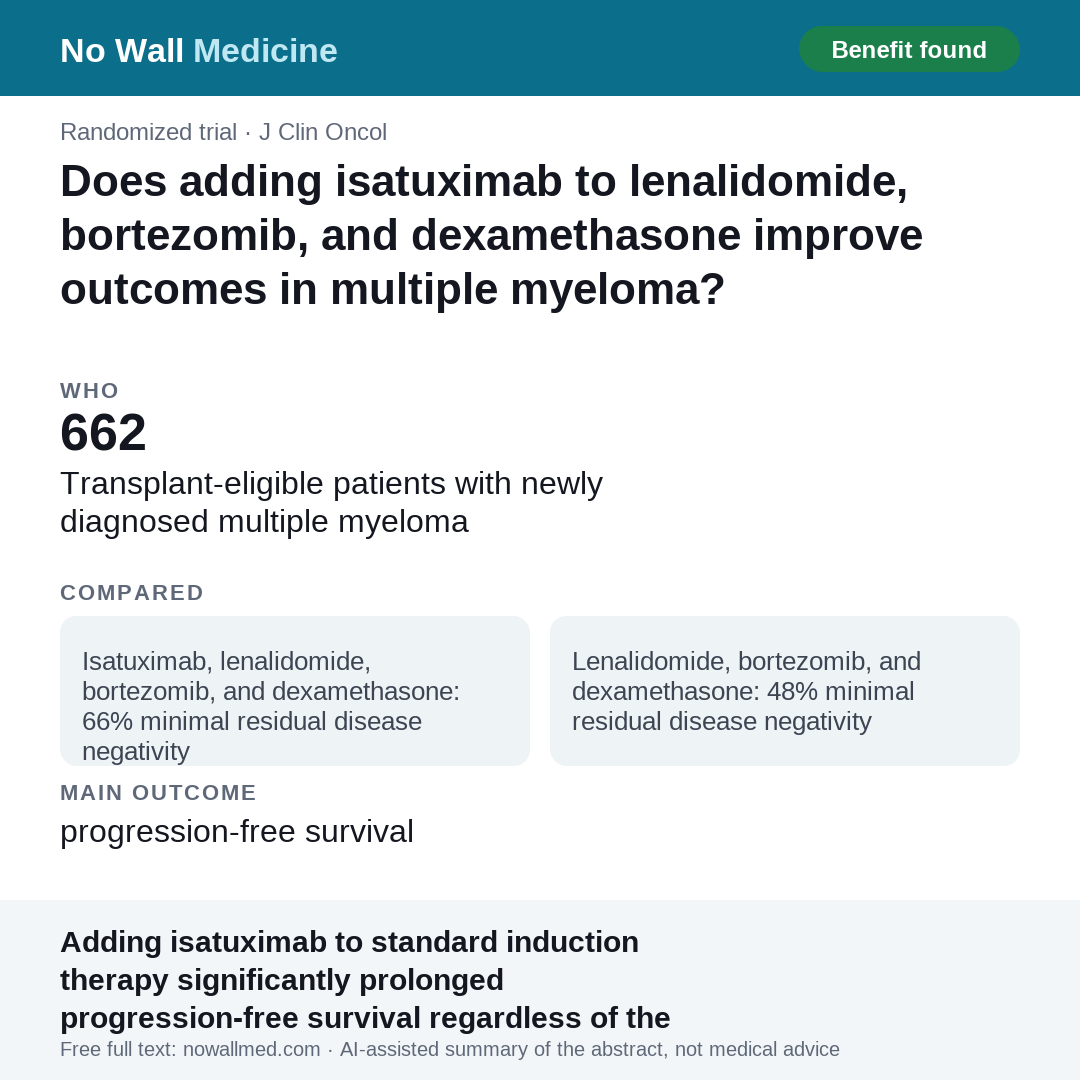
Clinical question: Does adding isatuximab to lenalidomide, bortezomib, and dexamethasone improve outcomes in multiple myeloma?
Why it matters: It was unknown if adding isatuximab to standard induction therapy improves outcomes for patients eligible for stem-cell transplants.
Key points
- Researchers studied 662 patients with newly diagnosed multiple myeloma who were randomly assigned to receive either isatuximab, lenalidomide, bortezomib, and dexamethasone or lenalidomide, bortezomib, and dexamethasone.
- The isatuximab group had higher rates of minimal residual disease negativity, which means no detectable cancer cells remain, at 66% compared to 48% in the standard group.
- Isatuximab induction therapy was associated with prolonged progression-free survival, a measure of time until the disease worsens, with a hazard ratio of 0.70 (95% CI, 0.52 to 0.95).
Headline and key points written with AI from the paper’s abstract, with every number checked against it. Read the paper before relying on them.
Was this summary helpful?
Subject terms
Cite this article
Mai EK, Bertsch U, Pozek E, Fenk R, Besemer B, Hanoun C. Isatuximab, Lenalidomide, Bortezomib, and Dexamethasone Induction Therapy for Transplant-Eligible Newly Diagnosed Multiple Myeloma: Final Part 1 Analysis of the GMMG-HD7 Trial. J Clin Oncol. 2024. doi:10.1200/JCO-24-02266
Spotted a mistake? Suggest a correction
Top studies every Monday
The week’s key trials and guidelines in your specialties, plus any topics you follow. By email, free.
Get the weekly digest