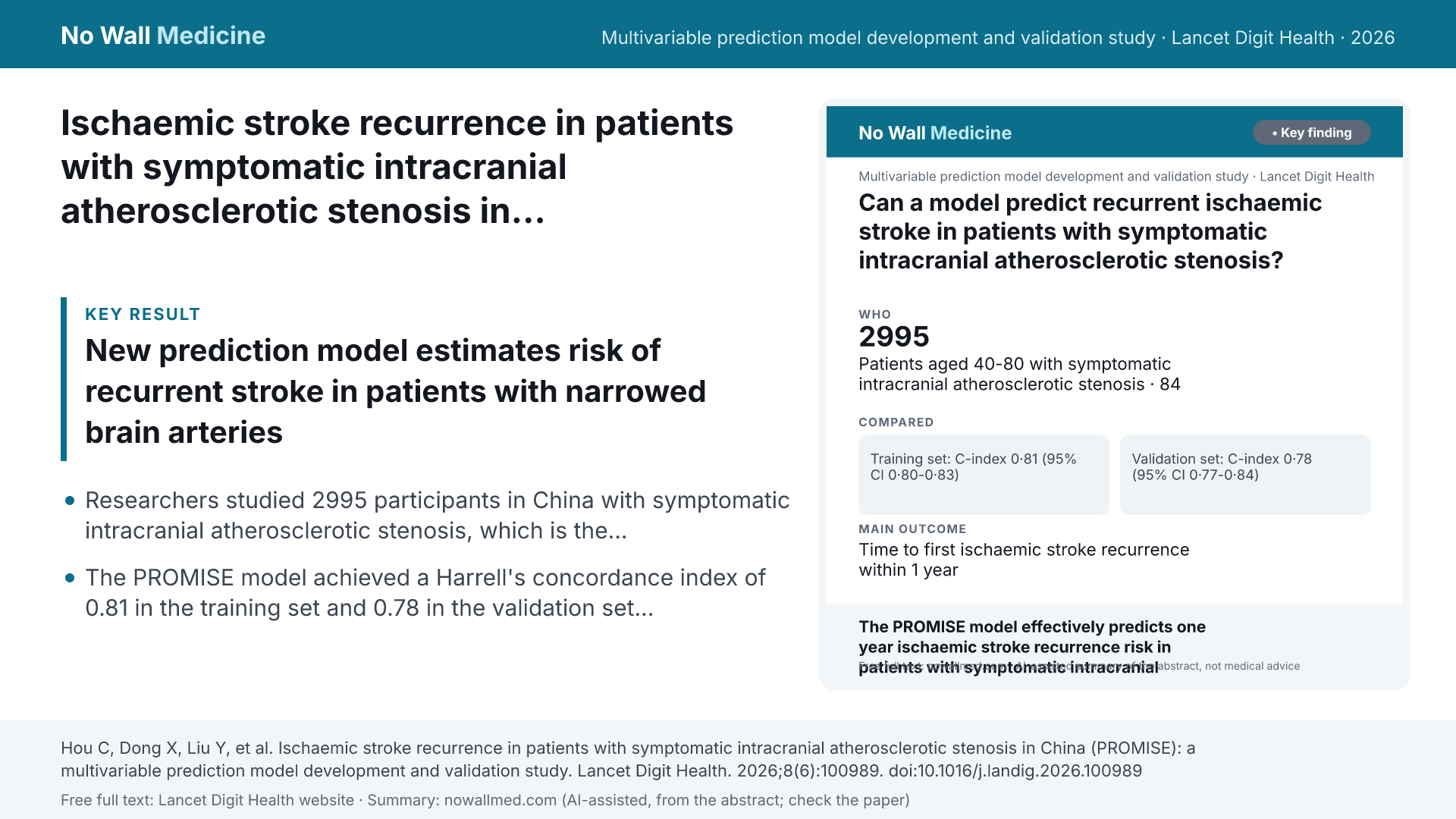
New prediction model estimates risk of recurrent stroke in patients with narrowed brain arteries
Ischaemic stroke recurrence in patients with symptomatic intracranial atherosclerotic stenosis in China (PROMISE): a multivariable prediction model development and validation study
Multivariable prediction model development and validation studyBenefit found
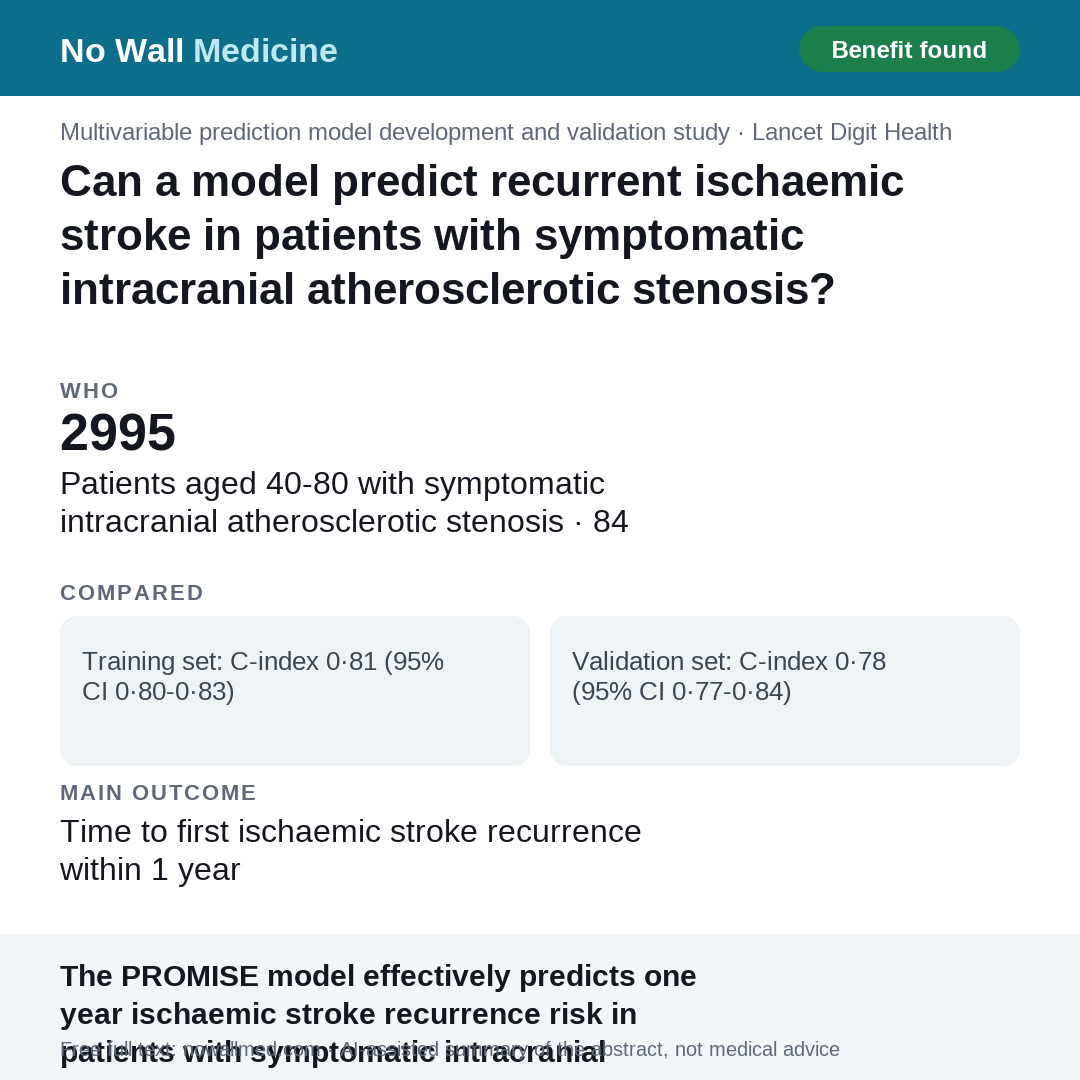
Can a model predict recurrent ischaemic stroke in patients with symptomatic intracranial atherosclerotic stenosis?
Who
2995
Patients aged 40-80 with symptomatic intracranial atherosclerotic stenosis · 84 hospitals in China
Compared
Training set: C-index 0·81 (95% CI 0·80-0·83)
Validation set: C-index 0·78 (95% CI 0·77-0·84)
Main outcome
Time to first ischaemic stroke recurrence within 1 year
Bottom line: The PROMISE model effectively predicts one year ischaemic stroke recurrence risk in patients with symptomatic intracranial atherosclerotic stenosis.
Funded by: National Natural Science Foundation of China and others
Lancet Digit Health · 2026-04-21Download image
Clinical question: Can a model predict recurrent ischaemic stroke in patients with symptomatic intracranial atherosclerotic stenosis?
Why it matters: Patients with symptomatic narrowing of the brain arteries face a high risk of having another stroke, but individualized risk prediction tools were needed.
Key points
- Researchers studied 2995 participants in China with symptomatic intracranial atherosclerotic stenosis, which is the narrowing of major arteries inside the brain.
- The PROMISE model achieved a Harrell's concordance index of 0.81 in the training set and 0.78 in the validation set for predicting stroke recurrence.
- The model used variables such as age, body mass index, hypertension, diabetes, smoking status, cholesterol, and the location and degree of artery narrowing.
Headline and key points written with AI from the paper’s abstract, with every number checked against it. Read the paper before relying on them.
Was this summary helpful?
Subject terms
Cite this article
Hou C, Dong X, Liu Y, et al. Ischaemic stroke recurrence in patients with symptomatic intracranial atherosclerotic stenosis in China (PROMISE): a multivariable prediction model development and validation study. Lancet Digit Health. 2026. doi:10.1016/j.landig.2026.100989
Spotted a mistake? Suggest a correction