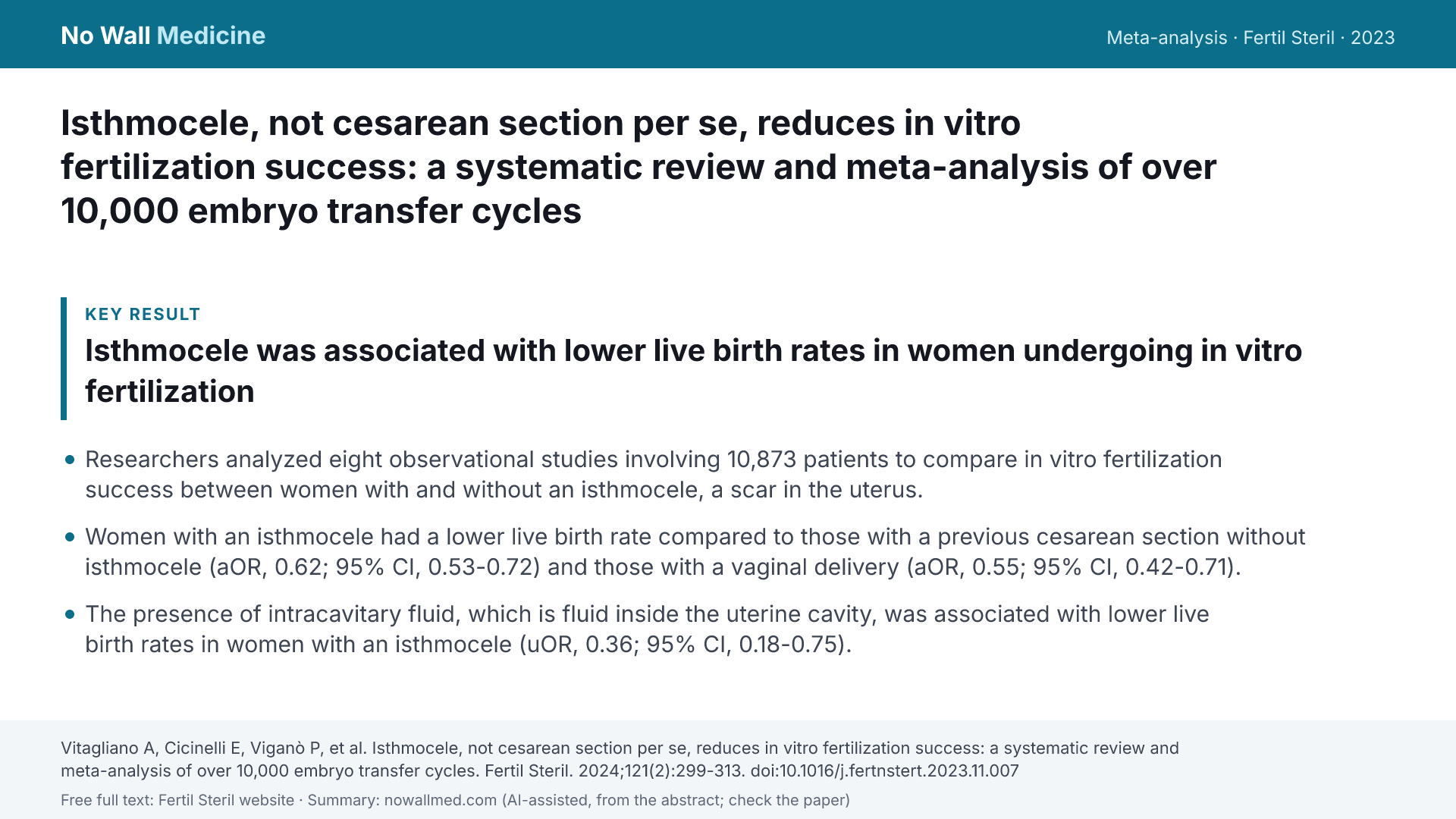
Isthmocele was associated with lower live birth rates in women undergoing in vitro fertilization
Isthmocele, not cesarean section per se, reduces in vitro fertilization success: a systematic review and meta-analysis of over 10,000 embryo transfer cycles
Systematic review and meta-analysisHarm found
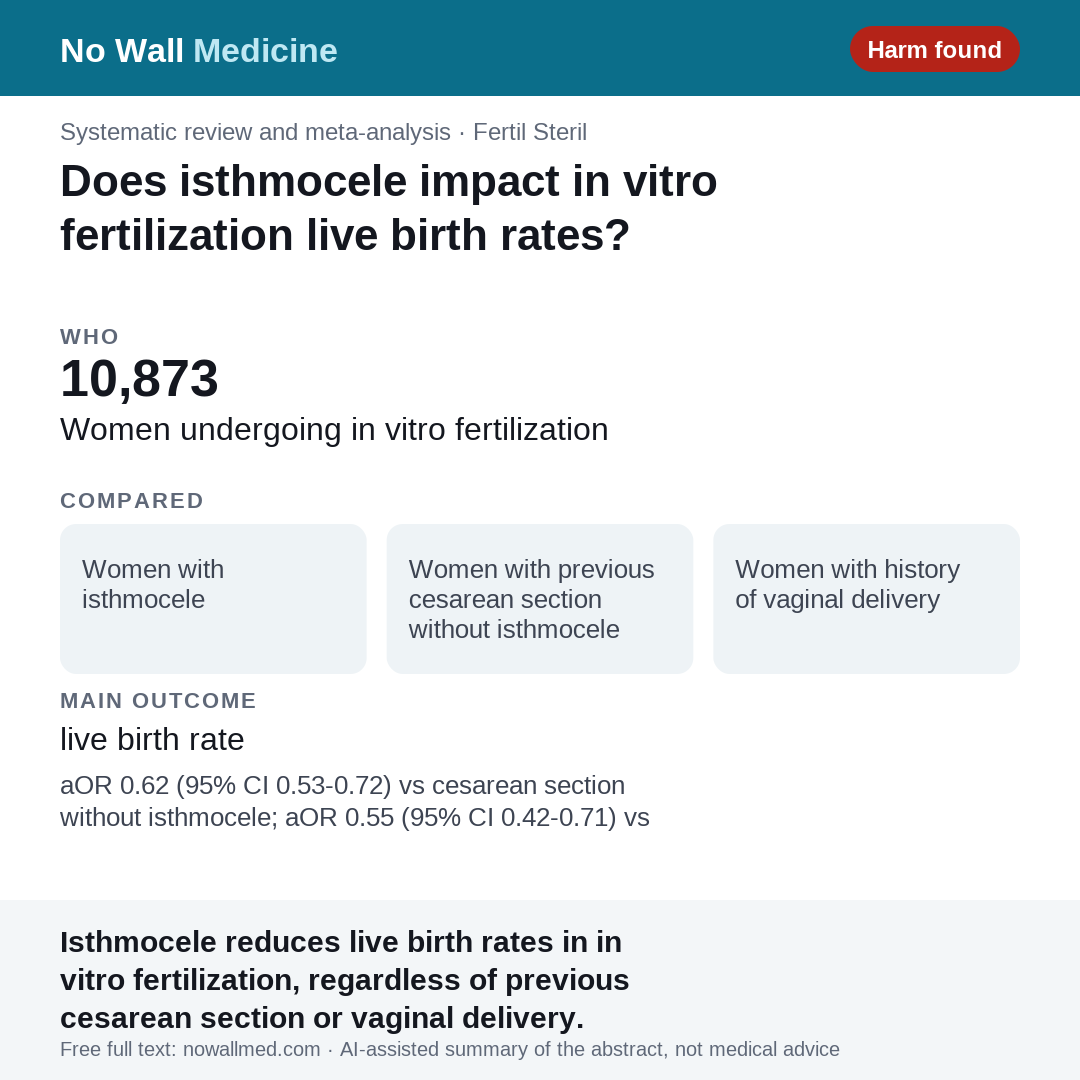
Does isthmocele impact in vitro fertilization live birth rates?
Who
10,873
Women undergoing in vitro fertilization
Compared
Women with isthmocele
Women with previous cesarean section without isthmocele
Women with history of vaginal delivery
Main outcome
live birth rate
Result: aOR 0.62 (95% CI 0.53-0.72) vs cesarean section without isthmocele; aOR 0.55 (95% CI 0.42-0.71) vs vaginal delivery
Bottom line: Isthmocele reduces live birth rates in in vitro fertilization, regardless of previous cesarean section or vaginal delivery.
Fertil Steril · 2023-11-10Download image
Clinical question: Does isthmocele impact in vitro fertilization live birth rates?
Why it matters: It was unclear if lower success rates in in vitro fertilization were caused by the cesarean section procedure itself or by the presence of an isthmocele.
Key points
- Researchers analyzed eight observational studies involving 10,873 patients to compare in vitro fertilization success between women with and without an isthmocele, a scar in the uterus.
- Women with an isthmocele had a lower live birth rate compared to those with a previous cesarean section without isthmocele (aOR, 0.62; 95% CI, 0.53-0.72) and those with a vaginal delivery (aOR, 0.55; 95% CI, 0.42-0.71).
- The presence of intracavitary fluid, which is fluid inside the uterine cavity, was associated with lower live birth rates in women with an isthmocele (uOR, 0.36; 95% CI, 0.18-0.75).
Headline and key points written with AI from the paper’s abstract, with every number checked against it. Read the paper before relying on them.
Was this summary helpful?
Subject terms
Cite this article
Vitagliano A, Cicinelli E, Viganò P, et al. Isthmocele, not cesarean section per se, reduces in vitro fertilization success: a systematic review and meta-analysis of over 10,000 embryo transfer cycles. Fertil Steril. 2023. doi:10.1016/j.fertnstert.2023.11.007
Spotted a mistake? Suggest a correction