Baricitinib is the only Janus kinase inhibitor with proven mortality reduction in severe COVID-19
JAK inhibitors and COVID-19
Review of clinical evidenceBenefit found
Do Janus kinase inhibitors provide benefit in treating COVID-19?
Who
Patients with COVID-19
Compared
Baricitinib
Other Janus kinase inhibitors
Main outcome
Reduction in mortality and major outcomes
Bottom line: Baricitinib is proven to reduce mortality in severe COVID-19, though a class effect for other inhibitors is emerging.
Limitation: The precise timing of treatment and control of viral replication remain important for future trials.
J Immunother Cancer · 2022-04-23Download image
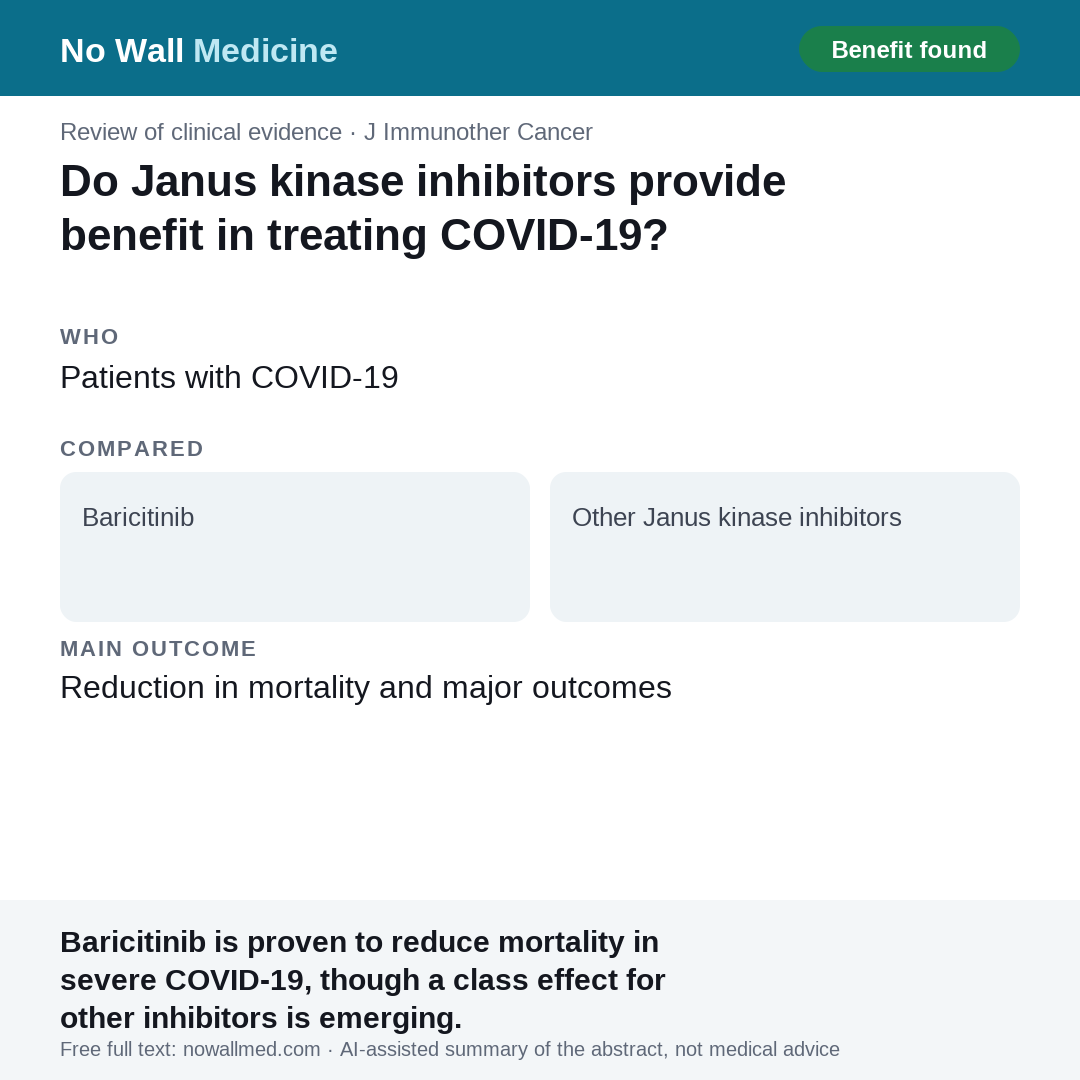
Clinical question: Do Janus kinase inhibitors provide benefit in treating COVID-19?
Why it matters: It is unknown if all Janus kinase inhibitors share a class effect in treating COVID-19 or if the benefits are unique to baricitinib.
Key points
- The review examines Janus kinase inhibitors, which are drugs that block proteins involved in immune signaling, for treating COVID-19.
- While a meta-analysis suggested these drugs might reduce major outcomes, only baricitinib has proven efficient to reduce mortality in individual randomized clinical trials.
- The main caution regarding baricitinib is the induced immunosuppression, which is the suppression of the body's immune response.
Headline and key points written with AI from the paper’s abstract, with every number checked against it. Read the paper before relying on them.
Was this summary helpful?
Abstract
During SARS-CoV-2 infection, the innate immune response can be inhibited or delayed, and the subsequent persistent viral replication can induce emergency signals that may culminate in a cytokine storm contributing to the severe evolution of COVID-19. Cytokines are key regulators of the immune response and virus clearance, and, as such, are linked to the-possibly altered-response to the SARS-CoV-2. They act via a family of more than 40 transmembrane receptors that are coupled to one or several of the 4 Janus kinases (JAKs) coded by the human genome, namely JAK1, JAK2, JAK3, and TYK2. Once activated, JAKs act on pathways for either survival, proliferation, differentiation, immune regulation or, in the case of type I interferons, antiviral and antiproliferative effects. Studies of graft-versus-host and systemic rheumatic diseases indicated that JAK inhibitors (JAKi) exert immunosuppressive effects that are non-redundant with those of corticotherapy. Therefore, they hold the potential to cut-off pathological reactions in COVID-19. Significant clinical experience already exists with several JAKi in COVID-19, such as baricitinib, ruxolitinib, tofacitinib, and nezulcitinib, which were suggested by a meta-analysis (Patoulias et al.) to exert a benefit in terms of risk reduction concerning major outcomes when added to standard of care in patients with COVID-19. Yet, only baricitinib is recommended in first line for severe COVID-19 treatment by the WHO, as it is the only JAKi that has proven efficient to reduce mortality in individual randomized clinical trials (RCT), especially the Adaptive COVID-19 Treatment Trial (ACTT-2) and COV-BARRIER phase 3 trials. As for secondary effects of JAKi treatment, the main caution with baricitinib consists in the induced immunosuppression as long-term side effects should not be an issue in patients treated for COVID-19.We discuss whether a class effect of JAKi may be emerging in COVID-19 treatment, although at the moment the convincing data are for baricitinib only. Given the key role of JAK1 in both type I IFN action and signaling by cytokines involved in pathogenic effects, establishing the precise timing of treatment will be very important in future trials, along with the control of viral replication by associating antiviral molecules.
Abstract reproduced under the article’s CC BY NC licence.
Subject terms
Cite this article
Levy G, Guglielmelli P, Langmuir P, Constantinescu SN. JAK inhibitors and COVID-19. J Immunother Cancer. 2022. doi:10.1136/jitc-2021-002838
Spotted a mistake? Suggest a correction
Top studies every Monday
The week’s key trials and guidelines in your specialties, plus any topics you follow. By email, free.
Get the weekly digest