Tailored smartphone intervention led to higher smoking abstinence at 26 weeks in low-income adults
Just-in-Time Adaptive Intervention for Smoking Cessation in Low-Income Adults: A Randomized Clinical Trial
Randomized clinical trialBenefit found
Does Smart-T smartphone intervention improve smoking cessation compared to QuitGuide in low-income adults?
Who
454
United States adults with household incomes below 200% federal poverty line · United States
Compared
23.1%Smart-T (37 of 160 participants)
14.3%QuitGuide (23 of 161 participants)
Main outcome
Biochemically verified 7-day point prevalence abstinence at 26 weeks
Result: adjusted odds ratio 1.81 (95% CI 1.03-3.18)
Bottom line: The Smart-T intervention led to significantly higher smoking abstinence at 26 weeks compared with QuitGuide in low-income adults.
JAMA Netw Open · 2025-08-01Download image
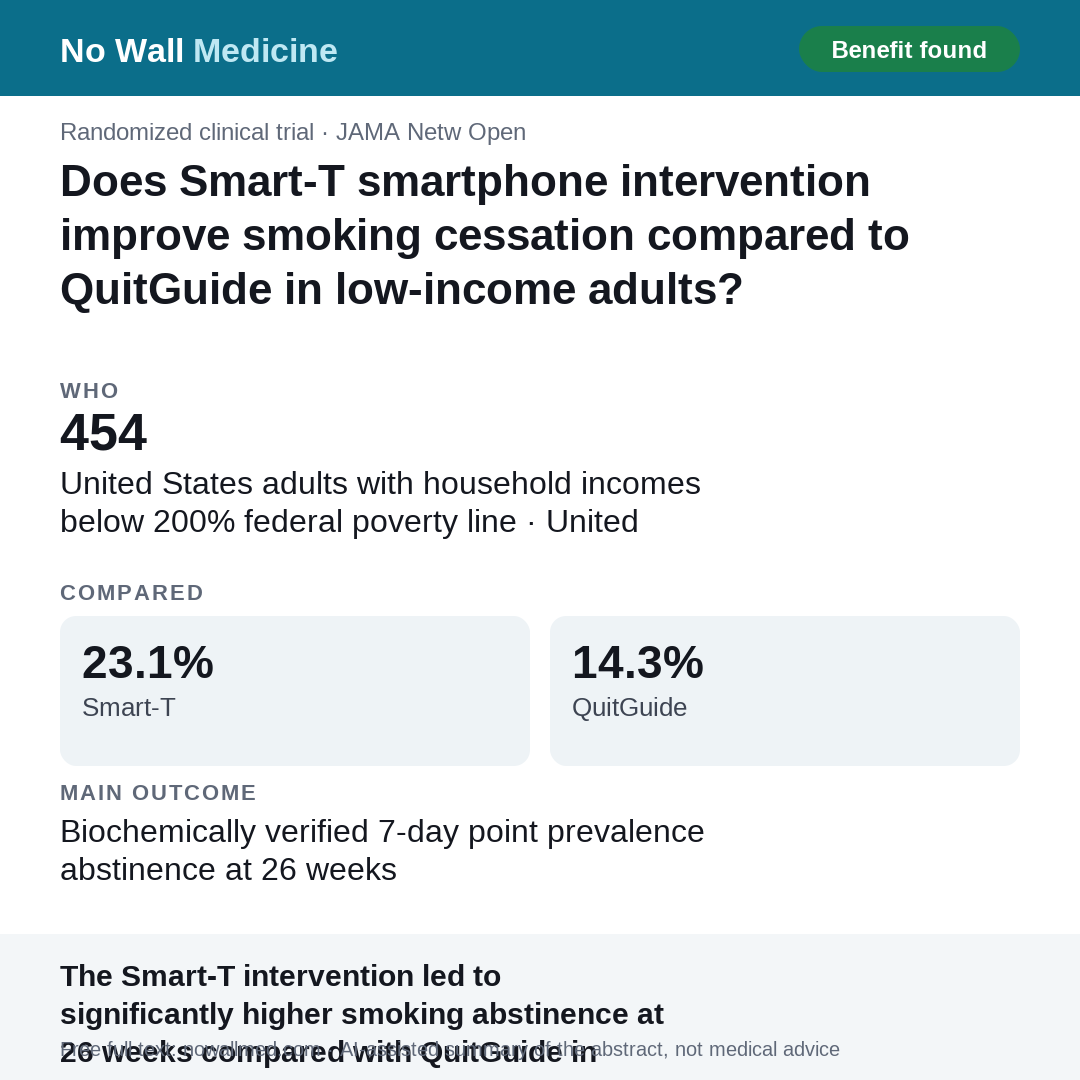
Clinical question: Does Smart-T smartphone intervention improve smoking cessation compared to QuitGuide in low-income adults?
Why it matters: Low-income adults face disproportionate barriers to quitting smoking and experience unique triggers that may require different support than standard clinical guidelines.
Key points
- The study randomized 454 US adults with household incomes below 200% of the federal poverty line to either the Smart-T app or the QuitGuide app.
- At 26 weeks, biochemically verified 7-day abstinence was 16.4% in the Smart-T group compared to 10.0% in the QuitGuide group using intention-to-treat analysis.
- While Smart-T showed higher odds of abstinence at 26 weeks, no significant differences were found for 30-day or continuous abstinence.
Headline and key points written with AI from the paper’s abstract, with every number checked against it. Read the paper before relying on them.
Topics
Cite this article
Hébert ET, Kendzor DE, Vidrine DJ, Langford JS, Kezbers KM, Montgomery A. Just-in-Time Adaptive Intervention for Smoking Cessation in Low-Income Adults: A Randomized Clinical Trial. JAMA Netw Open. 2025. doi:10.1001/jamanetworkopen.2025.26691
Spotted a mistake? Suggest a correction
Top studies every Monday
The week’s key trials and guidelines in your specialties, plus any topics you follow. By email, free.
Get the weekly digest