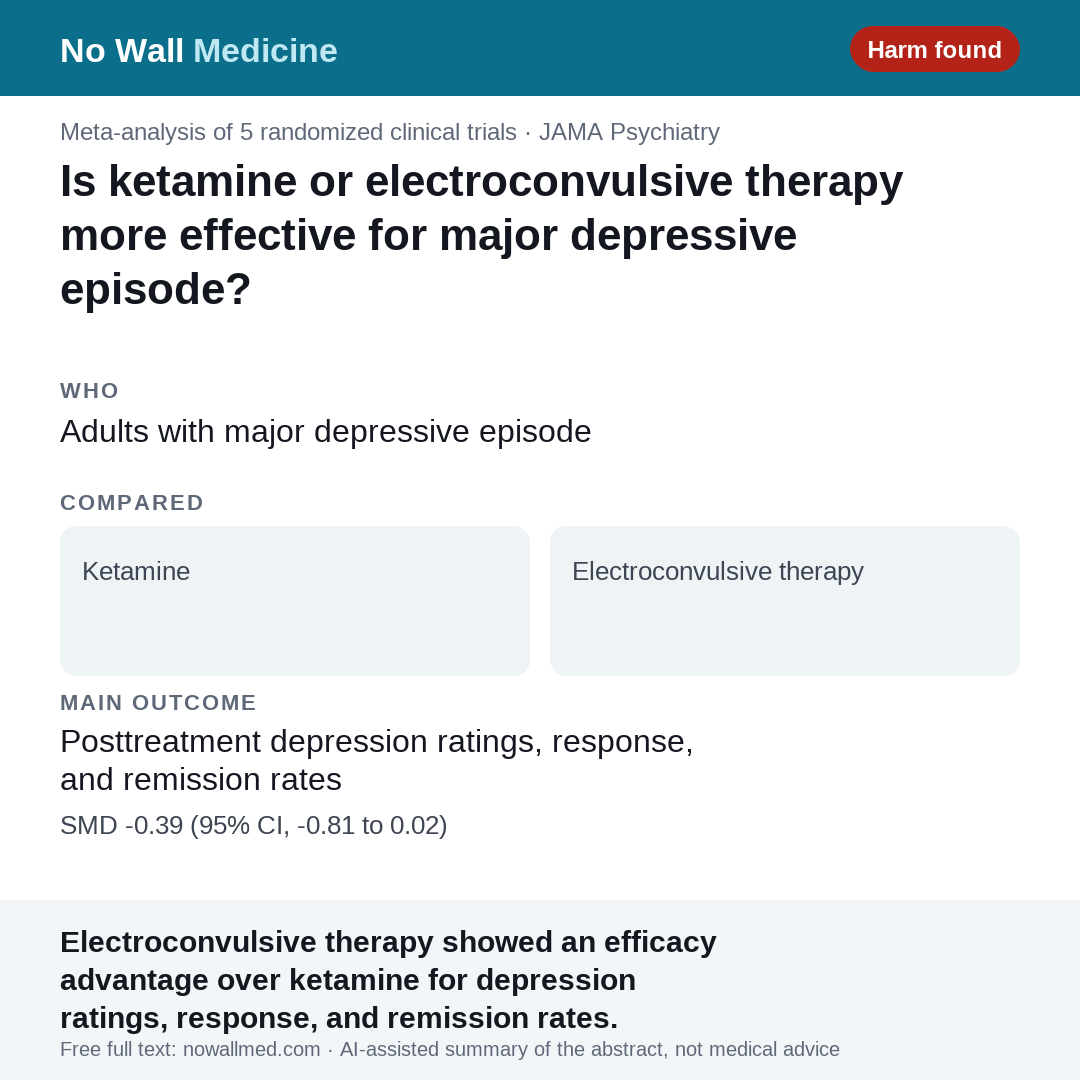
Electroconvulsive therapy showed higher response and remission rates than ketamine for major depressive episodes
Ketamine vs Electroconvulsive Therapy for Major Depressive Episode: A Systematic Review and Meta-analysis
Meta-analysis of 5 randomized clinical trialsHarm found
Is ketamine or electroconvulsive therapy more effective for major depressive episode?
Who
Adults with major depressive episode
Compared
Ketamine
Electroconvulsive therapy
Main outcome
Posttreatment depression ratings, response, and remission rates
Result: SMD -0.39 (95% CI, -0.81 to 0.02)
Bottom line: Electroconvulsive therapy showed an efficacy advantage over ketamine for depression ratings, response, and remission rates.
Limitation: Small number of studies, limited sample size, and high risk of bias in all trials.
JAMA Psychiatry · 2023-04-13Download image
Clinical question: Is ketamine or electroconvulsive therapy more effective for major depressive episode?
Why it matters: The relative efficacy of ketamine compared to electroconvulsive therapy for adults with major depressive episodes needs clarification.
Key points
- Researchers analyzed five randomized clinical trials involving 141 participants receiving ketamine and 137 participants receiving electroconvulsive therapy for major depressive episodes.
- In a sensitivity analysis of stronger trials, electroconvulsive therapy was superior for depression ratings, response rates (RR, 1.27; 95% CI, 1.06-1.53), and remission rates (RR, 1.43; 95% CI, 1.12-1.82).
- No significant differences were found between the two treatments regarding the number of sessions required to reach response or remission, or for cognitive outcomes.
Limitation the authors note: The authors noted a small number of studies, a limited sample size, and a high risk of bias in all included trials.
Headline and key points written with AI from the paper’s abstract, with every number checked against it. Read the paper before relying on them.
Was this summary helpful?
Subject terms
Cite this article
Menon V, Varadharajan N, Faheem A, Andrade C. Ketamine vs Electroconvulsive Therapy for Major Depressive Episode: A Systematic Review and Meta-analysis. JAMA Psychiatry. 2023. doi:10.1001/jamapsychiatry.2023.0562
Spotted a mistake? Suggest a correction
Top studies every Monday
The week’s key trials and guidelines in your specialties, plus any topics you follow. By email, free.
Get the weekly digest