Kidney function and obstructive lung disease: a bidirectional Mendelian randomisation study
Bidirectional two-sample Mendelian randomisation analysisBenefit found
Does kidney function have a causal effect on obstructive lung disease?
Who
Individuals of European ancestry
Compared
Increased kidney function: 10% increase in eGFR; β=0.055, 95% CI 0.024-0.086
Increased FEV1/FVC: β=0.568%, 95% CI -0.458-1.605%
Main outcome
Obstructive lung disease and FEV1/FVC z-scores
Result: OR 0.93, 95% CI 0.87-0.99 for FEV1/FVC <70%
Bottom line: Increased kidney function is a causative factor for reduced risk of obstructive lung diseases.
Eur Respir J · 2021-12-09Download image
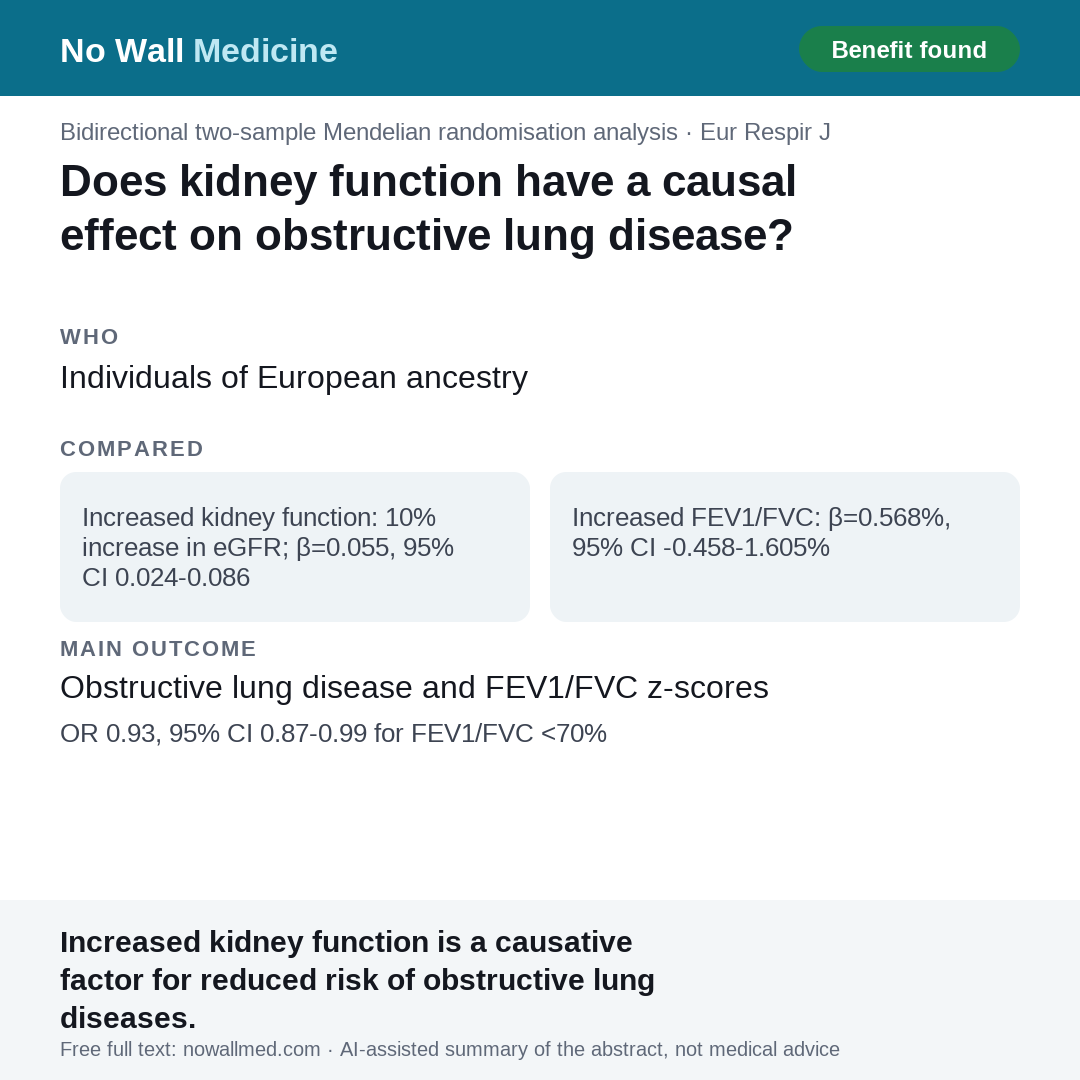
Clinical question: Does kidney function have a causal effect on obstructive lung disease?
Abstract
Background
Additional study is warranted to investigate the causal effects between kidney function and obstructive lung disease. Methods
This study was a bidirectional two-sample Mendelian randomisation (MR) analysis. The Chronic Kidney Disease Genetics (CKDGen) genome-wide association study (GWAS) meta-analysis for estimated glomerular filtration rate (eGFR) including individuals of European ancestry (n=567 460) provided the genetic instrument for kidney function and outcome summary statistics. A GWAS for forced expiratory volume in 1 s (FEV1)/forced vital capacity (FVC) including individuals of European ancestry from the UK Biobank (n=321 047) provided the genetic instrument for FEV1/FVC and outcome data. A polygenic score (PGS) analysis was performed to test the causal estimates from kidney function to binary obstructive lung disease outcomes, including COPD, asthma and FEV1/FVC <70%, and to perform nonlinear MR with individual-level UK Biobank data. Results
The causal estimates by summary-level MR indicated that genetically predicted increased kidney function was significantly associated with increased FEV1/FVC z-scores (10% increase in eGFR; β=0.055, 95% CI 0.024-0.086). The PGS for increased eGFR showed a significant association with a reduced risk of FEV1/FVC <70% (OR 0.93, 95% CI 0.87-0.99), COPD (OR 0.93, 95% CI 0.87-0.99) and late-onset (age ≥50 years) asthma (OR 0.93, 95% CI 0.88-0.99). The nonlinear MR demonstrated that the causal effect from eGFR to FEV1/FVC was apparent in eGFR ranges <60 mL·min-1·1.73 m-2. Conversely, genetically predicted FEV1/FVC showed nonsignificant causal estimates of eGFR change (β=0.568%, 95% CI -0.458-1.605%). Conclusion
This study supports kidney function impairment as a causative factor for obstructive lung disease.
Subject terms
Cite this article
Park S, Lee S, Kim Y, Cho S, Kim K, Kim YC. Kidney function and obstructive lung disease: a bidirectional Mendelian randomisation study. Eur Respir J. 2021. doi:10.1183/13993003.00848-2021
Spotted a mistake? Suggest a correction
Top studies every Monday
The week’s key trials and guidelines in your specialties, plus any topics you follow. By email, free.
Get the weekly digest