Oxytocin use for labor augmentation was associated with increased risks for newborns in low-income countries
Labor augmentation with oxytocin in low- and lower-middle-income countries: a systematic review and meta-analysis
Systematic review and meta-analysisKey finding
What are the benefits and risks of oxytocin for labor augmentation in low-resource settings?
Who
124,643
Women in low- and lower-middle-income countries · 25 low- and lower-middle-income countries
Compared
Oxytocin augmentation
Placebo or no oxytocin
Main outcome
Perinatal outcomes including mortality, Apgar score, resuscitation, and encephalopathy
Result: relative risk 1.45 (95% confidence interval, 1.02-2.06) for stillbirth and day-1 neonatal mortality
Bottom line: Oxytocin use in low-resource settings is associated with increased risks of stillbirth, neonatal mortality, and neonatal encephalopathy.
Limitation: The finding is limited by confounding by indication.
AJOG Glob Rep · 2022-10-21 · Save PNG
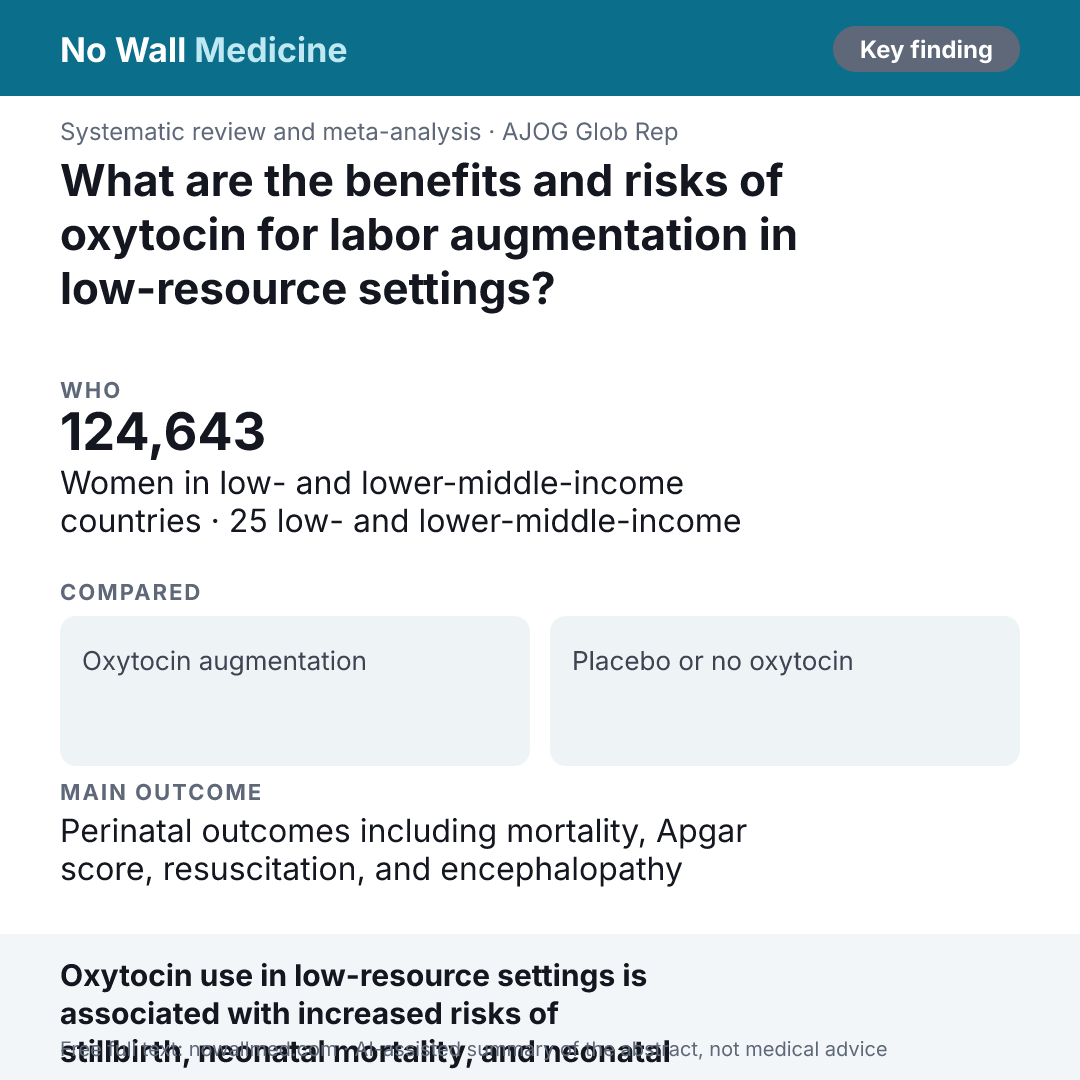
Clinical question: What are the benefits and risks of oxytocin for labor augmentation in low-resource settings?
Why it matters: Existing reviews of oxytocin for labor augmentation primarily include studies from high-income countries, leaving the risks in low-resource settings unknown.
Key points
- Researchers analyzed 42 studies involving 124,643 women across 25 low- and lower-middle-income countries.
- Oxytocin use was associated with stillbirth and day-1 neonatal mortality (relative risk, 1.45), low Apgar scores (relative risk, 1.54), and neonatal resuscitation (relative risk, 2.69).
- The use of oxytocin was also associated with neonatal encephalopathy, a type of brain dysfunction in newborns, with a relative risk of 2.90.
Limitation the authors note: The findings are limited by confounding by indication, which occurs when the reason for prescribing a treatment is also related to the outcome.
Headline and key points written with AI from the paper’s abstract, with every number checked against it. Read the paper before relying on them.
Was this summary helpful?
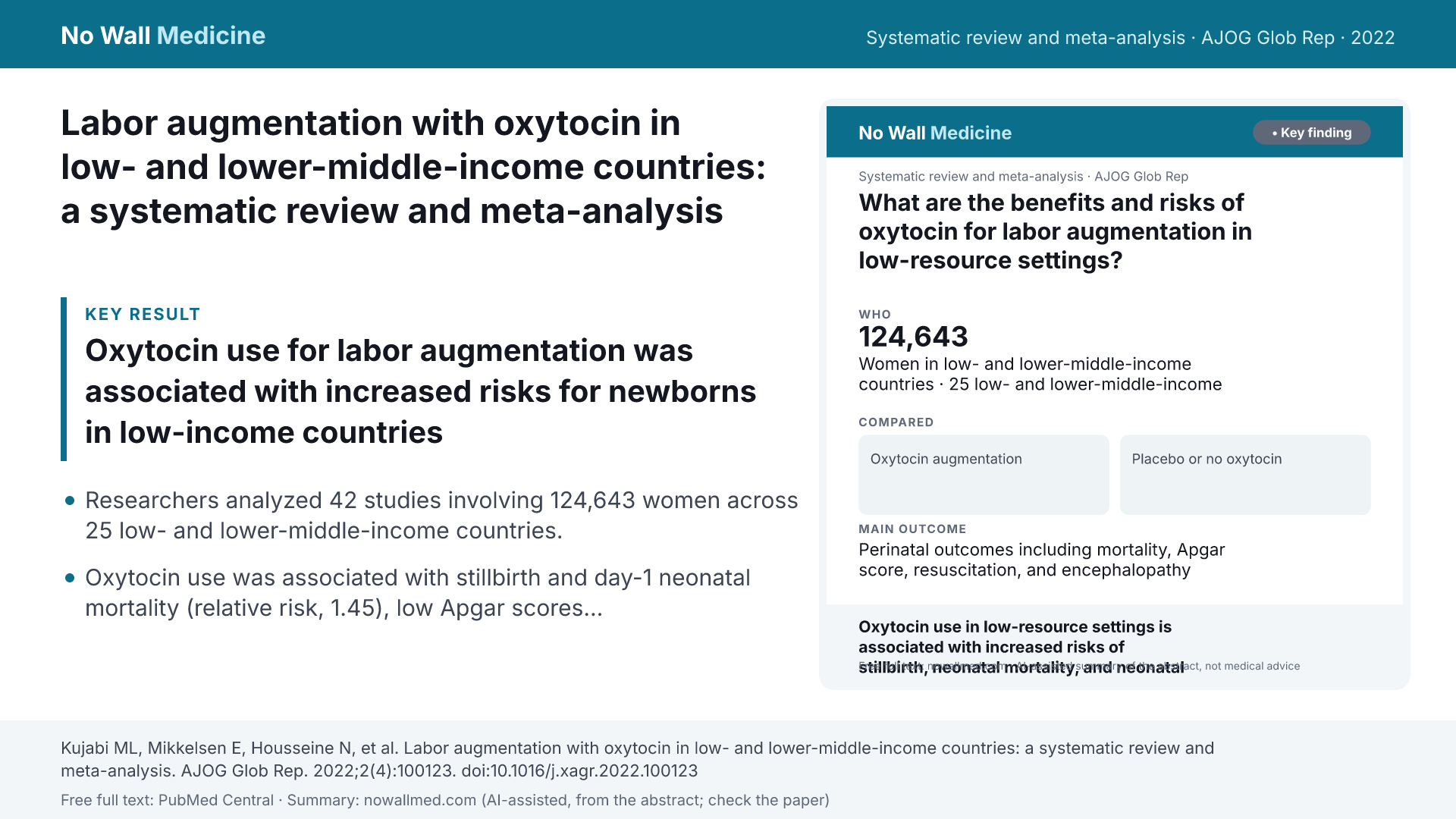
Headline, design, result, key points, caveat and citation as plain text.
Cite this article
Kujabi ML, Mikkelsen E, Housseine N, et al. Labor augmentation with oxytocin in low- and lower-middle-income countries: a systematic review and meta-analysis. AJOG Glob Rep. 2022;2(4):100123. doi:10.1016/j.xagr.2022.100123
Spotted a mistake? Suggest a correction