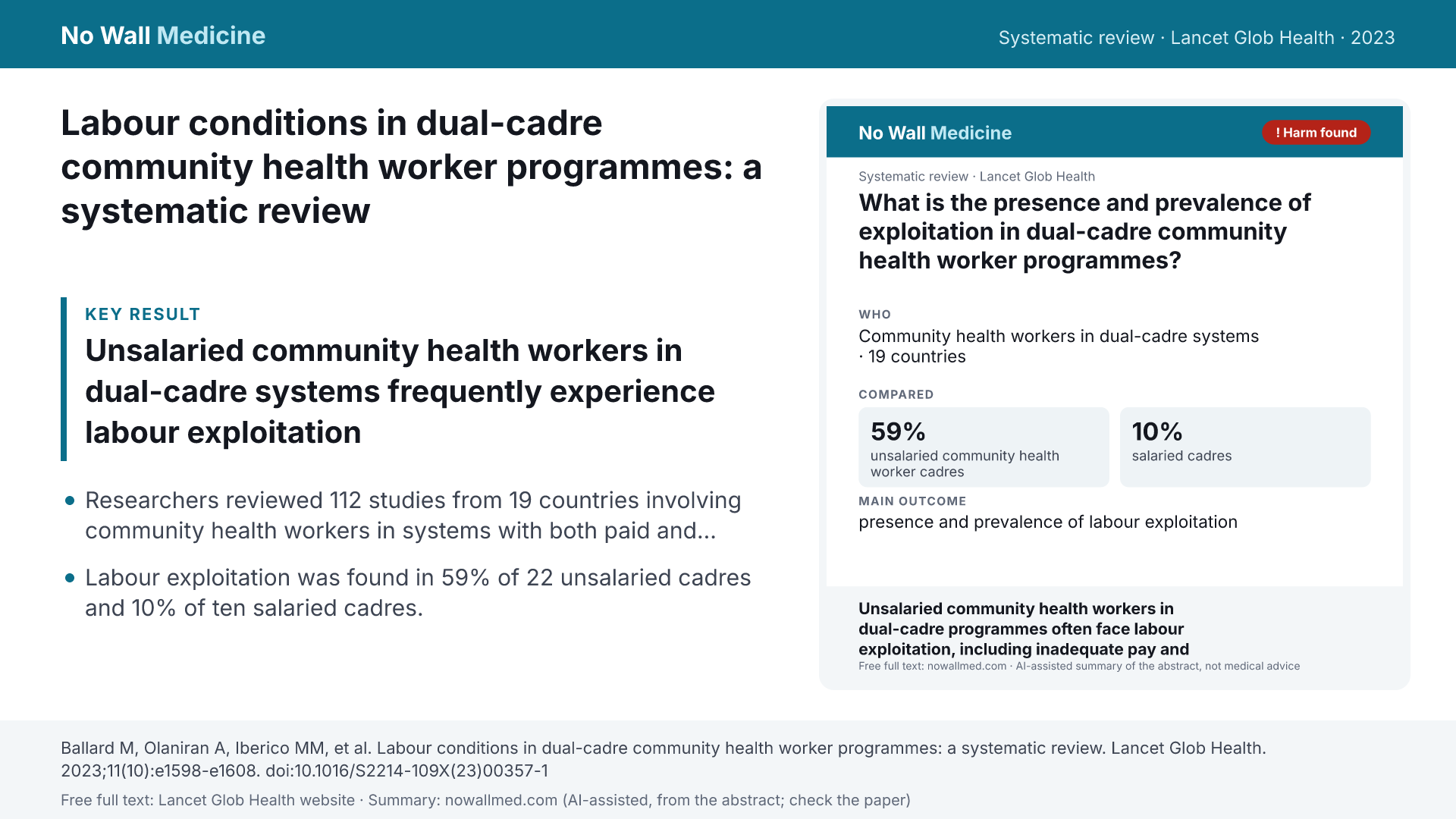
Unsalaried community health workers in dual-cadre systems frequently experience labour exploitation
Labour conditions in dual-cadre community health worker programmes: a systematic review
Systematic reviewHarm found
What is the presence and prevalence of exploitation in dual-cadre community health worker programmes?
Who
Community health workers in dual-cadre systems · 19 countries
Compared
59%unsalaried community health worker cadres
10%salaried cadres
Main outcome
presence and prevalence of labour exploitation
Bottom line: Unsalaried community health workers in dual-cadre programmes often face labour exploitation, including inadequate pay and overburdensome workloads.
Lancet Glob Health · 2023-09-22Download image
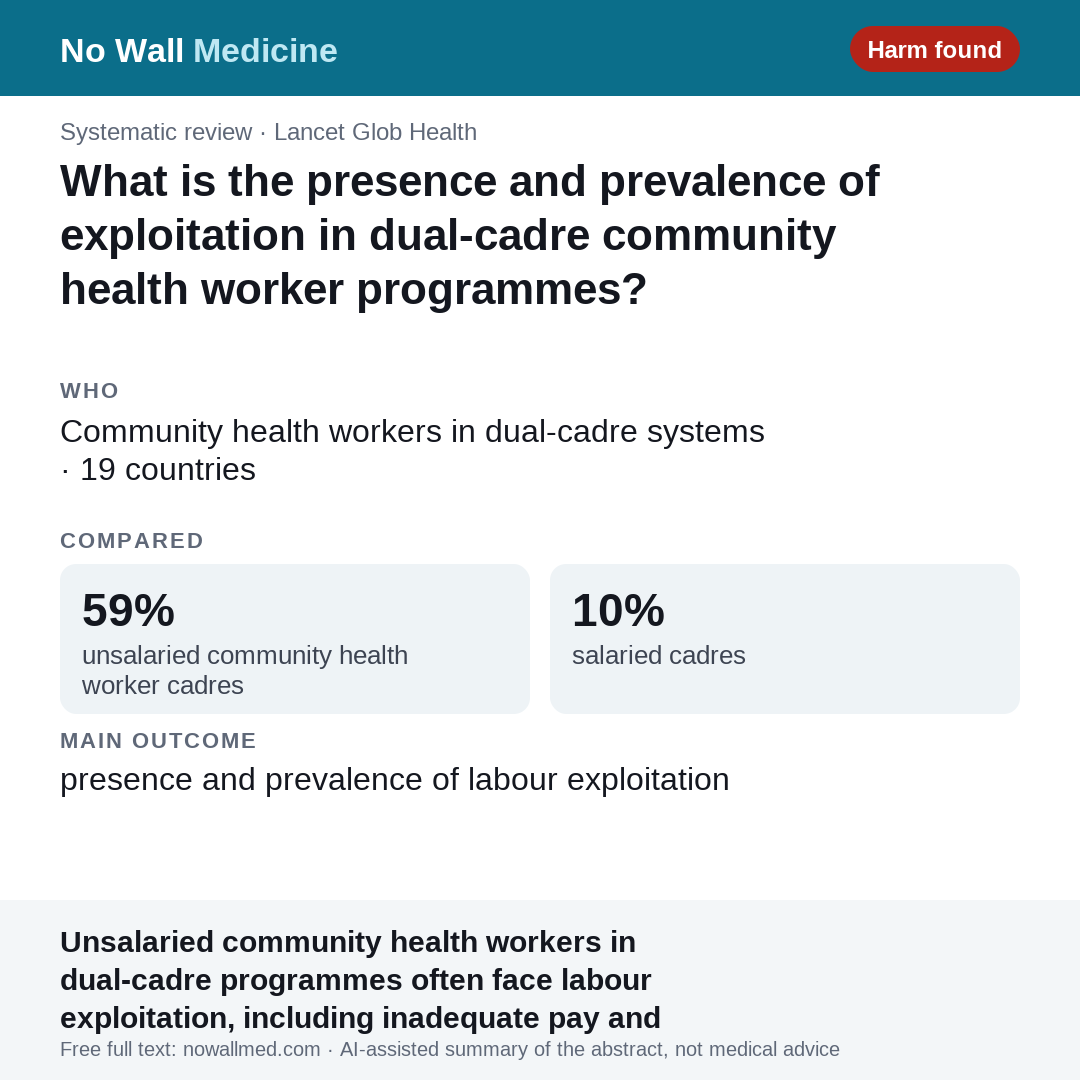
Clinical question: What is the presence and prevalence of exploitation in dual-cadre community health worker programmes?
Key points
- Researchers reviewed 112 studies from 19 countries involving community health workers in systems with both paid and unpaid staff.
- Labour exploitation was found in 59% of 22 unsalaried cadres and 10% of ten salaried cadres.
- Among 18 unsalaried workers, 17% would need to work more than 40 h per week to complete their assigned tasks.
Headline and key points written with AI from the paper’s abstract, with every number checked against it. Read the paper before relying on them.
Was this summary helpful?
Abstract
Background
Health care delivered by community health workers reduces morbidity and mortality while providing a considerable return on investment. Despite growing consensus that community health workers, a predominantly female workforce, should receive a salary, many community health worker programmes take the form of dual-cadre systems, where a salaried cadre of community health workers works alongside a cadre of unsalaried community health workers. We aimed to determine the presence, prevalence, and magnitude of exploitation in national dual-cadre programmes. Methods
We did a systematic review of available evidence from peer-reviewed databases and grey literature from database inception to Aug 2, 2021, for studies on unsalaried community health worker cadres in dual-cadre systems. Editorials, protocols, guidelines, or conference reports were excluded in addition to studies about single-tier community health worker programmes and those reporting on only salaried cadres of community health workers in a dual-cadre system. We extracted data on remuneration, workload, task complexity, and self-reported experiences of community health workers. Three models were created: a minimum model with the shortest time and frequency per task documented in the literature, a maximum model with the longest time, and a median model. Labour exploitation was defined as being engaged in work below the country's minimum wage together with excessive work hours or complex tasks. The study was registered with PROSPERO, CRD42021271500. Findings
We included 117 reports from 112 studies describing community health workers in dual-cadre programmes across 19 countries. The majority of community health workers were female. 13 (59%) of 22 unsalaried community health worker cadres and one (10%) of ten salaried cadres experienced labour exploitation. Three (17%) of 18 unsalaried community health workers would need to work more than 40 h per week to fulfil their assigned responsibilities. Unsalaried community health worker cadres frequently reported non-payment, inadequate or inconsistent payment of incentives, and an overburdensome workload. Interpretation
Unsalaried community health workers in dual-cadre programmes often face labour exploitation, potentially leading to inadequate health-care provision. Labour laws must be upheld and the creation of professional community health worker cadres with fair contracts prioritised, international funding allocated to programmes that rely on unsalaried workers should be transparently reported, the workloads of community health workers should be modelled a priori and actual time use routinely assessed, community health workers should have input in policies that affect them, and volunteers should not be responsible for the delivery of essential health services. Funding
None.
Abstract reproduced under the article’s CC BY NC ND licence.
Subject terms
Headline, design, result, key points, caveat and citation as plain text.
Cite this article
Ballard M, Olaniran A, Iberico MM, et al. Labour conditions in dual-cadre community health worker programmes: a systematic review. Lancet Glob Health. 2023. doi:10.1016/S2214-109X(23)00357-1
Spotted a mistake? Suggest a correction