Large-bore mechanical thrombectomy outperformed catheter-directed thrombolysis for intermediate-risk pulmonary embolism
Large-Bore Mechanical Thrombectomy Versus Catheter-Directed Thrombolysis in the Management of Intermediate-Risk Pulmonary Embolism: Primary Results of the PEERLESS Randomized Controlled Trial
Prospective, multicenter, randomized controlled trialBenefit found
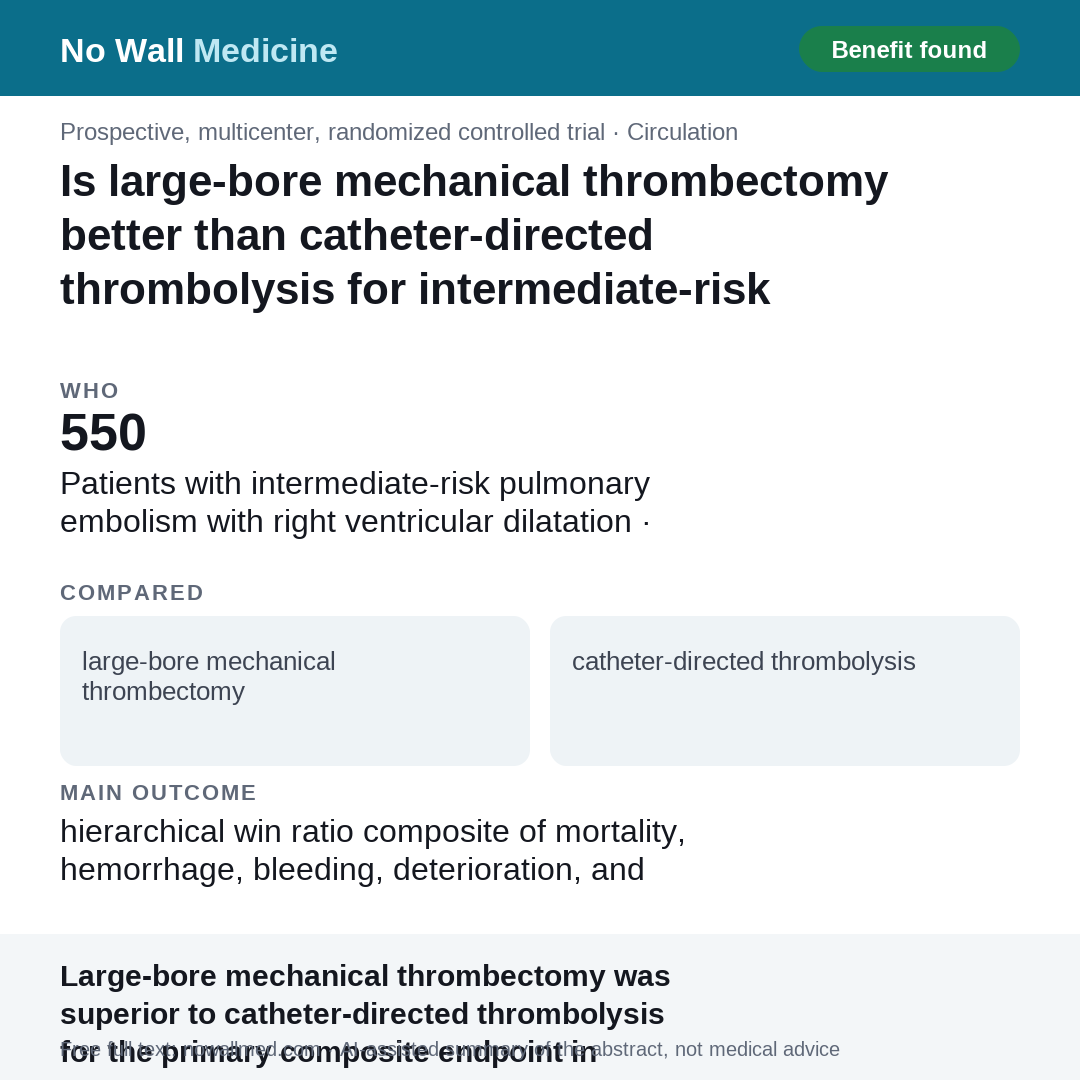
Is large-bore mechanical thrombectomy better than catheter-directed thrombolysis for intermediate-risk pulmonary embolism?
Who
550
Patients with intermediate-risk pulmonary embolism with right ventricular dilatation · multicenter
Compared
large-bore mechanical thrombectomy
catheter-directed thrombolysis
Main outcome
hierarchical win ratio composite of mortality, hemorrhage, bleeding, deterioration, and intensive care use
Result: win ratio 5.01 (95% CI 3.68-6.97)
Bottom line: Large-bore mechanical thrombectomy was superior to catheter-directed thrombolysis for the primary composite endpoint in intermediate-risk pulmonary embolism.
Circulation · 2024-10-29Download image
Clinical question: Is large-bore mechanical thrombectomy better than catheter-directed thrombolysis for intermediate-risk pulmonary embolism?
Why it matters: There is a lack of randomized controlled trial data comparing outcomes of different catheter-based interventions for intermediate-risk pulmonary embolism.
Key points
- Researchers randomized 550 patients with intermediate-risk pulmonary embolism and right ventricular dilatation to receive either large-bore mechanical thrombectomy or catheter-directed thrombolysis.
- The primary composite endpoint occurred significantly less frequently with large-bore mechanical thrombectomy compared to catheter-directed thrombolysis (win ratio, 5.01; P<0.001).
- Large-bore mechanical thrombectomy was associated with fewer intensive care unit admissions (41.6% versus 98.6%) and shorter hospital stays (4.5±2.8 versus 5.3±3.9 overnights).
Headline and key points written with AI from the paper’s abstract, with every number checked against it. Read the paper before relying on them.
Topics
Cite this article
Jaber WA, Gonsalves CF, Stortecky S, Horr S, Pappas O, Gandhi RT. Large-Bore Mechanical Thrombectomy Versus Catheter-Directed Thrombolysis in the Management of Intermediate-Risk Pulmonary Embolism: Primary Results of the PEERLESS Randomized Controlled Trial. Circulation. 2024. doi:10.1161/CIRCULATIONAHA.124.072364
Spotted a mistake? Suggest a correction
Top studies every Monday
The week’s key trials and guidelines in your specialties, by email. Free.
Get the weekly digest