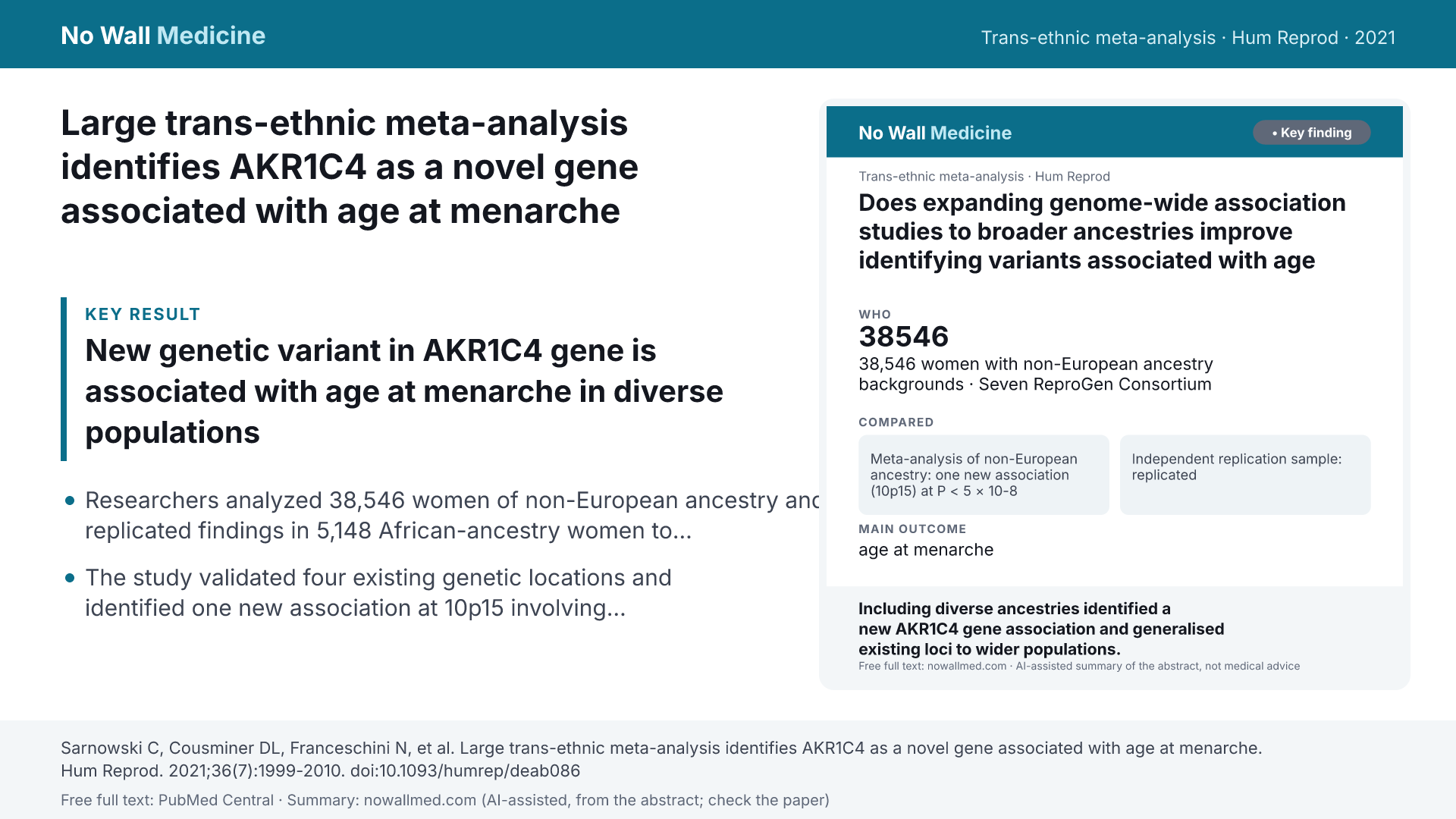
Large trans-ethnic meta-analysis identifies AKR1C4 as a novel gene associated with age at menarche
Key result: New genetic variant in AKR1C4 gene is associated with age at menarche in diverse populations
Key points
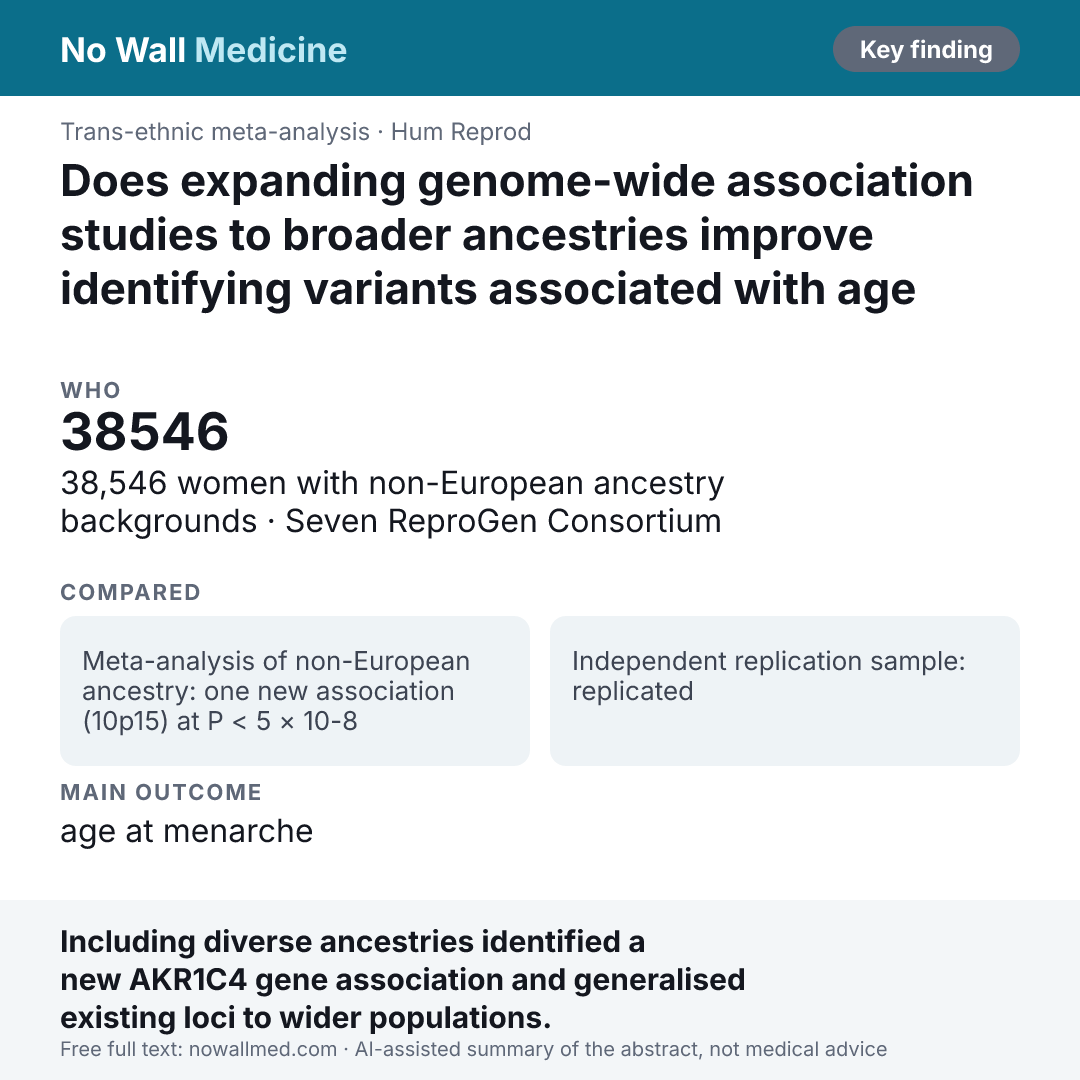
- Researchers analyzed 38,546 women of non-European ancestry and replicated findings in 5,148 African-ancestry women to study age at menarche, the age when a girl's first period begins.
- The study validated four existing genetic locations and identified one new association at 10p15 involving a low-frequency variant in the AKR1C4 gene, which helps regulate steroid hormone metabolism.
- The newly identified genetic variant is more frequent in women of African ancestry and has a very low frequency in women of Asian or European ancestry.
Why it matters: Most genetic studies on the age at which menstruation begins have been performed in women of European ancestry, leaving it unknown if these findings apply to other global populations.
Limitation the authors note: Women may not fully recall the exact age of their first period, and extreme ages under 9 years or over 18 years were excluded from the analysis.
Discussion prompts
- Would these patients look like yours? Who was left out?
- Is the main outcome one that matters to patients?
- Is the difference large enough to change what you do?
Cite: Sarnowski C, Cousminer DL, Franceschini N, et al. Large trans-ethnic meta-analysis identifies AKR1C4 as a novel gene associated with age at menarche. Hum Reprod. 2021;36(7):1999-2010. doi:10.1093/humrep/deab086
Free full text: PubMed Central · Summary and visual abstract: nowallmed.com/a/large-trans-ethnic-meta-analysis-identifies-akr1c4-as-a-novel-gene-vhjd0w/ (AI-assisted from the abstract; check the paper before relying on it).