Meta-analysis finds 33.5% case-fatality ratio and 8.19 day delay to hospital admission for Lassa fever
Lassa fever outbreaks, mathematical models, and disease parameters: a systematic review and meta-analysis
Systematic review and meta-analysisMixed results
What are the key epidemiological parameters of Lassa fever?
Who
193
Lassa fever outbreak data and parameter estimates · West Africa
Compared
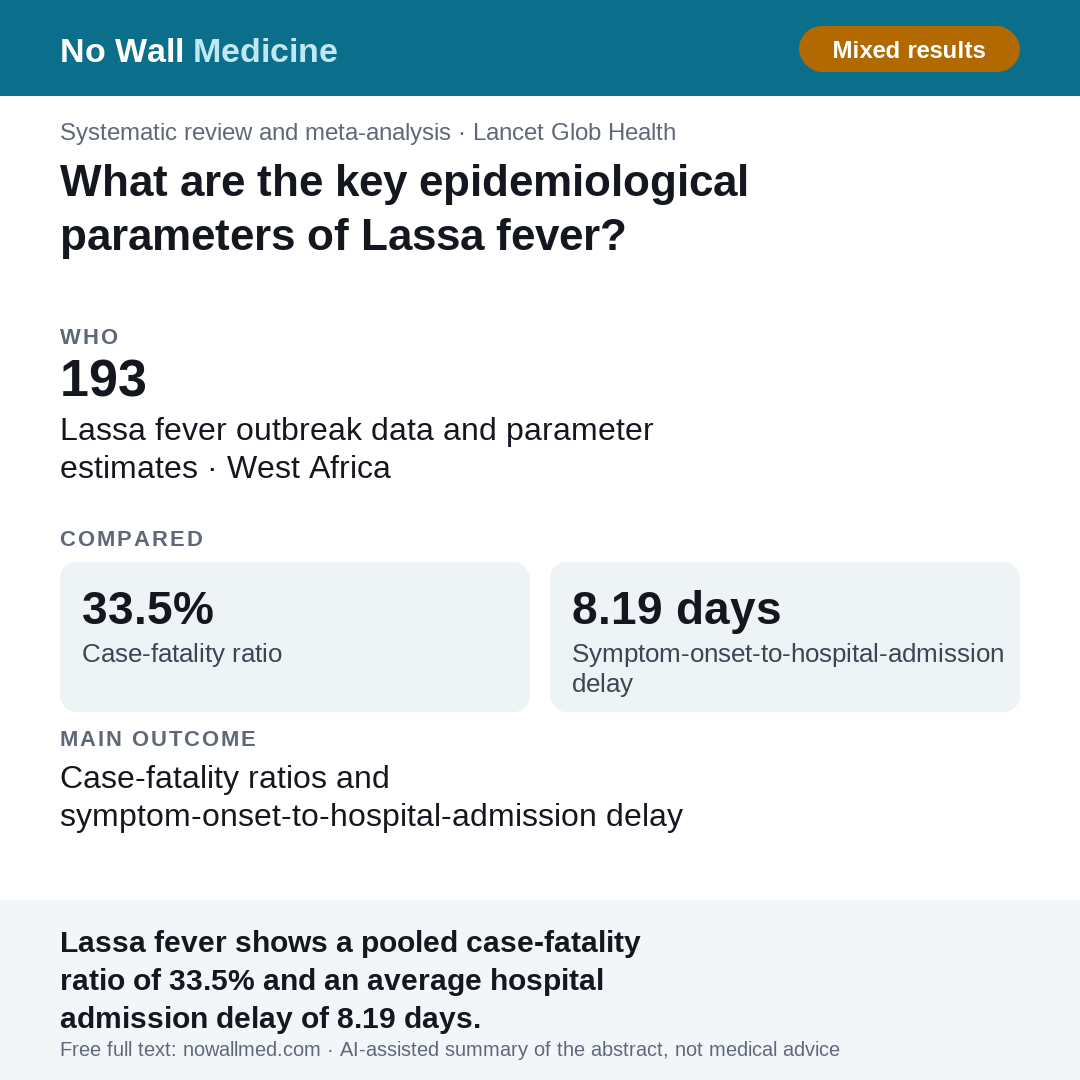
33.5%Case-fatality ratio
8.19 daysSymptom-onset-to-hospital-admission delay
Main outcome
Case-fatality ratios and symptom-onset-to-hospital-admission delay
Result: CFR 33.5% (95% CI 25.8-42.2); delay 8.19 days (95% CI 7.31-9.06)
Bottom line: Lassa fever shows a pooled case-fatality ratio of 33.5% and an average hospital admission delay of 8.19 days.
Funded by: UK Medical Research Council, NIHR, Academy of Medical Sciences, and others
Lancet Glob Health · 2024-11-23Download image
Clinical question: What are the key epidemiological parameters of Lassa fever?
Why it matters: Key epidemiological parameters and transmission dynamics for Lassa fever are poorly characterized in existing literature despite its high burden in West Africa.
Key points
- Researchers analyzed 193 publications containing 440 parameter estimates regarding Lassa fever outbreaks and transmission.
- The pooled case-fatality ratio, which is the proportion of deaths among confirmed cases, was 33.5% (95% CI 25.8-42.2).
- The average delay from the start of symptoms to hospital admission was 8.19 days (95% CI 7.31-9.06).
Headline and key points written with AI from the paper’s abstract, with every number checked against it. Read the paper before relying on them.
Abstract
Background
Understanding the epidemiological parameters and transmission dynamics of Lassa fever, a significant public health threat in west Africa caused by the rodent-borne Lassa virus, is crucial for informing evidence-based interventions and outbreak response strategies. Therefore, our study aimed to collate and enhance understanding of the key epidemiological parameters of Lassa fever. Methods
We conducted a systematic review, searching PubMed and Web of Science for peer-reviewed studies published from database inception up to June 13, 2024, to compile and analyse key epidemiological parameters, mathematical models, and outbreaks of Lassa fever. English-language, peer-reviewed, original research articles were included if they reported on Lassa fever outbreak sizes, transmission models, viral evolution, transmission, natural history, severity, seroprevalence, or risk factors. Non-peer-reviewed literature was excluded. Data were extracted by two independent individuals from published literature, focusing on seroprevalence, transmissibility, epidemiological delays, and disease severity. We performed a meta-analysis to calculate pooled estimates of case-fatality ratios (CFRs) and the delay from symptom onset to hospital admission. This study is registered with PROSPERO (identifier number CRD42023393345). Findings
The database search returned 5614 potentially relevant studies, and a further 16 studies were identified from backward citation chaining. After de-duplication and exclusion, 193 publications met our inclusion criteria and provided 440 relevant parameter estimates in total. Although Lassa virus is endemic in west Africa, the spatiotemporal coverage of general-population seroprevalence estimates (ranging from 2·6% [6/232] to 58·2% [103/177]) was poor, highlighting the spatial uncertainty in Lassa fever risk. Similarly, only four basic reproduction number estimates (ranging from 1·13 to 1·40) were available. We estimated a pooled total random effect CFR of 33·5% (95% CI 25·8-42·2, I2=95%) and found potential variation in severity by geographical regions typically associated with specific Lassa virus lineages. We estimated a pooled total random effect mean symptom-onset-to-hospital-admission delay of 8·19 days (95% CI 7·31-9·06, I2=93%), but other epidemiological delays were poorly characterised in the existing literature. Interpretation
Our findings highlight the absence of empirical Lassa fever parameter estimates despite its high burden in west Africa. Improved surveillance approaches to capture mild cases in humans and to further cover rodent populations are needed to better understand Lassa fever transmission dynamics. Addressing these gaps is essential for developing accurate mathematical models and informing evidence-based interventions to mitigate the effect of Lassa fever on public health in endemic regions. Funding
UK Medical Research Council, National Institute for Health and Care Research, Academy of Medical Sciences, Wellcome, UK Department for Business, Energy, and Industrial Strategy, British Heart Foundation, Diabetes UK, Schmidt Foundation, Community Jameel, Royal Society, and Imperial College London. Translation
For the French translation of the abstract see Supplementary Materials section.
Abstract reproduced under the article’s CC BY licence.
Topics
Cite this article
Doohan P, Jorgensen D, Naidoo TM, McCain K, Hicks JT, McCabe R. Lassa fever outbreaks, mathematical models, and disease parameters: a systematic review and meta-analysis. Lancet Glob Health. 2024. doi:10.1016/S2214-109X(24)00379-6
Spotted a mistake? Suggest a correction