Late gadolinium-enhanced cardiovascular magnetic resonance for predicting left ventricular reverse remodeling in dilated cardiomyopathy: A comprehensive review and meta-analysis
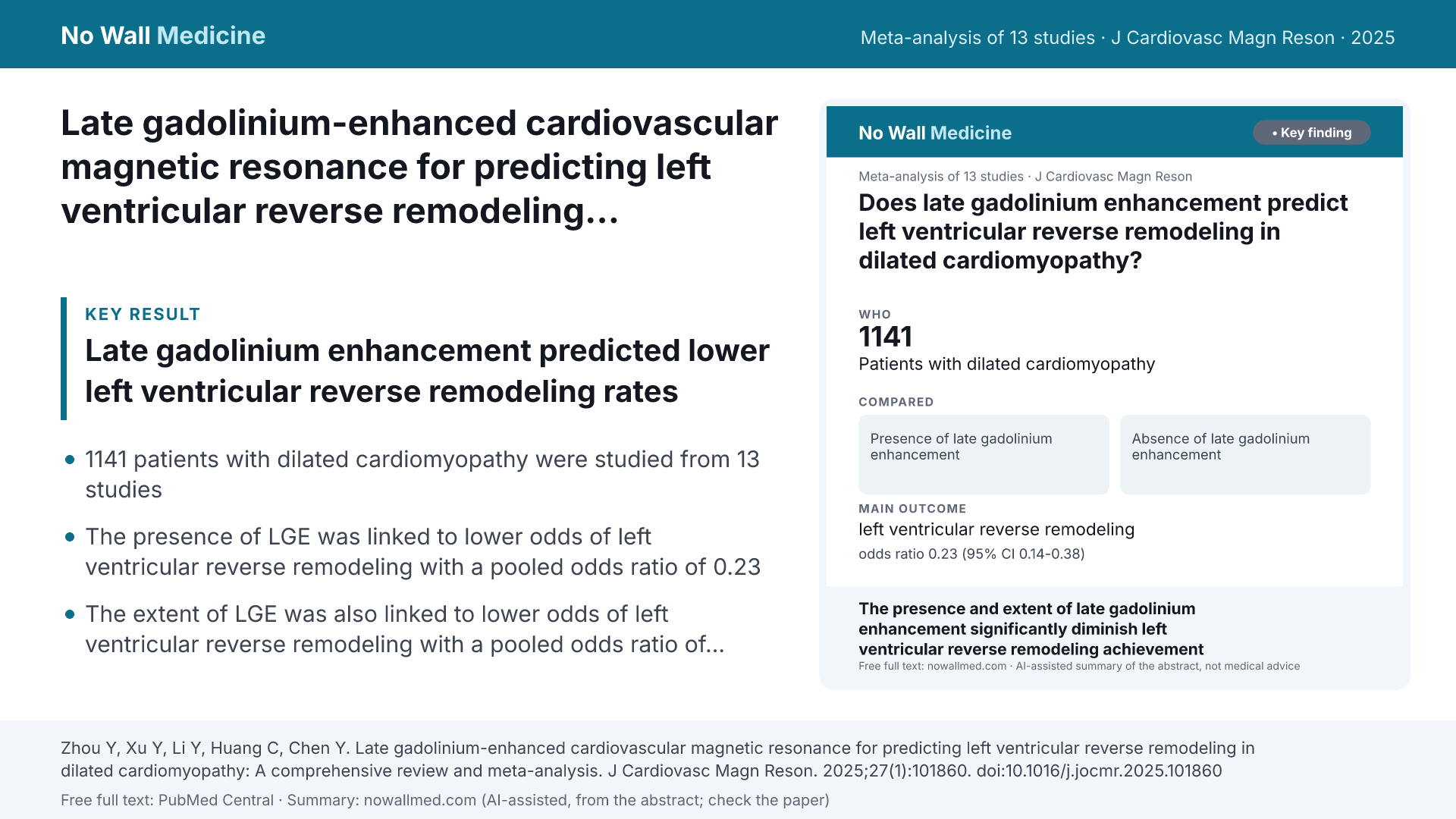
Key result: Late gadolinium enhancement predicted lower left ventricular reverse remodeling rates
Meta-analysis of 13 studiesKey finding
Does late gadolinium enhancement predict left ventricular reverse remodeling in dilated cardiomyopathy?
Who
1141
Patients with dilated cardiomyopathy
Compared
Presence of late gadolinium enhancement
Absence of late gadolinium enhancement
Main outcome
left ventricular reverse remodeling
Result: odds ratio 0.23 (95% CI 0.14-0.38)
Bottom line: The presence and extent of late gadolinium enhancement significantly diminish left ventricular reverse remodeling achievement in dilated cardiomyopathy patients.
J Cardiovasc Magn Reson · 2025-02-13
Key points
- 1141 patients with dilated cardiomyopathy were studied from 13 studies.
- The presence of LGE was linked to lower odds of left ventricular reverse remodeling with a pooled odds ratio of 0.23.
- The extent of LGE was also linked to lower odds of left ventricular reverse remodeling with a pooled odds ratio of 0.94 per percent increase.
Limitation the authors note: The study had significant heterogeneity among studies with an I2 of 68% for the presence of LGE
Discussion prompts
- Would these patients look like yours? Who was left out?
- Is the main outcome one that matters to patients?
- Is the difference large enough to change what you do?
Cite: Zhou Y, Xu Y, Li Y, Huang C, Chen Y. Late gadolinium-enhanced cardiovascular magnetic resonance for predicting left ventricular reverse remodeling in dilated cardiomyopathy: A comprehensive review and meta-analysis. J Cardiovasc Magn Reson. 2025;27(1):101860. doi:10.1016/j.jocmr.2025.101860
Free full text: PubMed Central · Summary and visual abstract: nowallmed.com/a/late-gadolinium-enhanced-cardiovascular-magnetic-resonance-for-w0gr67/ (AI-assisted from the abstract; check the paper before relying on it).