Telephone-based behavioral activation and mindfulness reduced loneliness in low-income older adults
Layperson-Delivered Telephone-Based Behavioral Activation Among Low-Income Older Adults During the COVID-19 Pandemic: The HEAL-HOA Randomized Clinical Trial
Assessor-blinded, 3-arm randomized clinical trialBenefit found
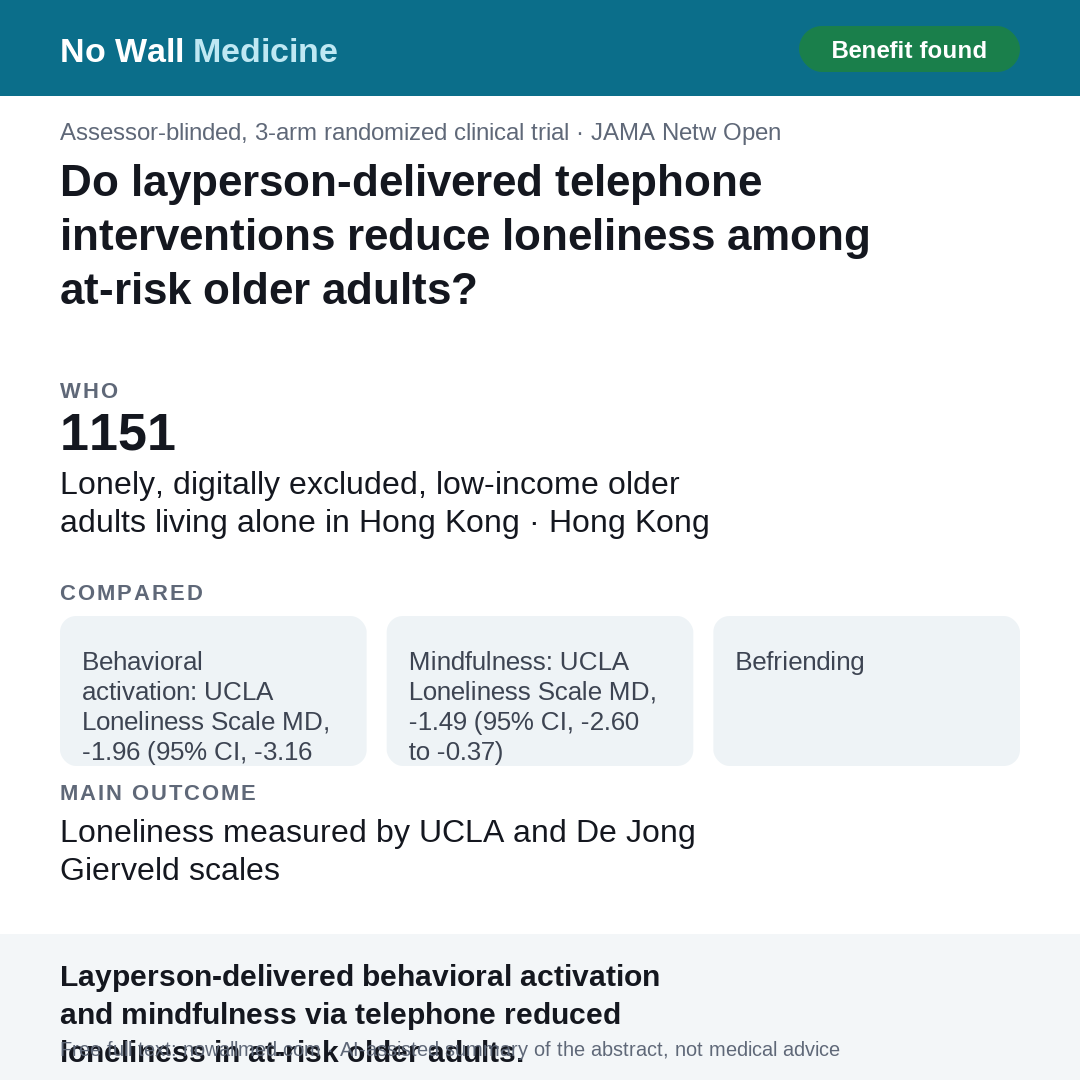
Do layperson-delivered telephone interventions reduce loneliness among at-risk older adults?
Who
1151
Lonely, digitally excluded, low-income older adults living alone in Hong Kong · Hong Kong
Compared
Behavioral activation: UCLA Loneliness Scale MD, -1.96 (95% CI, -3.16 to -0.77)
Mindfulness: UCLA Loneliness Scale MD, -1.49 (95% CI, -2.60 to -0.37)
Befriending
Main outcome
Loneliness measured by UCLA and De Jong Gierveld scales
Result: UCLA Loneliness Scale MD, -1.96 (95% CI, -3.16 to -0.77) for behavioral activation
Bottom line: Layperson-delivered behavioral activation and mindfulness via telephone reduced loneliness in at-risk older adults.
JAMA Netw Open · 2024-06-03Download image
Clinical question: Do layperson-delivered telephone interventions reduce loneliness among at-risk older adults?
Why it matters: Scalable interventions to address loneliness and mental health challenges in older adults are lacking, especially during disasters like pandemics.
Key points
- The trial randomized 1151 older adults in Hong Kong to behavioral activation, mindfulness, or telephone-based befriending interventions.
- At 3 months, behavioral activation and mindfulness groups showed lower UCLA Loneliness Scale scores compared to befriending.
- The mindfulness group also showed lower De Jong Gierveld Loneliness Scale scores compared to befriending at 3 months.
Headline and key points written with AI from the paper’s abstract, with every number checked against it. Read the paper before relying on them.
Was this summary helpful?
Subject terms
Cite this article
Kwok JYY, Jiang D, Yeung DY, Choi NG, Ho RTH, Warner LM. Layperson-Delivered Telephone-Based Behavioral Activation Among Low-Income Older Adults During the COVID-19 Pandemic: The HEAL-HOA Randomized Clinical Trial. JAMA Netw Open. 2024. doi:10.1001/jamanetworkopen.2024.16767
Spotted a mistake? Suggest a correction
Top studies every Monday
The week’s key trials and guidelines in your specialties, plus any topics you follow. By email, free.
Get the weekly digest