Higher bone lead levels are associated with increased risk of cardiovascular disease mortality
Lead-Attributable Cardiovascular Disease Burden: Global Burden of Disease Study 2023
Analysis of NHANES data and meta-regressionHarm found
What is the association between bone lead levels and cardiovascular disease mortality?
Who
42028
42,028 adults aged 18 to 90 years · United States and global estimates
Compared
Preindustrial bone lead (0.027 μg/g)
Bone lead 5 μg/g: 7.5% (95% uncertainty interval, 1.7%-14.1%) greater risk
Bone lead 10 μg/g: 15.8% (95% UI, 12.7%-19.1%) greater risk
Bone lead 25 μg/g: 41.3% (95% UI, 34.2%-49.2%) greater risk
Main outcome
Cardiovascular disease mortality
Bottom line: Higher cumulative bone lead levels are associated with increased cardiovascular disease mortality risk globally.
JAMA · 2026-03-30Download image
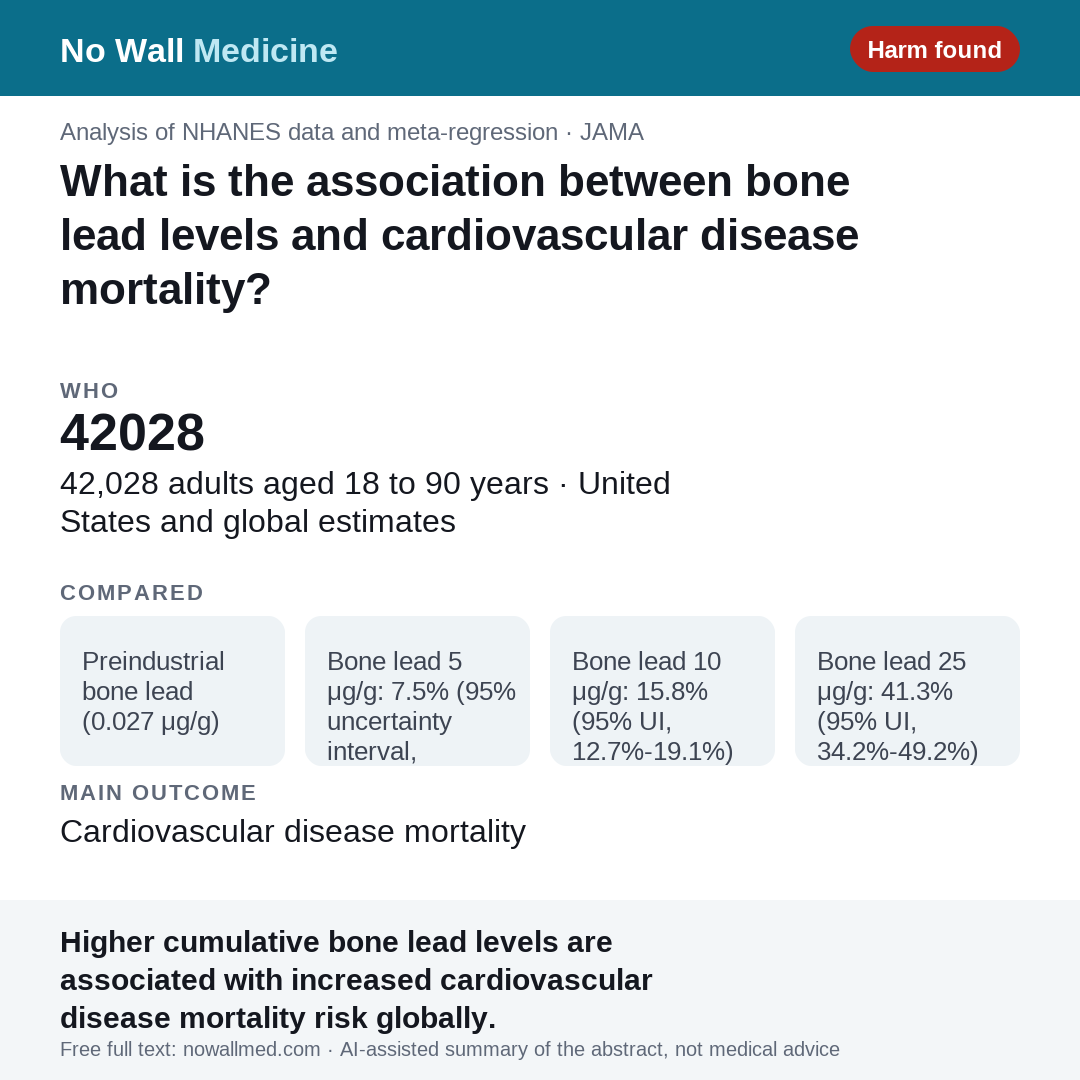
Clinical question: What is the association between bone lead levels and cardiovascular disease mortality?
Why it matters: Quantifying the direct effects of cumulative bone lead exposure on cardiovascular disease is essential to guide prevention and policy.
Key points
- Researchers analyzed 42,028 adults from the US National Health and Nutrition Examination Survey and combined findings with a systematic review and meta-regression.
- Compared to preindustrial levels, bone lead levels of 100 μg/g corresponded to an 87.9% greater risk of cardiovascular disease mortality.
- In 2023, lead exposure was linked to 3.5 million deaths and 71.6 million disability-adjusted life-years, which is a measure of overall disease burden.
Headline and key points written with AI from the paper’s abstract, with every number checked against it. Read the paper before relying on them.
Topics
Cite this article
GBD 2023 Lead Collaborators, Stanaway JD, Spearman S, DeCleene NK, Garcia V, Lara-Castor L. Lead-Attributable Cardiovascular Disease Burden: Global Burden of Disease Study 2023. JAMA. 2026. doi:10.1001/jama.2026.2197
Spotted a mistake? Suggest a correction