Supportive leadership and high-quality relationships are linked to better staff retention in long-term care
Leadership, Resources, and Workforce Stability in Long-Term Care: A Systematic Review
Systematic review with narrative synthesisBenefit found
How does frontline leadership influence staff turnover and retention in long-term care?
Who
14
Staff in long-term care settings · Nursing homes, residential care, and aged care facilities
Compared
Supportive leadership: more favorable retention-related outcomes
Higher job demands: less favorable outcomes
Main outcome
Staff turnover and retention
Bottom line: Leadership factors influence workforce stability through organizational, psychological, and relational pathways in long-term care.
J Am Med Dir Assoc · 2026-09-22Download image
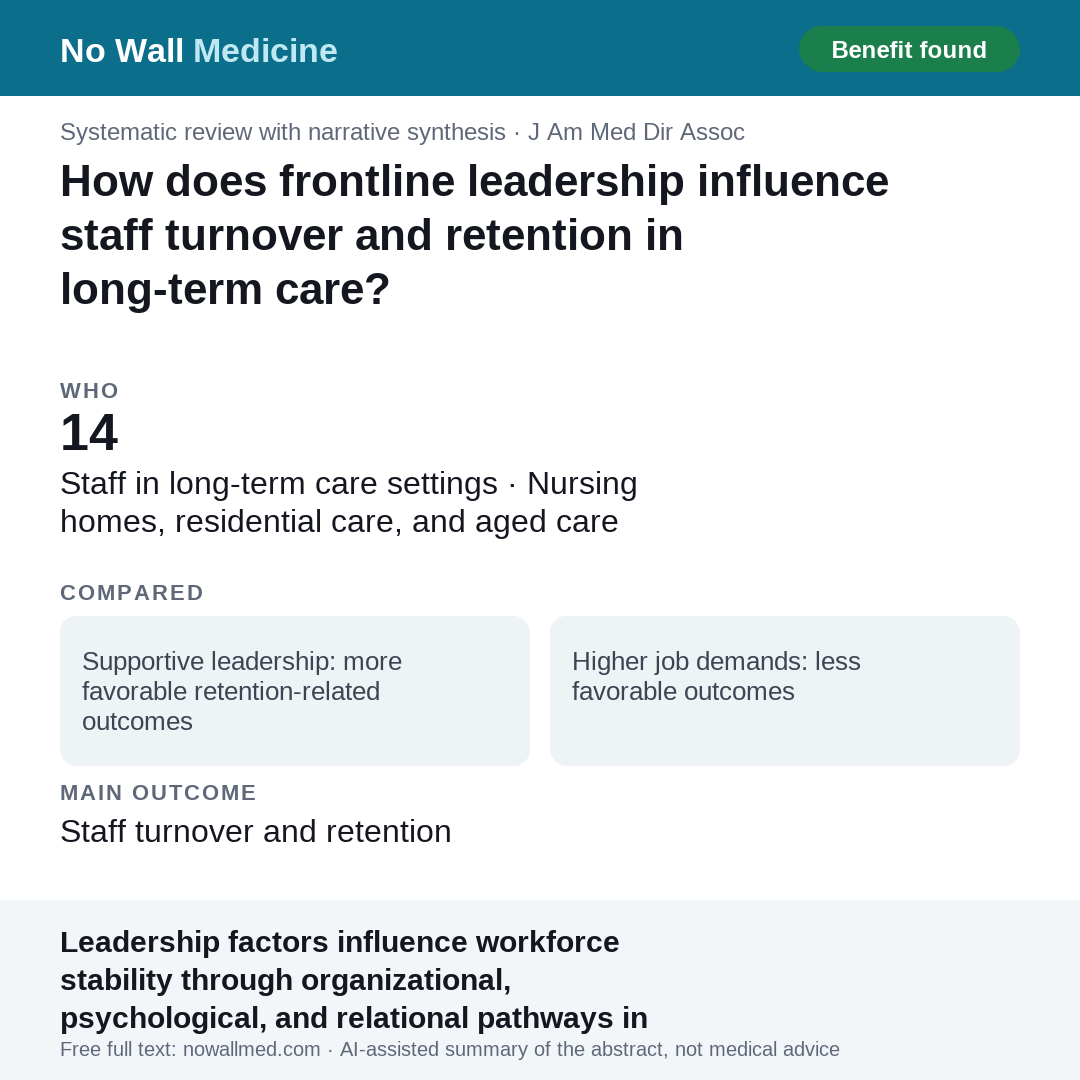
Clinical question: How does frontline leadership influence staff turnover and retention in long-term care?
Why it matters: There is a need to understand how frontline leadership and managerial functions influence staff turnover and retention in long-term care settings.
Key points
- Researchers reviewed 14 studies conducted in nursing homes, residential care, and aged care facilities to examine how leadership affects staff turnover.
- Supportive supervision and strong leader-staff relationships were associated with better retention, while high workloads and administrative burdens were linked to less favorable outcomes.
- The findings suggest leadership influences workforce stability through organizational, psychological, and relational pathways.
Headline and key points written with AI from the paper’s abstract, with every number checked against it. Read the paper before relying on them.
Cite this article
Yamamoto M. Leadership, Resources, and Workforce Stability in Long-Term Care: A Systematic Review. J Am Med Dir Assoc. 2026. doi:10.1016/j.jamda.2026.106503
Spotted a mistake? Suggest a correction