New distributed algorithms provide accurate risk factor analysis for long COVID in children
Learning competing risks across multiple hospitals: one-shot distributed algorithms
Simulation study and application to electronic health record dataBenefit found
How accurate are one-shot distributed algorithms for competing risk models using multi-hospital data?
Who
6
Pediatric patients from eight national children's hospitals · Eight national children's hospitals
Compared
One-shot distributed algorithms: 0.2% relative bias
Meta-analysis estimator: 40% relative bias
Main outcome
Relative bias in estimating risk factors for post-acute sequelae of SARS-COV-2
Bottom line: One-shot distributed algorithms provide highly accurate risk factor estimation compared to meta-analysis in multi-hospital settings.
J Am Med Inform Assoc · 2024-03-08Download image
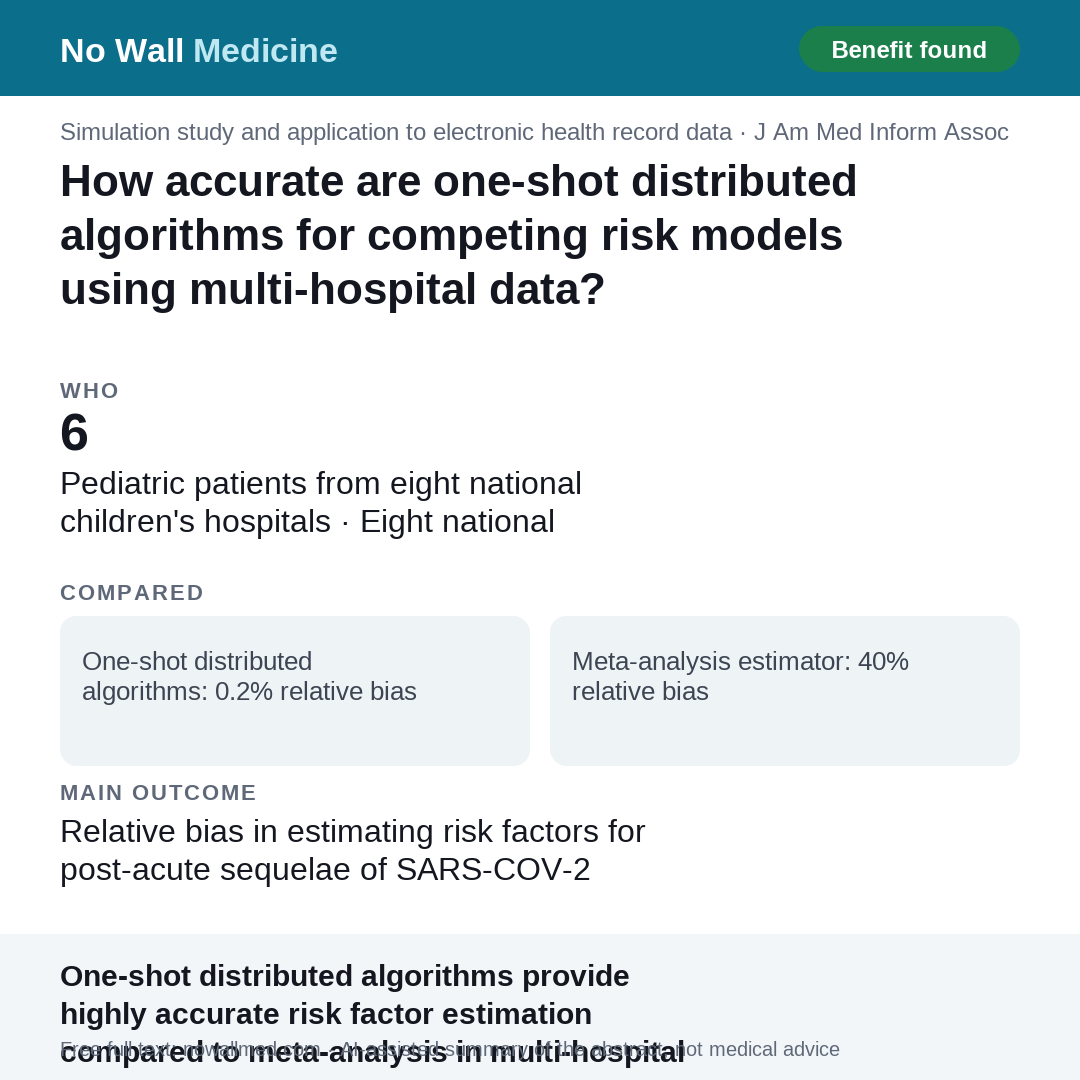
Clinical question: How accurate are one-shot distributed algorithms for competing risk models using multi-hospital data?
Why it matters: Standard meta-analysis methods may fail to accurately identify risk factors for rare clinical conditions like post-acute sequelae of SARS-CoV-2 in pediatric populations.
Key points
- Researchers tested two new distributed algorithms using electronic health record data from eight national children's hospitals covering over 6.5 million pediatric patients.
- The new algorithms showed a relative bias of ~0.2% compared to ~40% for meta-analysis when a clinical condition occurred in ~0.5% of cases.
- The algorithms identified risk factors like age, gender, obesity, and chronic condition history that meta-analysis failed to detect when compared to pooled data.
Headline and key points written with AI from the paper’s abstract, with every number checked against it. Read the paper before relying on them.
Topics
Cite this article
Zhang D, Tong J, Jing N, Yang Y, Luo C, Lu Y. Learning competing risks across multiple hospitals: one-shot distributed algorithms. J Am Med Inform Assoc. 2024. doi:10.1093/jamia/ocae027
Spotted a mistake? Suggest a correction
Top studies every Monday
The week’s key trials and guidelines in your specialties, plus any topics you follow. By email, free.
Get the weekly digest