Number of procedures needed to master pancreatic surgery varies by surgical approach and procedure type
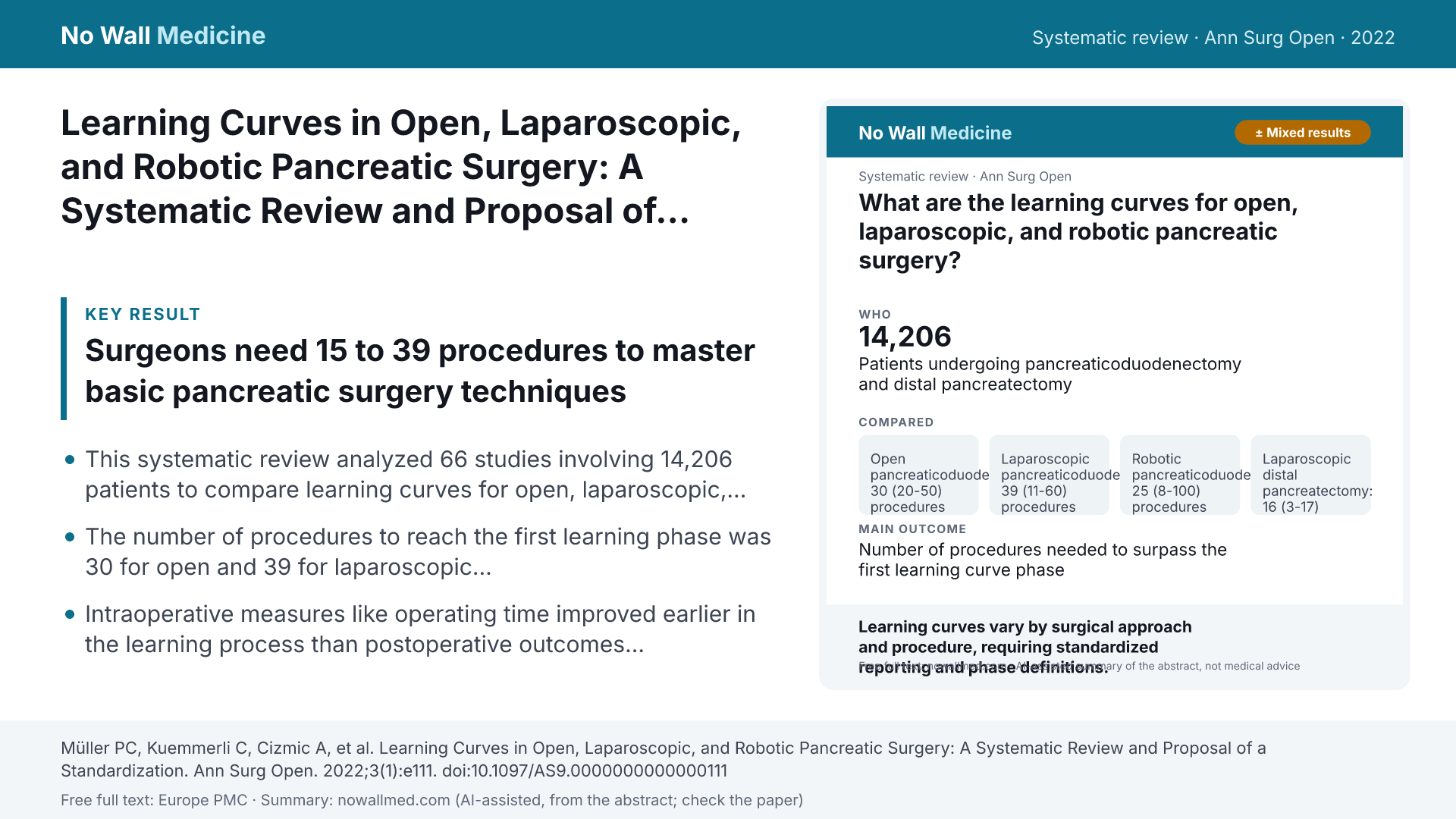
Learning Curves in Open, Laparoscopic, and Robotic Pancreatic Surgery: A Systematic Review and Proposal of a Standardization
Systematic reviewMixed results
What are the learning curves for open, laparoscopic, and robotic pancreatic surgery?
Who
14,206
Patients undergoing pancreaticoduodenectomy and distal pancreatectomy
Compared
Open pancreaticoduodenectomy: 30 (20-50) procedures
Laparoscopic pancreaticoduodenectomy: 39 (11-60) procedures
Robotic pancreaticoduodenectomy: 25 (8-100) procedures
Laparoscopic distal pancreatectomy: 16 (3-17) procedures
Main outcome
Number of procedures needed to surpass the first learning curve phase
Bottom line: Learning curves vary by surgical approach and procedure, requiring standardized reporting and phase definitions.
Limitation: Definitions of learning curves vary and have not been standardized.
Ann Surg Open · 2022-01-27Download image
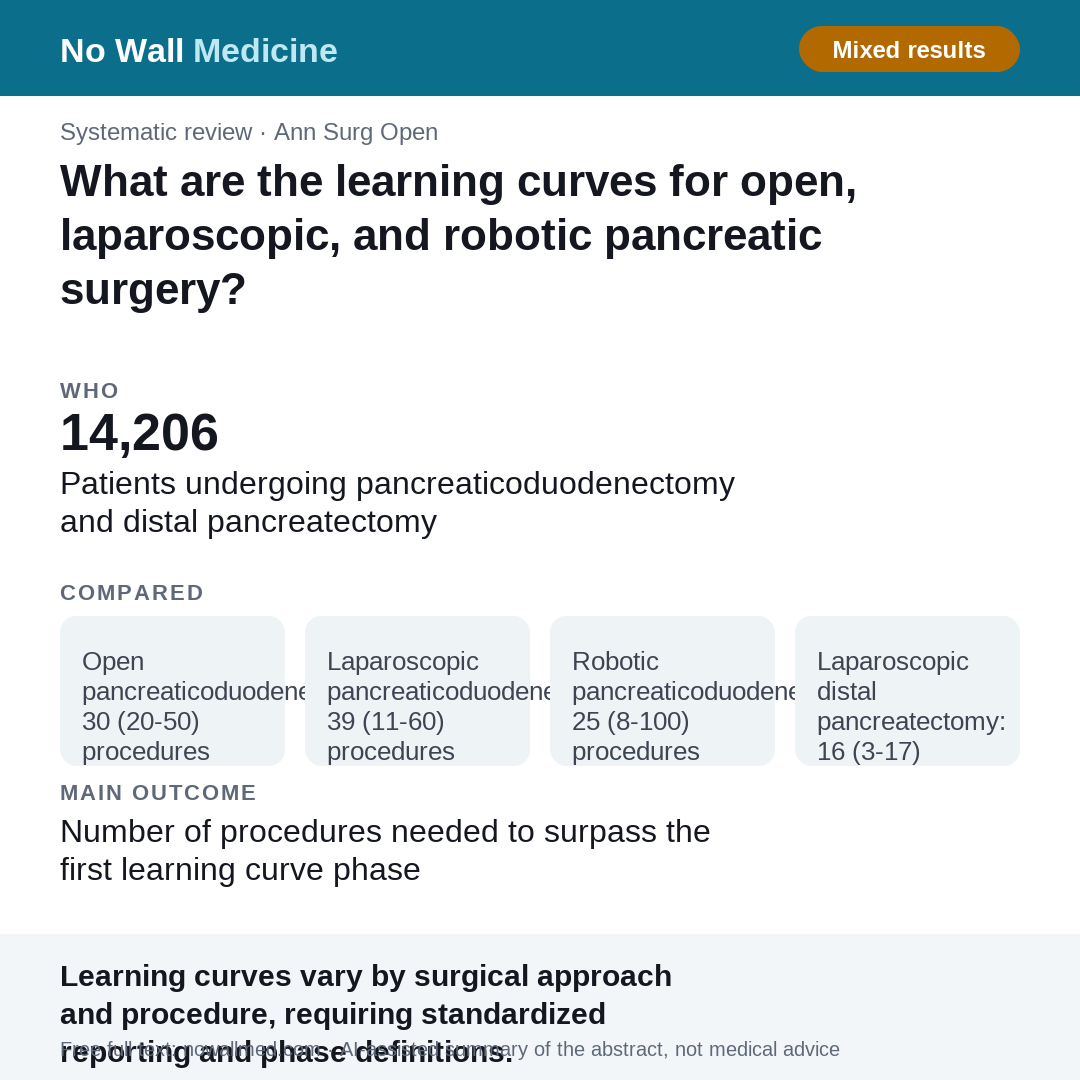
Clinical question: What are the learning curves for open, laparoscopic, and robotic pancreatic surgery?
Why it matters: Definitions of learning curves for pancreatic surgery vary and have not been standardized across different surgical methods.
Key points
- Researchers analyzed 66 studies involving 14,206 patients to determine how many surgeries are required to reach proficiency in different pancreatic procedures.
- The median number of procedures to surpass the first learning phase was 30 (20-50) for open pancreatoduodenectomy, 39 (11-60) for laparoscopic pancreatoduodenectomy, and 25 (8-100) for robotic pancreatoduodenectomy.
- In a three-phase model, operating time decreased by 15% and blood loss decreased by 29% during the first to second phase, while complications decreased by 46% during the second to third phase.
Limitation the authors note: Studies with higher sample sizes showed higher numbers of procedures needed to overcome the learning curve.
Headline and key points written with AI from the paper’s abstract, with every number checked against it. Read the paper before relying on them.
Was this summary helpful?
Abstract
Objective
To depict and analyze learning curves for open, laparoscopic, and robotic pancreatoduodenectomy (PD) and distal pancreatectomy (DP).Background
Formal training is recommended for safe introduction of pancreatic surgery but definitions of learning curves vary and have not been standardized.Methods
A systematic search on PubMed, Web of Science, and CENTRAL databases identified studies on learning curves in pancreatic surgery. Primary outcome was the number needed to reach the learning curve as defined by the included studies. Secondary outcomes included endpoints defining learning curves, methods of analysis (statistical/arbitrary), and classification of learning phases.Results
Out of 1115 articles, 66 studies with 14,206 patients were included. Thirty-five studies (53%) based the learning curve analysis on statistical calculations. Most often used parameters to define learning curves were operative time (n = 51), blood loss (n = 17), and complications (n = 10). The number of procedures to surpass a first phase of learning curve was 30 (20-50) for open PD, 39 (11-60) for laparoscopic PD, 25 (8-100) for robotic PD (P = 0.521), 16 (3-17) for laparoscopic DP, and 15 (5-37) for robotic DP (P = 0.914). In a three-phase model, intraoperative parameters improved earlier (first to second phase: operating time -15%, blood loss -29%) whereas postoperative parameters improved later (second to third phase: complications -46%, postoperative pancreatic fistula -48%). Studies with higher sample sizes showed higher numbers of procedures needed to overcome the learning curve (rho = 0.64, P Conclusions
This study summarizes learning curves for open-, laparoscopic-, and robotic pancreatic surgery with different definitions, analysis methods, and confounding factors. A standardized reporting of learning curves and definition of phases (competency, proficiency, mastery) is desirable and proposed.
Abstract reproduced under the article’s CC BY-NC-ND licence.
Cite this article
Müller PC, Kuemmerli C, Cizmic A, et al. Learning Curves in Open, Laparoscopic, and Robotic Pancreatic Surgery: A Systematic Review and Proposal of a Standardization. Ann Surg Open. 2022. doi:10.1097/AS9.0000000000000111
Spotted a mistake? Suggest a correction