Different robotic thyroid surgery approaches require different numbers of cases to reach surgical proficiency
Learning Curves in Robotic Thyroid Surgery: A Systematic Review Comparing Transoral, Axillary, and Facelift Approaches
Systematic reviewMixed results
What are the learning curves and required case volumes for different robotic thyroid surgery approaches?
Who
6438
Practitioners performing robotic thyroid surgery
Compared
Axillary robotic partial thyroidectomy: 46 cases (range: 20-66)
Axillary robotic total thyroidectomy: 34 cases (range: 20-50)
Transoral robotic approach: 31 (15-55) cases
Facelift approach: 32 (15-50) cases
Main outcome
Number of cases required for achieving proficiency
Bottom line: Facelift and transoral approaches may have faster learning curves than axillary approaches for robotic thyroid surgery.
Limitation: Substantial heterogeneity across studies for inclusion criteria, surgeon experience, and surgical outcomes.
J Otolaryngol Head Neck Surg · 2026-02-25Download image
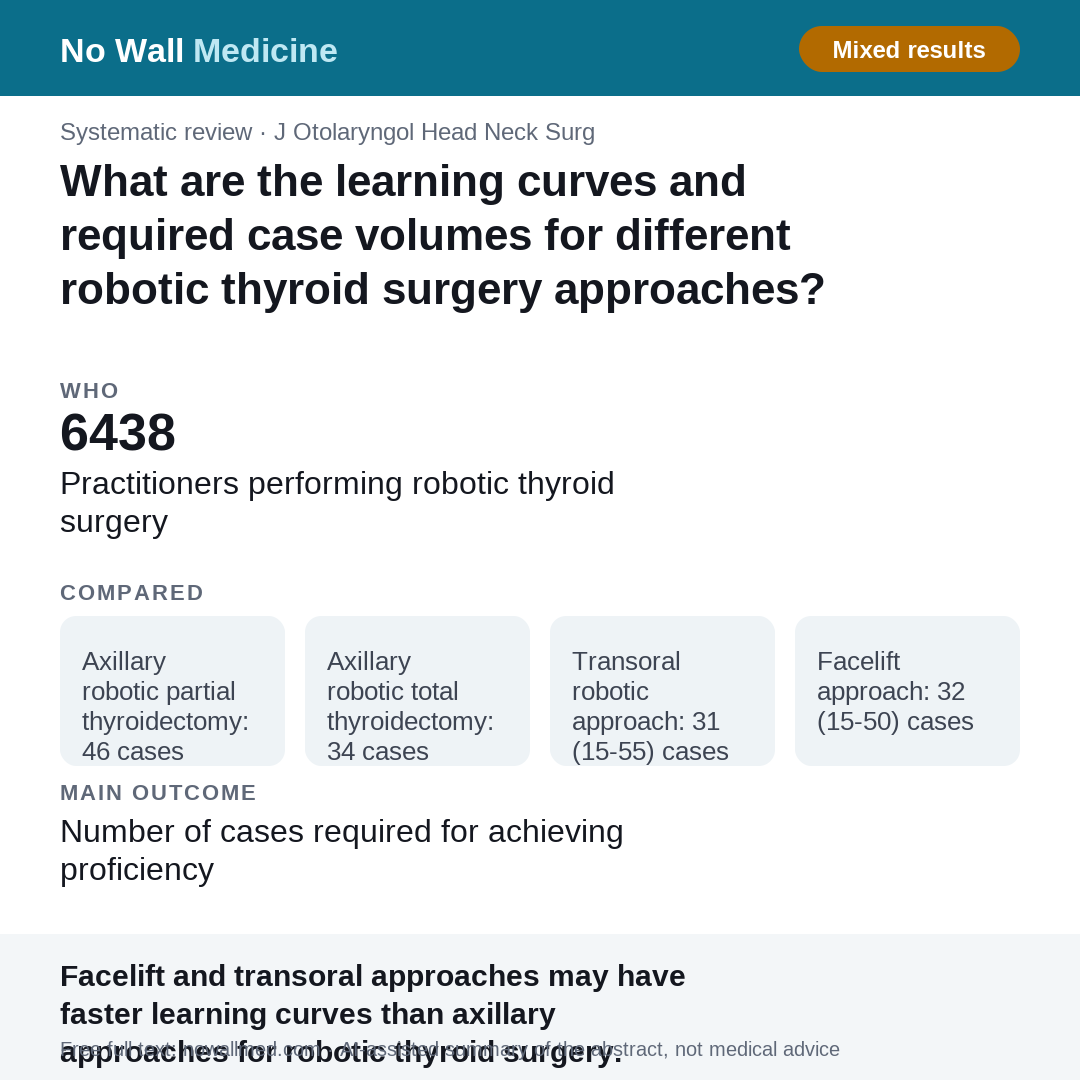
Clinical question: What are the learning curves and required case volumes for different robotic thyroid surgery approaches?
Why it matters: The number of cases needed to reach proficiency in robotic thyroid surgery is not fully characterized across different surgical approaches.
Key points
- Researchers reviewed 34 studies involving 6438 patients to compare learning curves for different robotic thyroid surgery methods.
- Proficiency required a mean of 46 cases for axillary partial thyroidectomy, 34 for axillary total thyroidectomy, 31 for transoral, and 32 for facelift approaches.
- Complication rates during the learning process were 16.7% for axillary, 11.1% for transoral, and 16.2% for facelift approaches.
Limitation the authors note: There was substantial heterogeneity across studies for inclusion criteria, surgeon experience, and surgical outcomes.
Headline and key points written with AI from the paper’s abstract, with every number checked against it. Read the paper before relying on them.
Topics
Cite this article
Lechien JR. Learning Curves in Robotic Thyroid Surgery: A Systematic Review Comparing Transoral, Axillary, and Facelift Approaches. J Otolaryngol Head Neck Surg. 2026. doi:10.1177/19160216261421877
Spotted a mistake? Suggest a correction