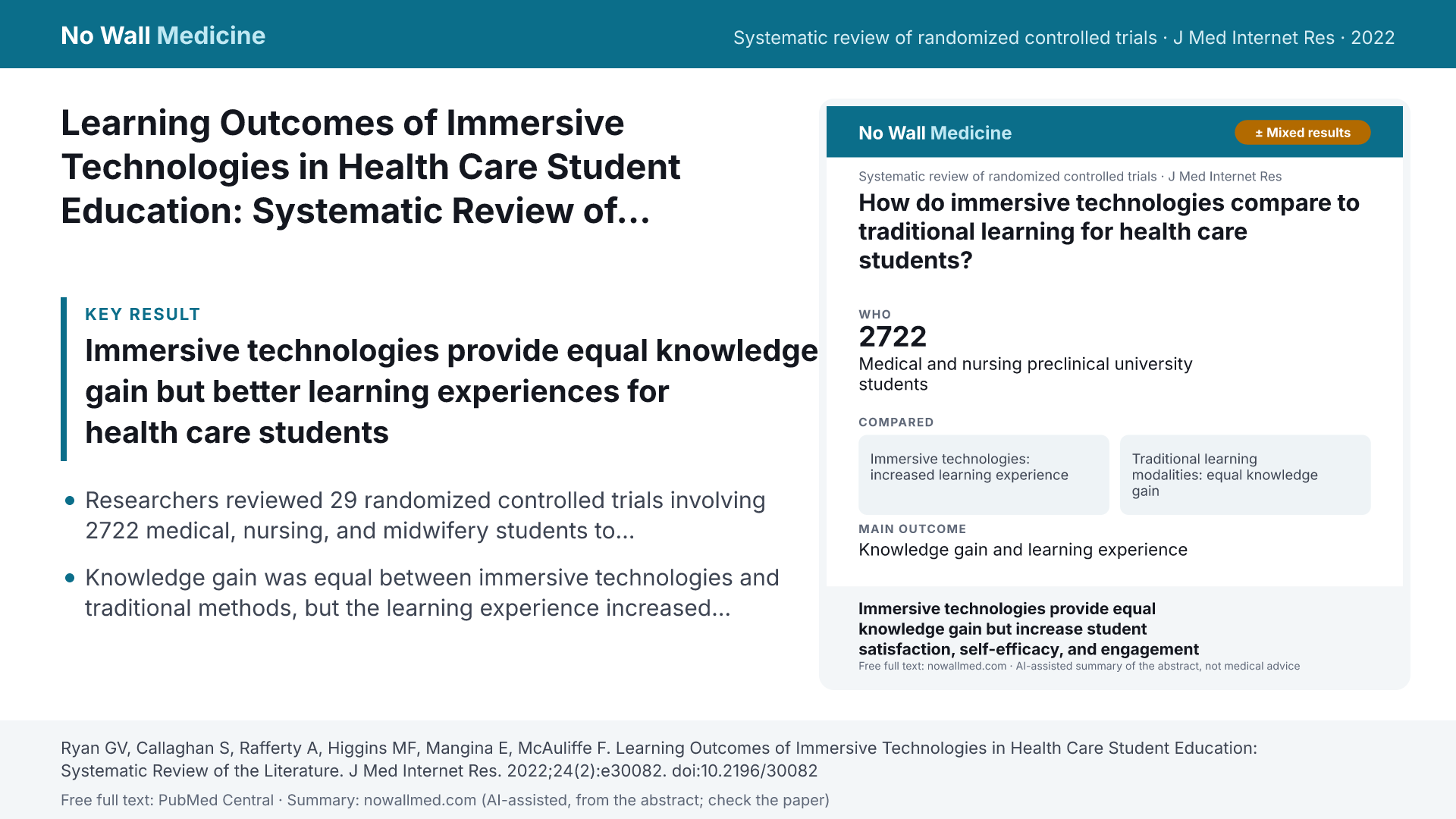
Immersive technologies provide equal knowledge gain but better learning experiences for health care students
Learning Outcomes of Immersive Technologies in Health Care Student Education: Systematic Review of the Literature
Systematic review of randomized controlled trialsMixed results
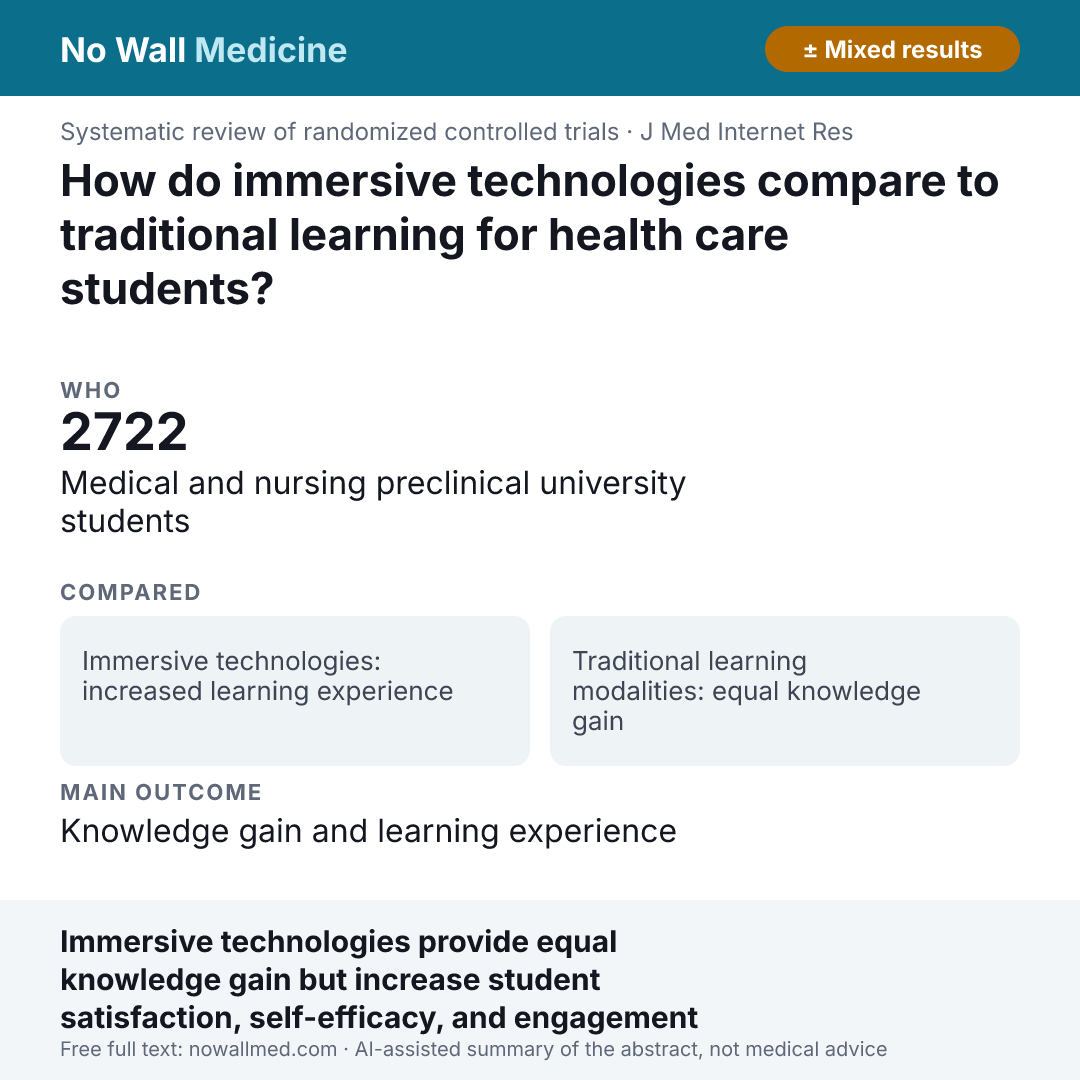
How do immersive technologies compare to traditional learning for health care students?
Who
2722
Medical and nursing preclinical university students
Compared
Immersive technologies: increased learning experience
Traditional learning modalities: equal knowledge gain
Main outcome
Knowledge gain and learning experience
Bottom line: Immersive technologies provide equal knowledge gain but increase student satisfaction, self-efficacy, and engagement compared to traditional methods.
Limitation: There were no studies involving midwifery students.
J Med Internet Res · 2022-02-01 · Save PNG
Clinical question: How do immersive technologies compare to traditional learning for health care students?
Key points
- Researchers reviewed 29 randomized controlled trials involving 2722 medical, nursing, and midwifery students to compare immersive technologies with traditional teaching.
- Knowledge gain was equal between immersive technologies and traditional methods, but the learning experience increased when using immersive tools.
- Virtual reality was the most common technology used, appearing in 22 of the 29 studies.
Headline and key points written with AI from the paper’s abstract, with every number checked against it. Read the paper before relying on them.
Was this summary helpful?
Subject terms
Headline, design, result, key points, caveat and citation as plain text.
Cite this article
Ryan GV, Callaghan S, Rafferty A, Higgins MF, Mangina E, McAuliffe F. Learning Outcomes of Immersive Technologies in Health Care Student Education: Systematic Review of the Literature. J Med Internet Res. 2022;24(2):e30082. doi:10.2196/30082
Spotted a mistake? Suggest a correction