Empagliflozin reduces heart failure hospitalizations after heart attack regardless of heart function or congestion
Left Ventricular Function, Congestion, and Effect of Empagliflozin on Heart Failure Risk After Myocardial Infarction
Randomized trialBenefit found
Does empagliflozin reduce heart failure risk after acute myocardial infarction?
Who
6522
Patients with acute myocardial infarction within 14 days
Compared
Empagliflozin
Placebo
Main outcome
First and total heart failure hospitalizations
Result: first heart failure hospitalization hazard ratio 0.77 (95% CI 0.60-0.98), total heart failure hospitalization rate ratio 0.67 (95% CI 0.50-0.89)
Bottom line: Empagliflozin reduced first and total heart failure hospitalizations regardless of ejection fraction or congestion status after myocardial infarction.
JACC · 2024-04-06Download image
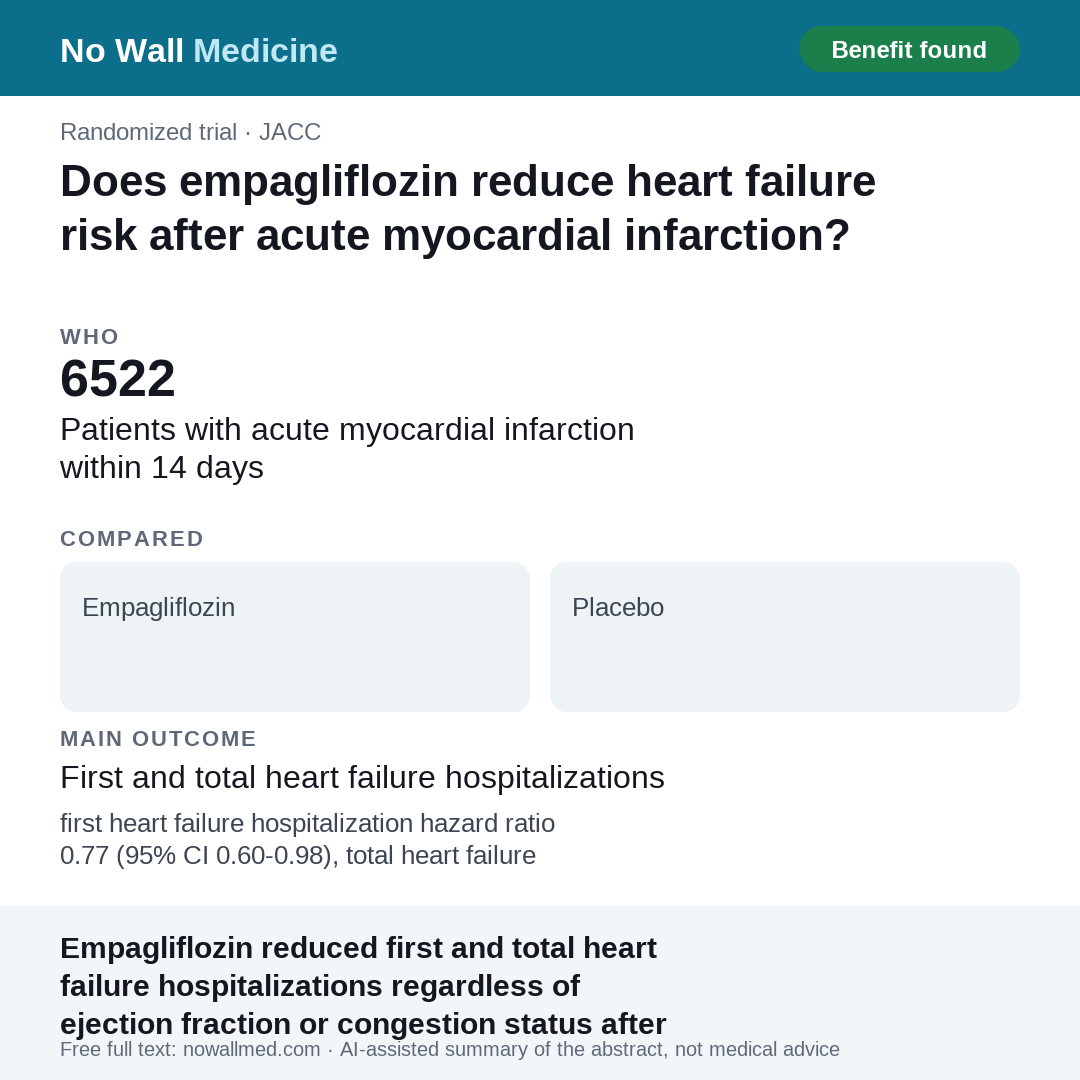
Clinical question: Does empagliflozin reduce heart failure risk after acute myocardial infarction?
Why it matters: It was unknown how left ventricular ejection fraction and congestion influence heart failure risks and the effectiveness of empagliflozin after a heart attack.
Key points
- Researchers studied 6,522 patients randomized within 14 days of a heart attack to receive either 10 mg of empagliflozin daily or a placebo.
- Empagliflozin reduced the risk for first heart failure hospitalizations (HR: 0.77) and total heart failure hospitalizations (RR: 0.67) regardless of heart pump function or congestion.
- Lower left ventricular ejection fraction, the percentage of blood pumped out of the heart, was associated with higher risks for death and heart failure hospitalizations.
Headline and key points written with AI from the paper’s abstract, with every number checked against it. Read the paper before relying on them.
Was this summary helpful?
Subject terms
Cite this article
Udell JA, Petrie MC, Jones WS, Anker SD, Harrington J, Mattheus M. Left Ventricular Function, Congestion, and Effect of Empagliflozin on Heart Failure Risk After Myocardial Infarction. JACC. 2024. doi:10.1016/j.jacc.2024.03.405
Spotted a mistake? Suggest a correction
Top studies every Monday
The week’s key trials and guidelines in your specialties, plus any topics you follow. By email, free.
Get the weekly digest