Changes in left ventricular volume were linked to survival in patients receiving medical therapy alone
Left ventricular volume change and long-term outcomes in ischaemic cardiomyopathy with or without surgical revascularisation: A post-hoc analysis of a randomised controlled trial
Post-hoc analysis of a randomized controlled trialMixed results
Does left ventricular volume change associate with long-term outcomes in ischaemic cardiomyopathy?
Who
523
Patients with ischaemic cardiomyopathy · 99 sites in 22 countries
Compared
Medical therapy alone: 22% lower risk of cardiovascular mortality (HR 0.78; 95% CI, 0.65-0.94)
Coronary artery bypass grafting plus medical therapy: not shown (cardiovascular mortality: HR 0.90; 95%CI, 0.74-1.10)
Main outcome
cardiovascular mortality or all-cause mortality
Result: HR 0.78 (95% CI, 0.65-0.94) for cardiovascular mortality in medical therapy
Bottom line: Left ventricular volume reduction predicts better survival in medical therapy alone but not after coronary artery bypass grafting.
Funded by: National Natural Science Foundation of China; Guangdong Province
eClinicalMedicine · 2022-08-27Download image
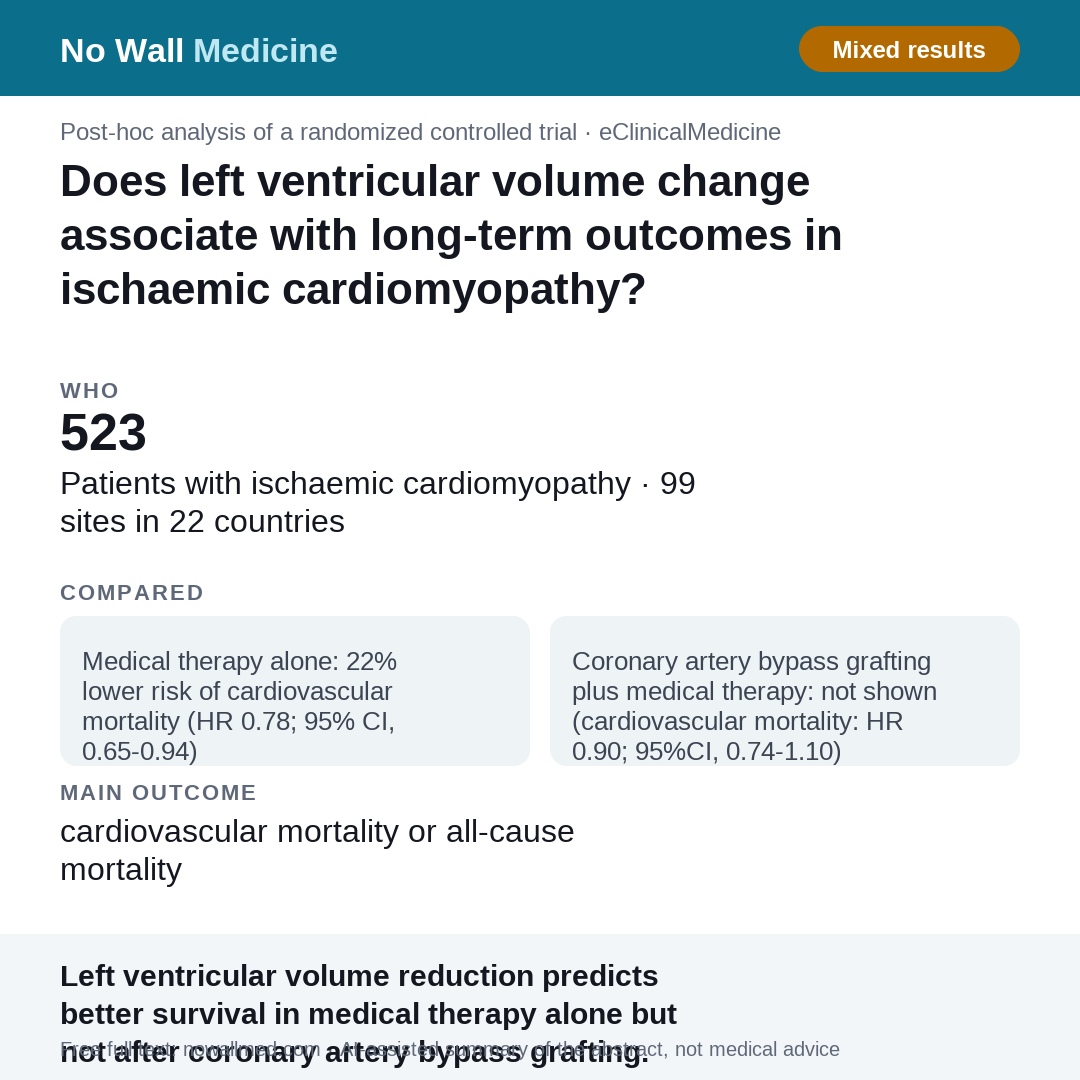
Clinical question: Does left ventricular volume change associate with long-term outcomes in ischaemic cardiomyopathy?
Why it matters: It was unclear if the link between changes in left ventricular volume and long-term outcomes is influenced by whether a patient undergoes heart bypass surgery.
Key points
- The analysis included 523 patients with ischaemic cardiomyopathy who were assigned to either medical therapy alone or heart bypass surgery plus medical therapy.
- In the medical therapy group, each 26% decrement in left ventricular end-systolic volume index was associated with a 22% lower risk of cardiovascular mortality and a 19% lower risk of all-cause mortality.
- This association between volume change and mortality was not shown in the group receiving heart bypass surgery plus medical therapy.
Headline and key points written with AI from the paper’s abstract, with every number checked against it. Read the paper before relying on them.
Was this summary helpful?
Cite this article
Zhou Z, Zhuang X, Liu M, Jian B, Fu G, Liao X. Left ventricular volume change and long-term outcomes in ischaemic cardiomyopathy with or without surgical revascularisation: A post-hoc analysis of a randomised controlled trial. eClinicalMedicine. 2022. doi:10.1016/j.eclinm.2022.101626
Spotted a mistake? Suggest a correction
Top studies every Monday
The week’s key trials and guidelines in your specialties, plus any topics you follow. By email, free.
Get the weekly digest