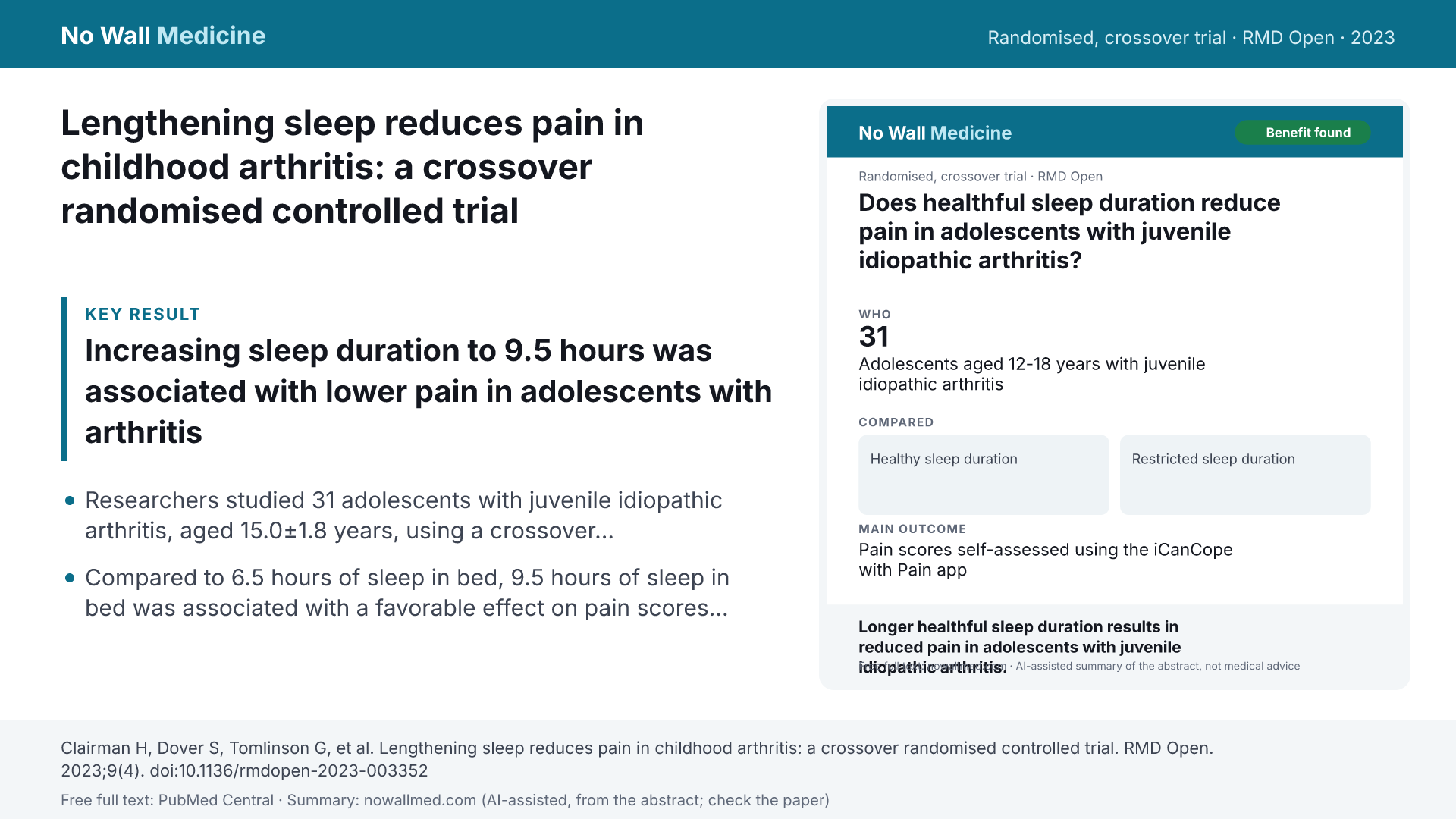
Increasing sleep duration to 9.5 hours was associated with lower pain in adolescents with arthritis
Lengthening sleep reduces pain in childhood arthritis: a crossover randomised controlled trial
Randomised, crossover trialBenefit found
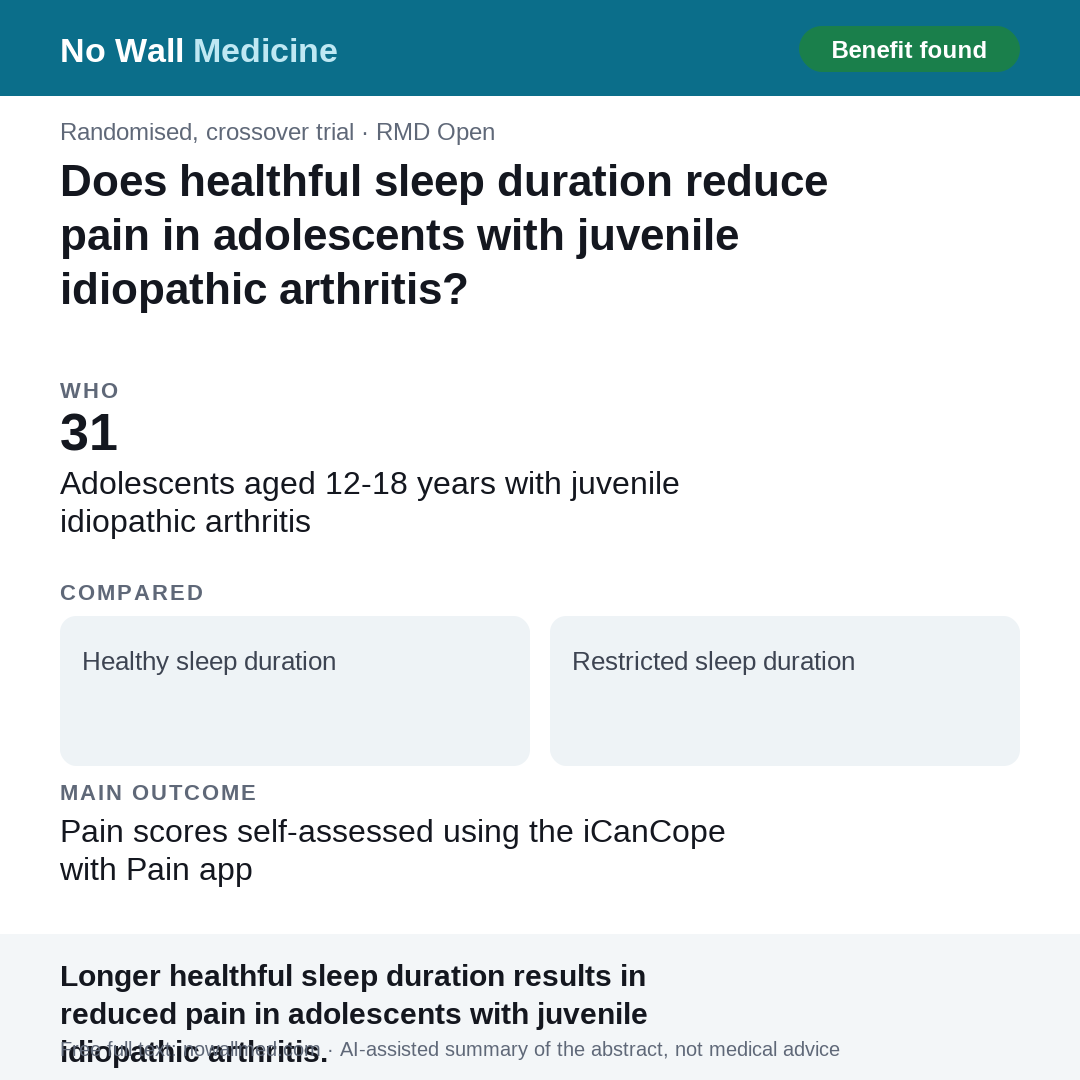
Does healthful sleep duration reduce pain in adolescents with juvenile idiopathic arthritis?
Who
31
Adolescents aged 12-18 years with juvenile idiopathic arthritis
Compared
Healthy sleep duration
Restricted sleep duration
Main outcome
Pain scores self-assessed using the iCanCope with Pain app
Result: odds ratio 0.61 (95% credible interval 0.39-0.95)
Bottom line: Longer healthful sleep duration results in reduced pain in adolescents with juvenile idiopathic arthritis.
RMD Open · 2023-11-02Download image
Clinical question: Does healthful sleep duration reduce pain in adolescents with juvenile idiopathic arthritis?
Key points
- Researchers studied 31 adolescents with juvenile idiopathic arthritis, aged 15.0±1.8 years, using a crossover trial comparing healthy sleep to restricted sleep.
- Compared to 6.5 hours of sleep in bed, 9.5 hours of sleep in bed was associated with a favorable effect on pain scores (OR 0.61, 95% CrI 0.39-0.95).
- Participants averaged 1.4 (95% CrI 1.2-1.6) more hours of sleep per night during the healthy sleep duration week relative to the restricted sleep week.
Headline and key points written with AI from the paper’s abstract, with every number checked against it. Read the paper before relying on them.
Was this summary helpful?
Abstract
Objectives
Juvenile idiopathic arthritis (JIA) is a common chronic childhood disease and chronic pain is a debilitating feature. A strong link has been shown between poor sleep and pain in JIA. However, the causal direction is unknown. This study's aim was to determine if, in adolescents with JIA, a recommended healthful sleep duration leads to reductions in pain when compared with the restricted sleep (RS) duration that is commonly seen. Methods
Patients with JIA (12-18 years old; pain score of ≥1 on a visual analogue scale) participated in a randomised, crossover sleep manipulation protocol. The 3-week protocol comprised a baseline week (BL), a week with healthy sleep duration (HSD; 9.5 hours in bed/night) and a RS week (RS; 6.5 hours in bed/night). After BL, participants were randomly assigned to either HSD or RS, and then crossed over to the other condition. Pain was self-assessed using the iCanCope with Pain app. We used Bayesian hierarchical models to estimate the effect of sleep duration on pain. Results
Participants (n=31; mean age=15.0±1.8 years) averaged 1.4 (95% credible interval (CrI) 1.2-1.6) more hours of sleep per night during HSD relative to RS. Compared with RS, HSD resulted in a favourable effect on pain scores (OR 0.61, 95% CrI 0.39-0.95). Conclusion
It is possible to have adolescents with childhood arthritis get a healthier sleep duration, and this longer sleep results in reduced pain. These findings complement prior correlational studies and confirm a causal relationship between reduced sleep duration and increased pain. Trial registration number
NCT04133662.
Abstract reproduced under the article’s CC BY NC licence.
Subject terms
Headline, design, result, key points, caveat and citation as plain text.
Cite this article
Clairman H, Dover S, Tomlinson G, et al. Lengthening sleep reduces pain in childhood arthritis: a crossover randomised controlled trial. RMD Open. 2023;9(4). doi:10.1136/rmdopen-2023-003352
Spotted a mistake? Suggest a correction