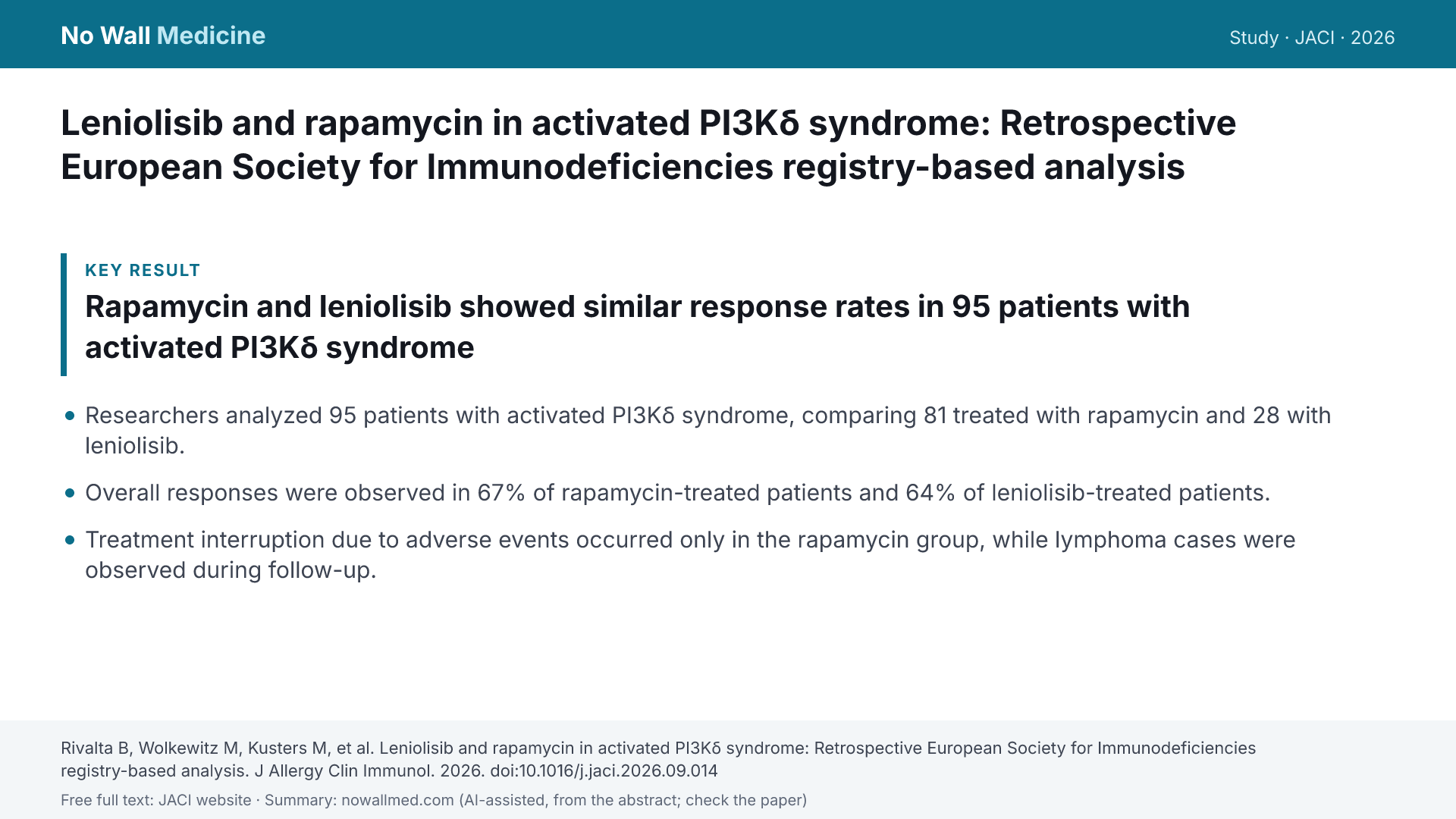
Rapamycin and leniolisib showed similar response rates in 95 patients with activated PI3Kδ syndrome
Leniolisib and rapamycin in activated PI3Kδ syndrome: Retrospective European Society for Immunodeficiencies registry-based analysis
Why it matters: Real-world data on the clinical course and tolerability of rapamycin versus leniolisib for activated PI3Kδ syndrome remained limited.
Key points
- Researchers analyzed 95 patients with activated PI3Kδ syndrome, comparing 81 treated with rapamycin and 28 with leniolisib.
- Overall responses were observed in 67% of rapamycin-treated patients and 64% of leniolisib-treated patients.
- Treatment interruption due to adverse events occurred only in the rapamycin group, while lymphoma cases were observed during follow-up.
Limitation the authors note: The study was a retrospective analysis of registry data, which limits causal inference.
Study type: Observational study: it can show a link, but not prove that one thing causes another.
Headline and key points written with AI from the paper’s abstract, with every number checked against it. Read the paper before relying on them.
Was this summary helpful?
Headline, design, result, key points, caveat and citation as plain text.
Cite this article
Rivalta B, Wolkewitz M, Kusters M, et al. Leniolisib and rapamycin in activated PI3Kδ syndrome: Retrospective European Society for Immunodeficiencies registry-based analysis. J Allergy Clin Immunol. 2026. doi:10.1016/j.jaci.2026.09.014
Spotted a mistake? Suggest a correction