Most FDA-cleared surgical robots operate at the lowest level of autonomy
Levels of autonomy in FDA-cleared surgical robots: a systematic review
Systematic reviewMixed results
What are the levels of autonomy in FDA-cleared surgical robots?
Who
49
Surgical robots cleared by the United States Food and Drug Administration · United States
Compared
86%Level 1 (Robot Assistance)
6%Level 3 (Conditional Autonomy)
Main outcome
Levels of autonomy in surgical robotics
Bottom line: Most FDA-cleared surgical robots are at Level 1 autonomy, though trends show increasing autonomy.
NPJ Digit Med · 2024-04-26Download image
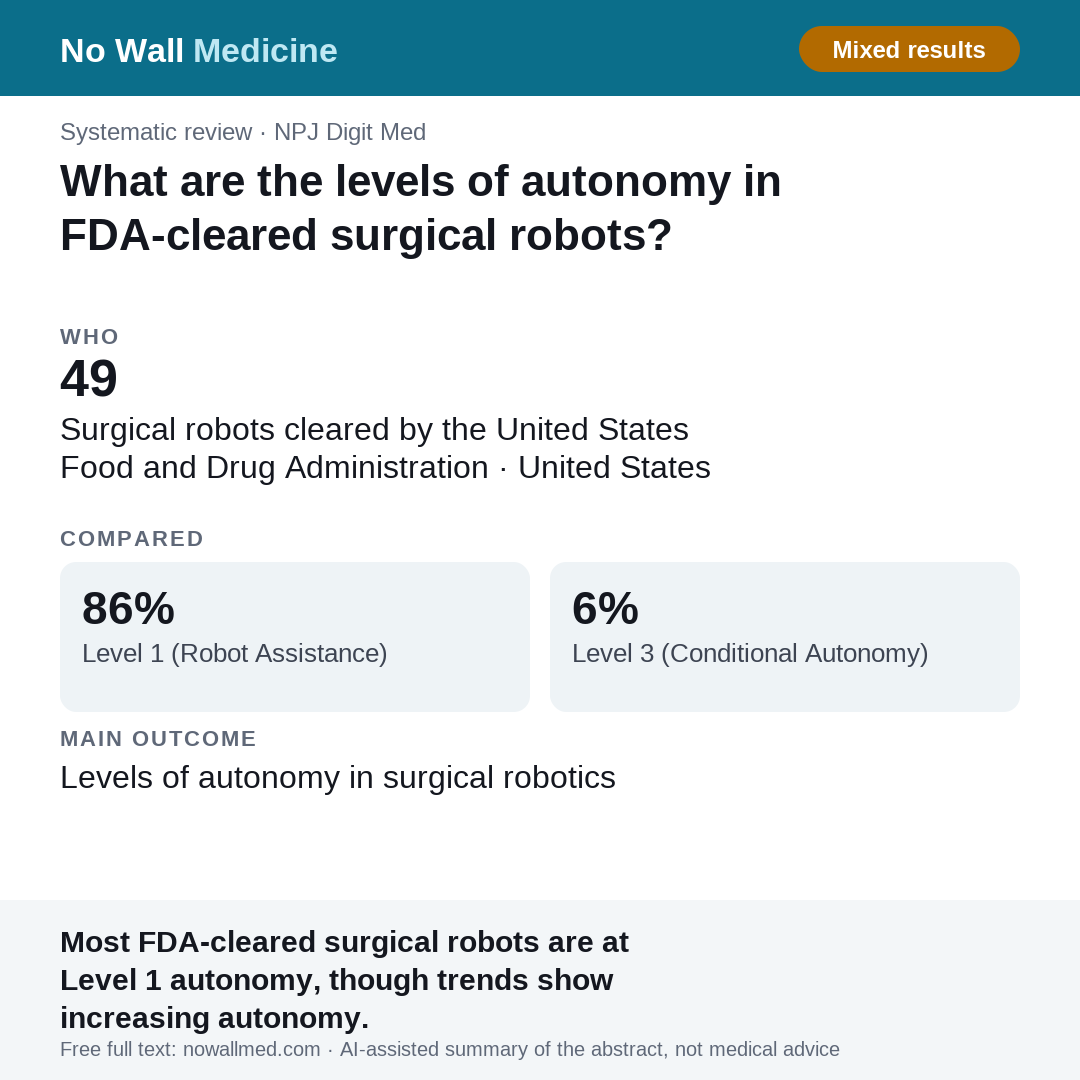
Clinical question: What are the levels of autonomy in FDA-cleared surgical robots?
Why it matters: Current classification and regulatory frameworks have not kept pace with the increasing autonomy of surgical robots.
Key points
- Researchers reviewed 49 surgical robots cleared by the United States Food and Drug Administration between 2015 and 2023 using a five-level classification system.
- The majority of surgical robots were categorized at Level 1, or robot assistance, at 86%, while 6% reached Level 3, or conditional autonomy.
- Two surgical robots were recognized by the United States Food and Drug Administration as having machine learning-enabled capabilities.
Headline and key points written with AI from the paper’s abstract, with every number checked against it. Read the paper before relying on them.
Was this summary helpful?
Cite this article
Lee A, Baker TS, Bederson JB, Rapoport BI. Levels of autonomy in FDA-cleared surgical robots: a systematic review. NPJ Digit Med. 2024. doi:10.1038/s41746-024-01102-y
Spotted a mistake? Suggest a correction
Top studies every Monday
The week’s key trials and guidelines in your specialties, plus any topics you follow. By email, free.
Get the weekly digest