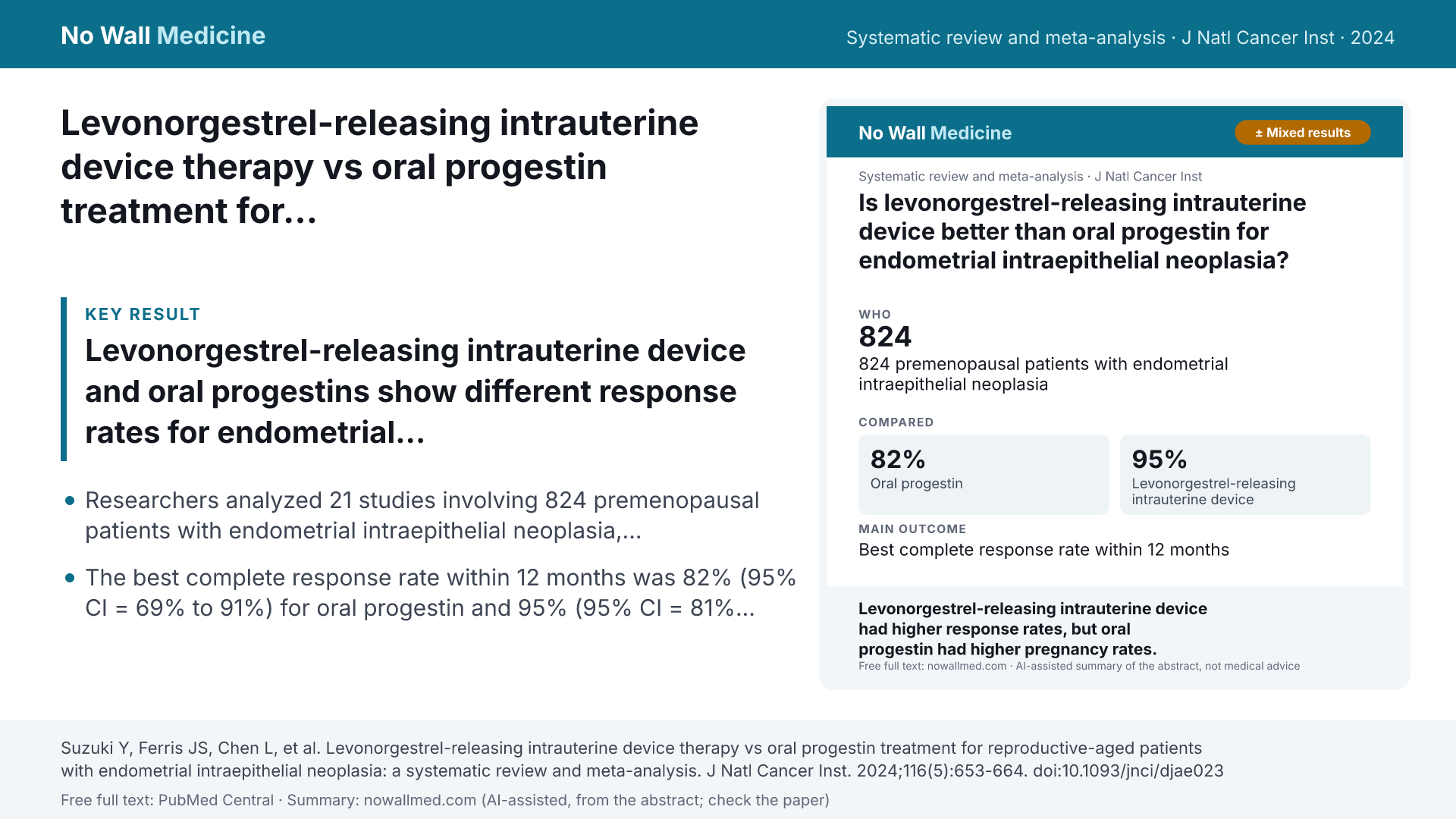
Levonorgestrel-releasing intrauterine device and oral progestins show different response rates for endometrial intraepithelial neoplasia
Levonorgestrel-releasing intrauterine device therapy vs oral progestin treatment for reproductive-aged patients with endometrial intraepithelial neoplasia: a systematic review and meta-analysis
Systematic review and meta-analysisMixed results
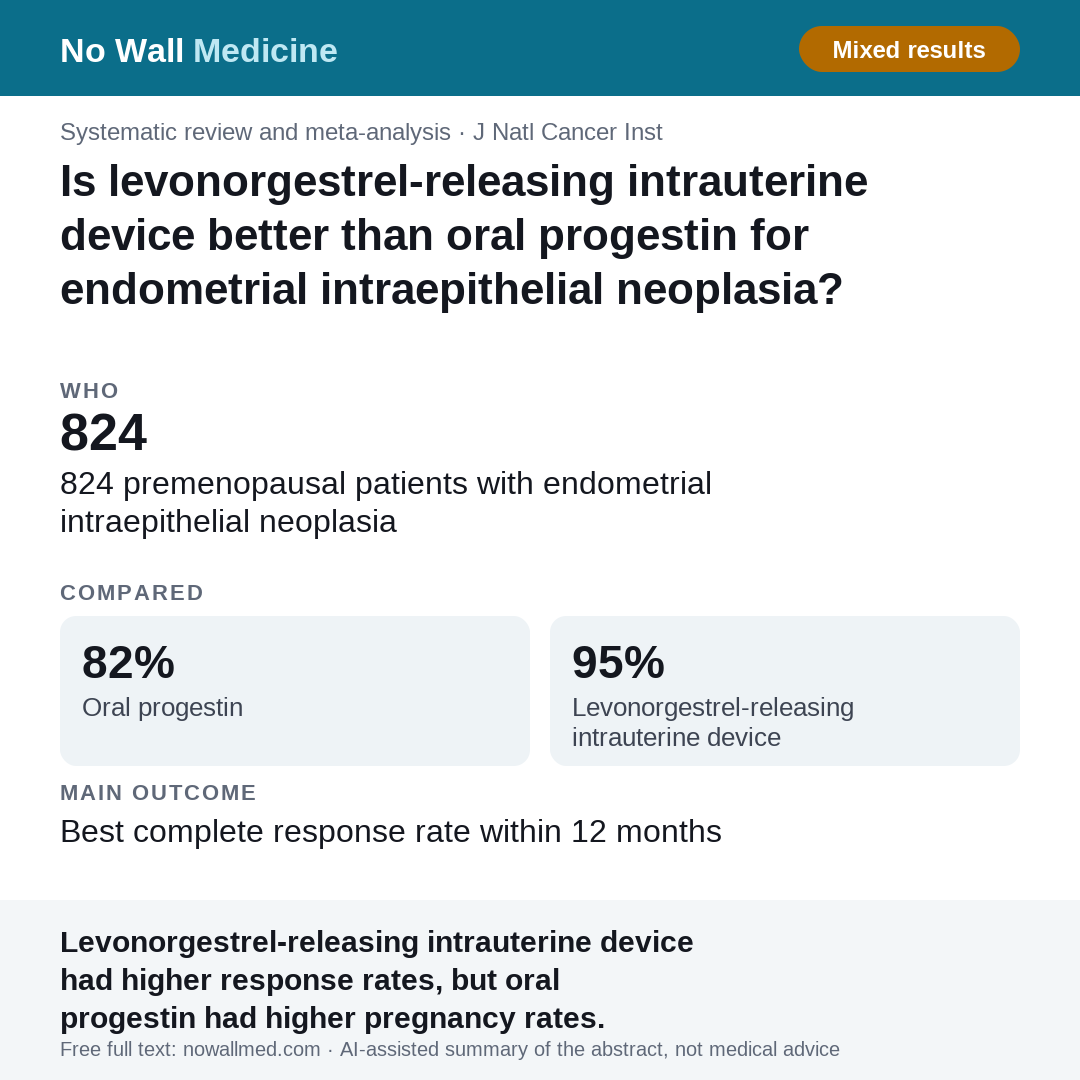
Is levonorgestrel-releasing intrauterine device better than oral progestin for endometrial intraepithelial neoplasia?
Who
824
824 premenopausal patients with endometrial intraepithelial neoplasia
Compared
82%Oral progestin (95% CI 69% to 91%)
95%Levonorgestrel-releasing intrauterine device (95% CI 81% to 99%)
Main outcome
Best complete response rate within 12 months
Bottom line: Levonorgestrel-releasing intrauterine device had higher response rates, but oral progestin had higher pregnancy rates.
J Natl Cancer Inst · 2024-02-02Download image
Clinical question: Is levonorgestrel-releasing intrauterine device better than oral progestin for endometrial intraepithelial neoplasia?
Key points
- Researchers analyzed 21 studies involving 824 premenopausal patients with endometrial intraepithelial neoplasia, comparing oral progestin to a levonorgestrel-releasing intrauterine device (a hormone-releasing device placed in the uterus).
- The best complete response rate within 12 months was 82% (95% CI = 69% to 91%) for oral progestin and 95% (95% CI = 81% to 99%) for the intrauterine device.
- The pooled pregnancy rate was 50% (95% CI = 35% to 65%) after oral progestin and 35% (95% CI = 23% to 49%) after the intrauterine device.
Limitation the authors note: The results were based on small numbers.
Headline and key points written with AI from the paper’s abstract, with every number checked against it. Read the paper before relying on them.
Was this summary helpful?
Subject terms
Cite this article
Suzuki Y, Ferris JS, Chen L, et al. Levonorgestrel-releasing intrauterine device therapy vs oral progestin treatment for reproductive-aged patients with endometrial intraepithelial neoplasia: a systematic review and meta-analysis. J Natl Cancer Inst. 2024. doi:10.1093/jnci/djae023
Spotted a mistake? Suggest a correction