Levosimendan did not reduce time to successful weaning from life support in cardiogenic shock patients
Levosimendan to Facilitate Weaning From ECMO in Patients With Severe Cardiogenic Shock: The LEVOECMO Randomized Clinical Trial
Randomized, double-blind, placebo-controlled trialNo clear difference
Does early levosimendan administration reduce time to successful venoarterial extracorporeal membrane oxygenation weaning?
Who
205
Adult patients with acute cardiogenic shock on venoarterial extracorporeal membrane oxygenation · 11 intensive care units in France
Compared
68.3%Levosimendan (69/101)
68.3%Placebo (71/104)
Main outcome
Time to successful extracorporeal membrane oxygenation weaning within 30 days
Result: subdistribution hazard ratio 1.02 (95% CI 0.74-1.39)
Bottom line: Early levosimendan administration did not significantly reduce the time to successful weaning from venoarterial extracorporeal membrane oxygenation.
JAMA · 2025-12-01Download image
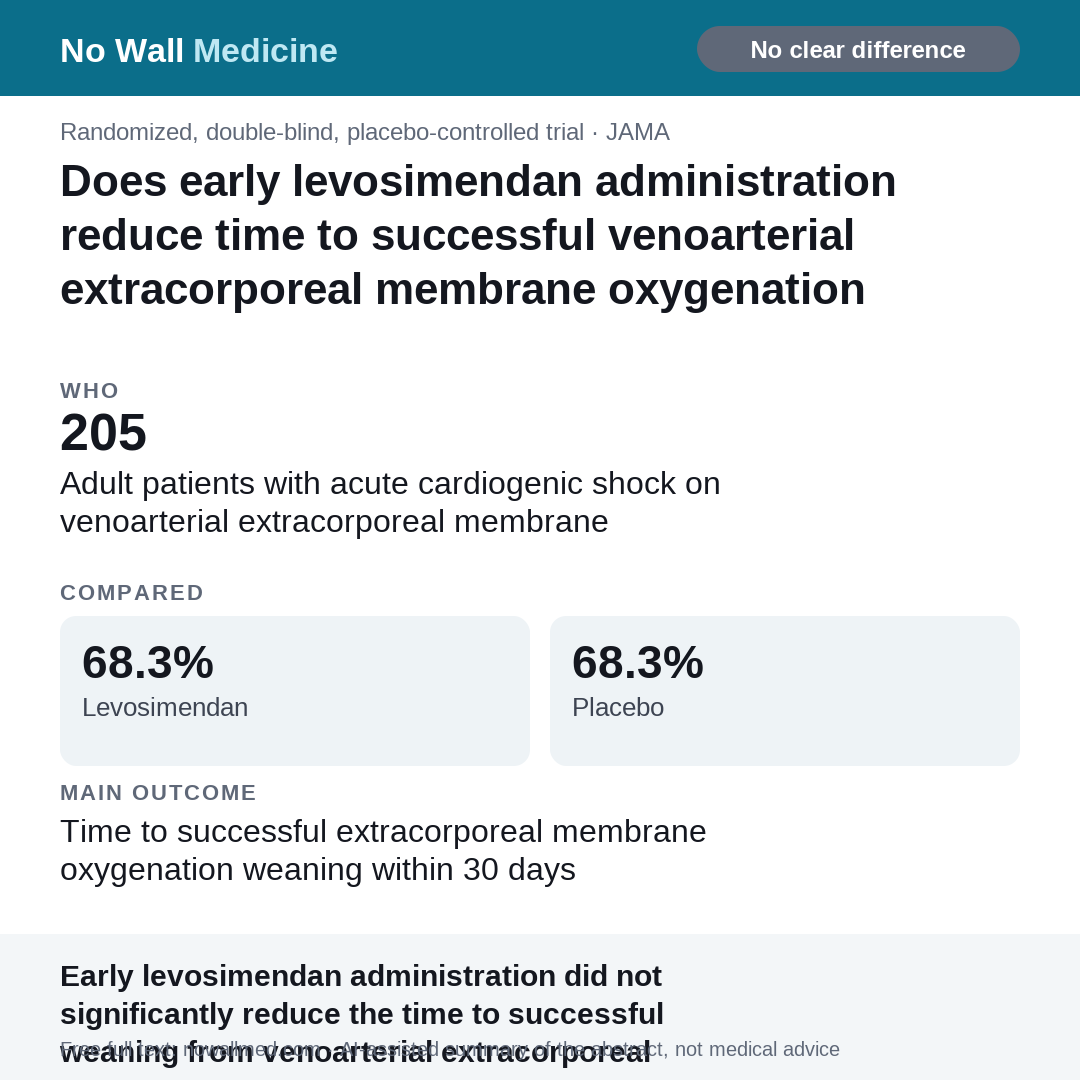
Clinical question: Does early levosimendan administration reduce time to successful venoarterial extracorporeal membrane oxygenation weaning?
Key points
- Researchers studied 205 adult patients with acute cardiogenic shock receiving venoarterial extracorporeal membrane oxygenation, a machine that provides heart and lung support, comparing levosimendan to a placebo.
- Successful weaning from life support within 30 days occurred in 68.3% of the levosimendan group and 68.3% of the placebo group, showing no significant difference.
- Ventricular arrhythmias, which are irregular heartbeats, occurred more frequently in the levosimendan group at 17.8% compared to 8.7% in the placebo group.
Headline and key points written with AI from the paper’s abstract, with every number checked against it. Read the paper before relying on them.
Was this summary helpful?
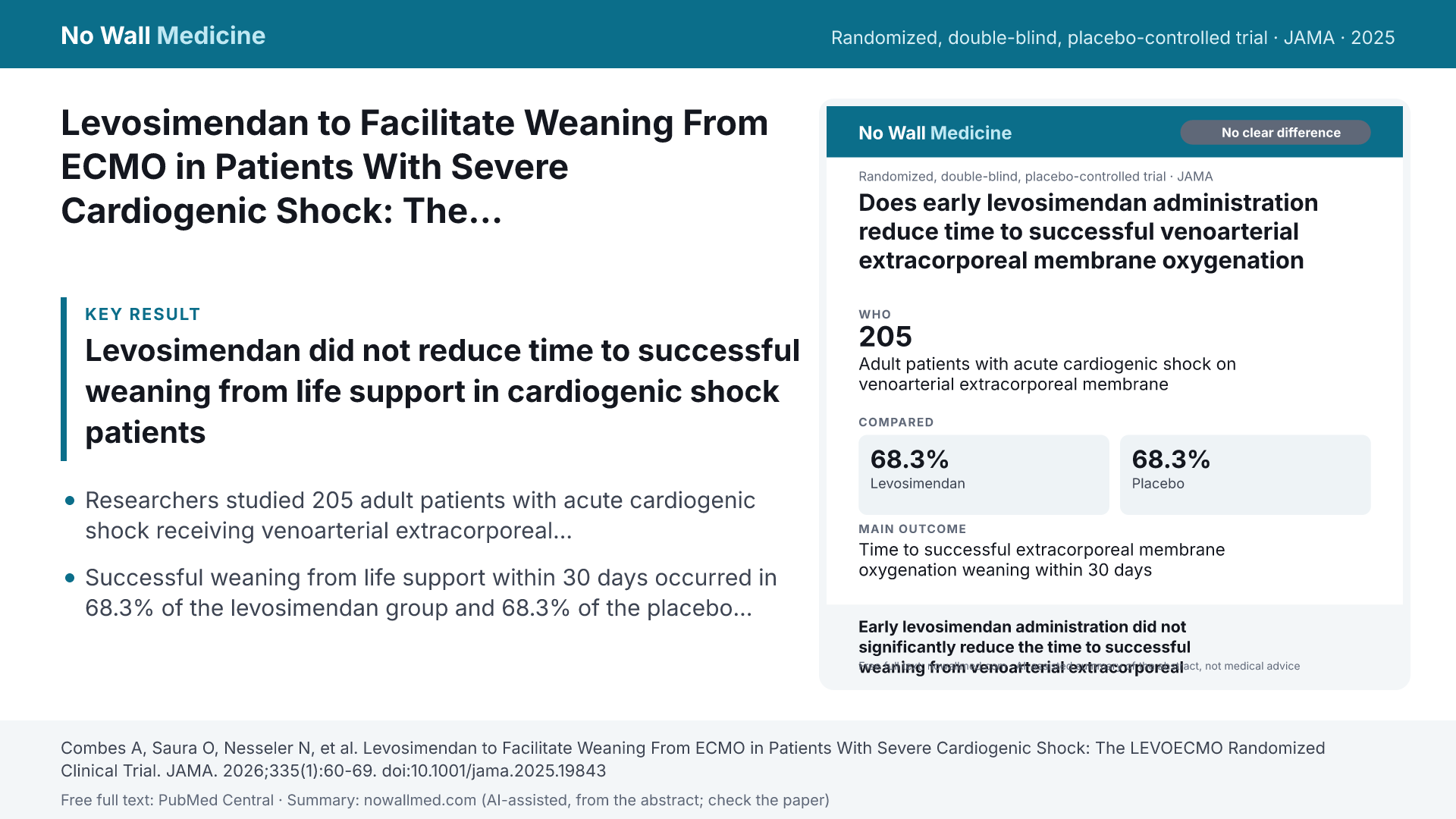
Subject terms
Headline, design, result, key points, caveat and citation as plain text.
Cite this article
Combes A, Saura O, Nesseler N, et al. Levosimendan to Facilitate Weaning From ECMO in Patients With Severe Cardiogenic Shock: The LEVOECMO Randomized Clinical Trial. JAMA. 2025. doi:10.1001/jama.2025.19843
Spotted a mistake? Suggest a correction