Prediction models for dementia risk show high bias and limited generalizability in systematic review
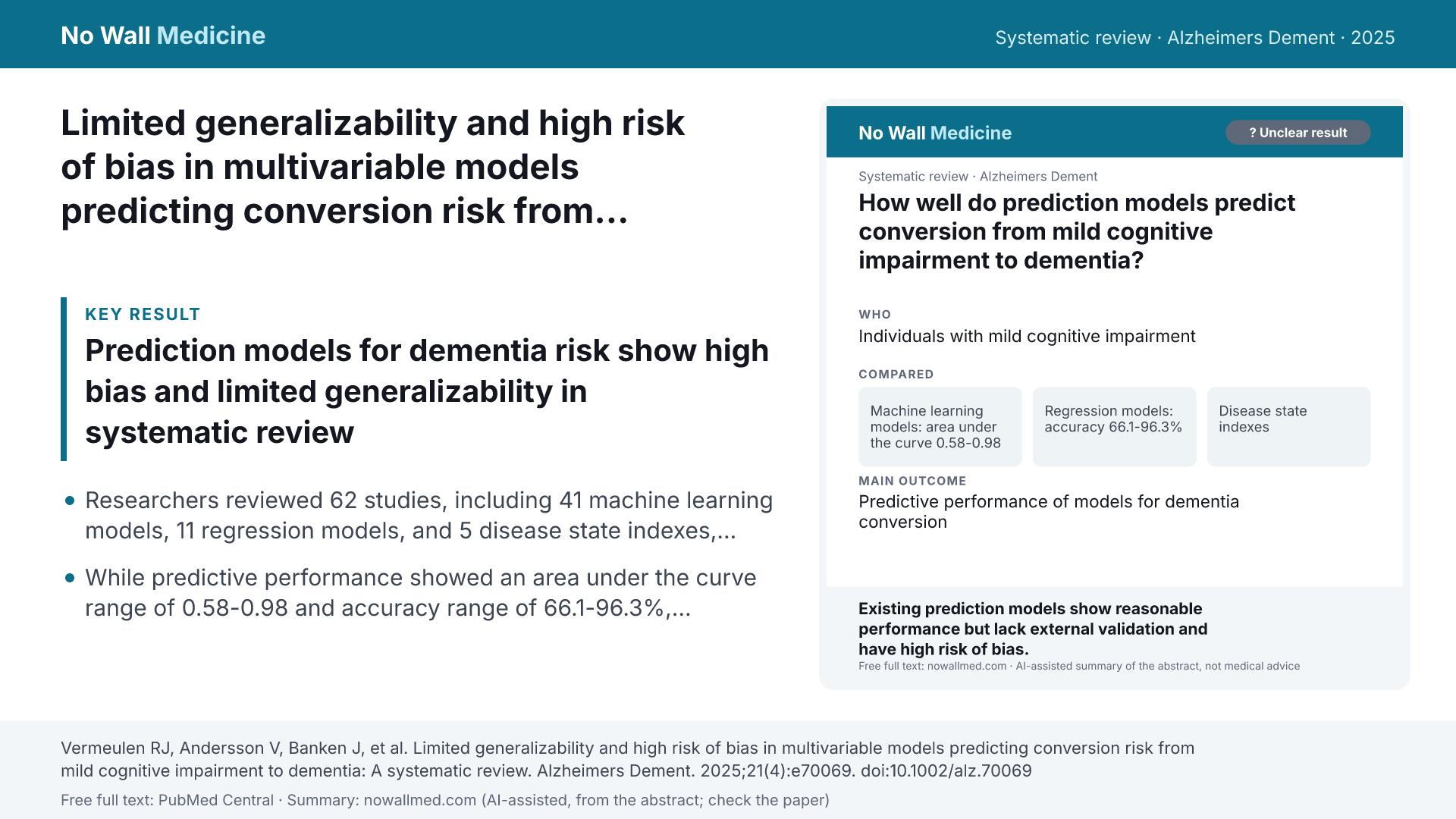
Limited generalizability and high risk of bias in multivariable models predicting conversion risk from mild cognitive impairment to dementia: A systematic review
Systematic reviewUnclear result
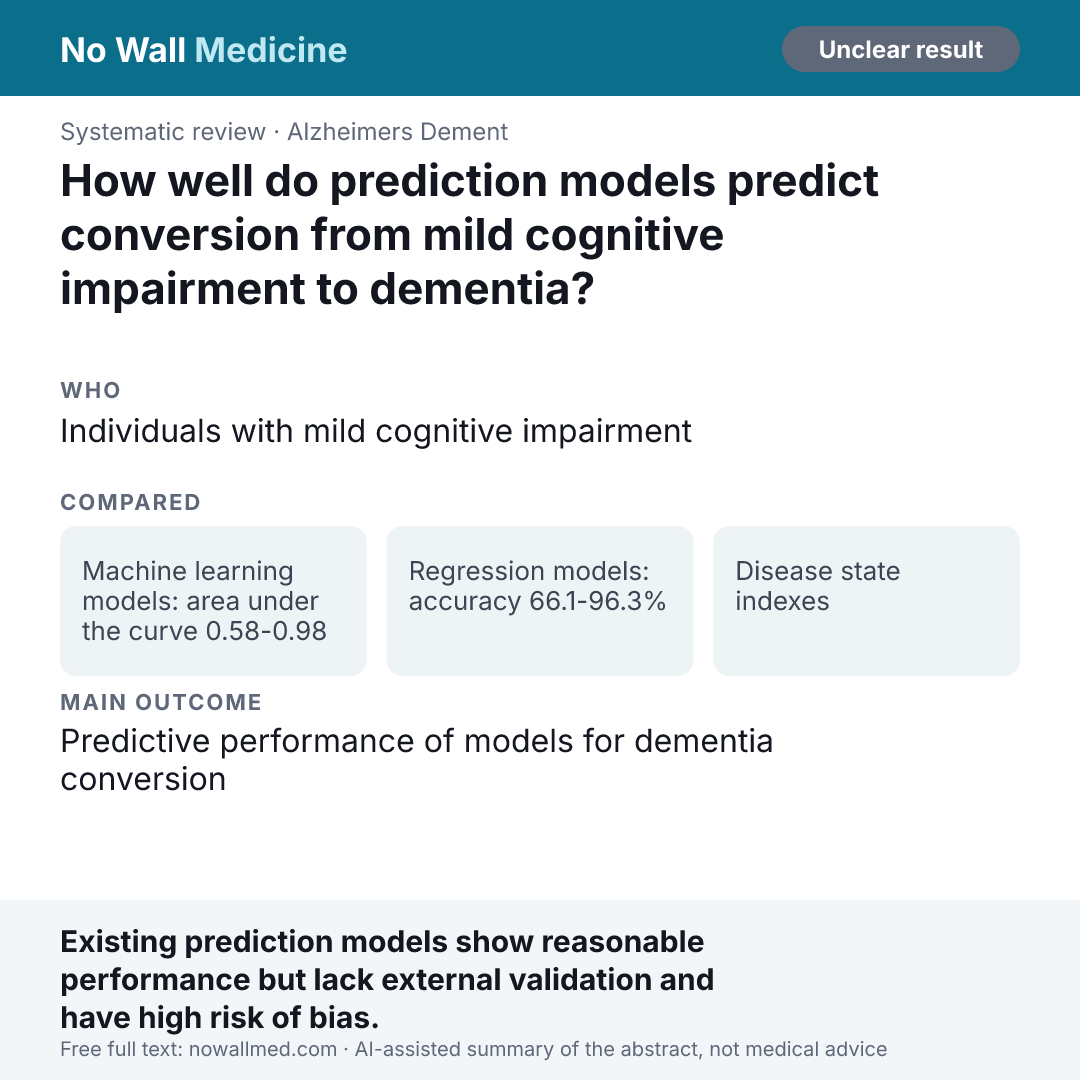
How well do prediction models predict conversion from mild cognitive impairment to dementia?
Who
Individuals with mild cognitive impairment
Compared
Machine learning models: area under the curve 0.58-0.98
Regression models: accuracy 66.1-96.3%
Disease state indexes
Main outcome
Predictive performance of models for dementia conversion
Bottom line: Existing prediction models show reasonable performance but lack external validation and have high risk of bias.
Limitation: Most studies are at high risk of bias and 47 studies lack external validation.
Alzheimers Dement · 2025-04-07 · Save PNG
Clinical question: How well do prediction models predict conversion from mild cognitive impairment to dementia?
Why it matters: Current prediction models for identifying which individuals with mild cognitive impairment will develop dementia lack external validation and have a high risk of bias.
Key points
- Researchers reviewed 62 studies, including 41 machine learning models, 11 regression models, and 5 disease state indexes, to assess how well they predict dementia from mild cognitive impairment.
- While predictive performance showed an area under the curve range of 0.58-0.98 and accuracy range of 66.1-96.3%, most studies had a high risk of bias.
- The review found that 47 studies lacked external validation, which is the process of testing a model on a new group of people to see if it still works.
Limitation the authors note: The review found that most studies included in the analysis were at high risk of bias and lacked external validation.
Headline and key points written with AI from the paper’s abstract, with every number checked against it. Read the paper before relying on them.
Was this summary helpful?
Subject terms
Headline, design, result, key points, caveat and citation as plain text.
Cite this article
Vermeulen RJ, Andersson V, Banken J, et al. Limited generalizability and high risk of bias in multivariable models predicting conversion risk from mild cognitive impairment to dementia: A systematic review. Alzheimers Dement. 2025;21(4):e70069. doi:10.1002/alz.70069
Spotted a mistake? Suggest a correction