Electric field directionality in the brain linked to treatment response in obsessive-compulsive disorder
Linking electric field directionality to treatment outcome in OCD: Insights from patient-specific tDCS modeling
Why it matters: Clinical outcomes for transcranial direct current stimulation in patients with treatment-resistant obsessive-compulsive disorder remain inconsistent.
Key points
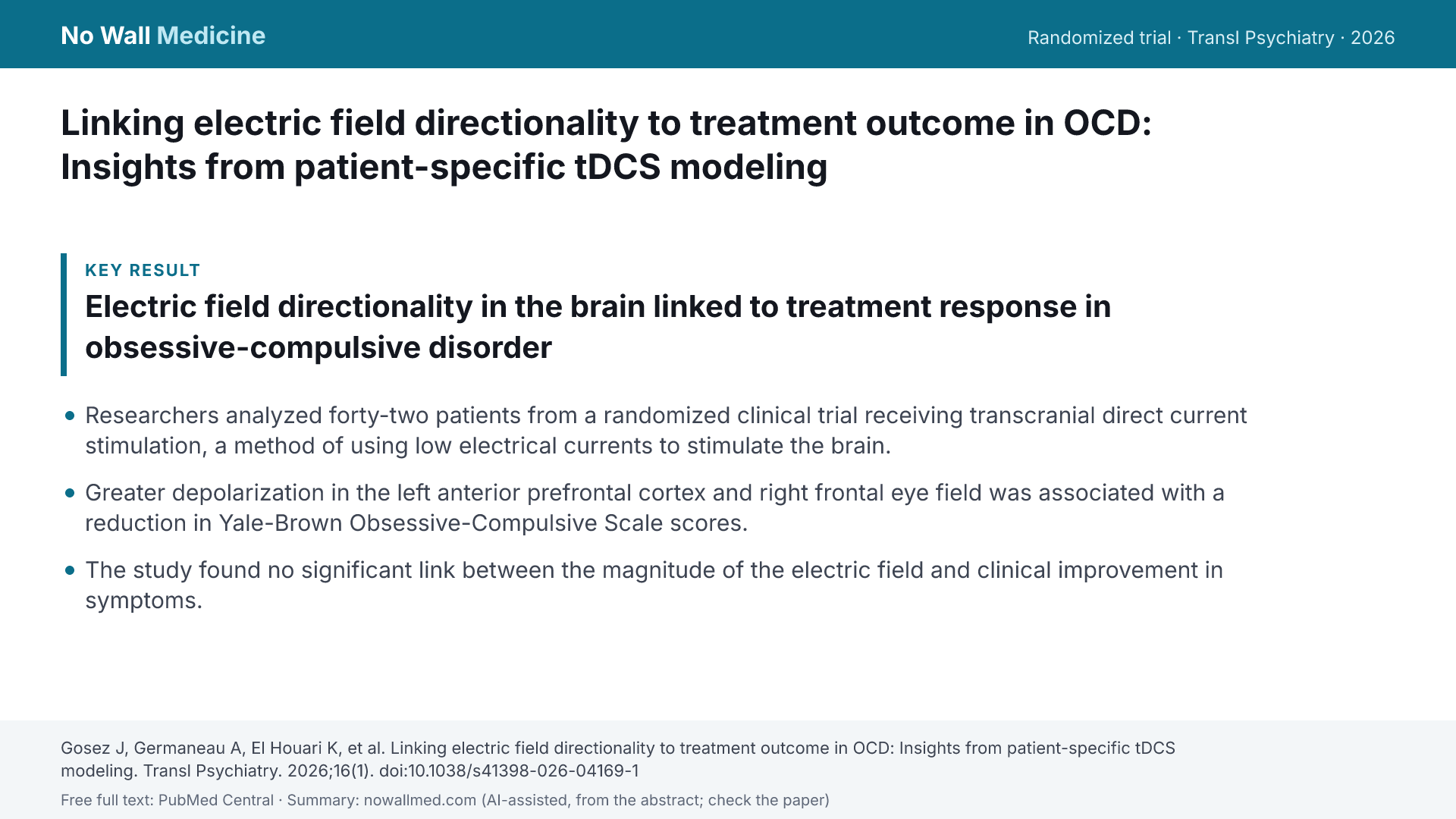
- Researchers analyzed forty-two patients from a randomized clinical trial receiving transcranial direct current stimulation, a method of using low electrical currents to stimulate the brain.
- Greater depolarization in the left anterior prefrontal cortex and right frontal eye field was associated with a reduction in Yale-Brown Obsessive-Compulsive Scale scores.
- The study found no significant link between the magnitude of the electric field and clinical improvement in symptoms.
Headline and key points written with AI from the paper’s abstract, with every number checked against it. Read the paper before relying on them.
Was this summary helpful?
Subject terms
Headline, design, result, key points, caveat and citation as plain text.
Cite this article
Gosez J, Germaneau A, El Houari K, et al. Linking electric field directionality to treatment outcome in OCD: Insights from patient-specific tDCS modeling. Transl Psychiatry. 2026;16(1). doi:10.1038/s41398-026-04169-1
Spotted a mistake? Suggest a correction