Intravenous lipid infusion increases blood pressure variability and impairs vascular function in healthy adults
Lipid Infusion Enhances Sympathetic Transduction via Redox-Sensitive Pathways
Randomized, double-blind, placebo-controlled crossover studyMixed results
Does intravenous lipid infusion enhance sympathetic-vascular transduction and arterial pressure variability?
Who
Healthy adults
Compared
Lipid plus saline: 4.7±2.0% MAP response to large MSNA bursts
Lipid plus ascorbic acid: 4.4±0.9% MAP response to large MSNA bursts
Main outcome
Sympathetic-vascular transduction and beat-to-beat arterial pressure variability
Bottom line: Lipid infusion enhances sympathetic-vascular transduction and pressure variability, but ascorbic acid does not fully reverse endothelial impairment.
Hypertension · 2026-08-19Download image
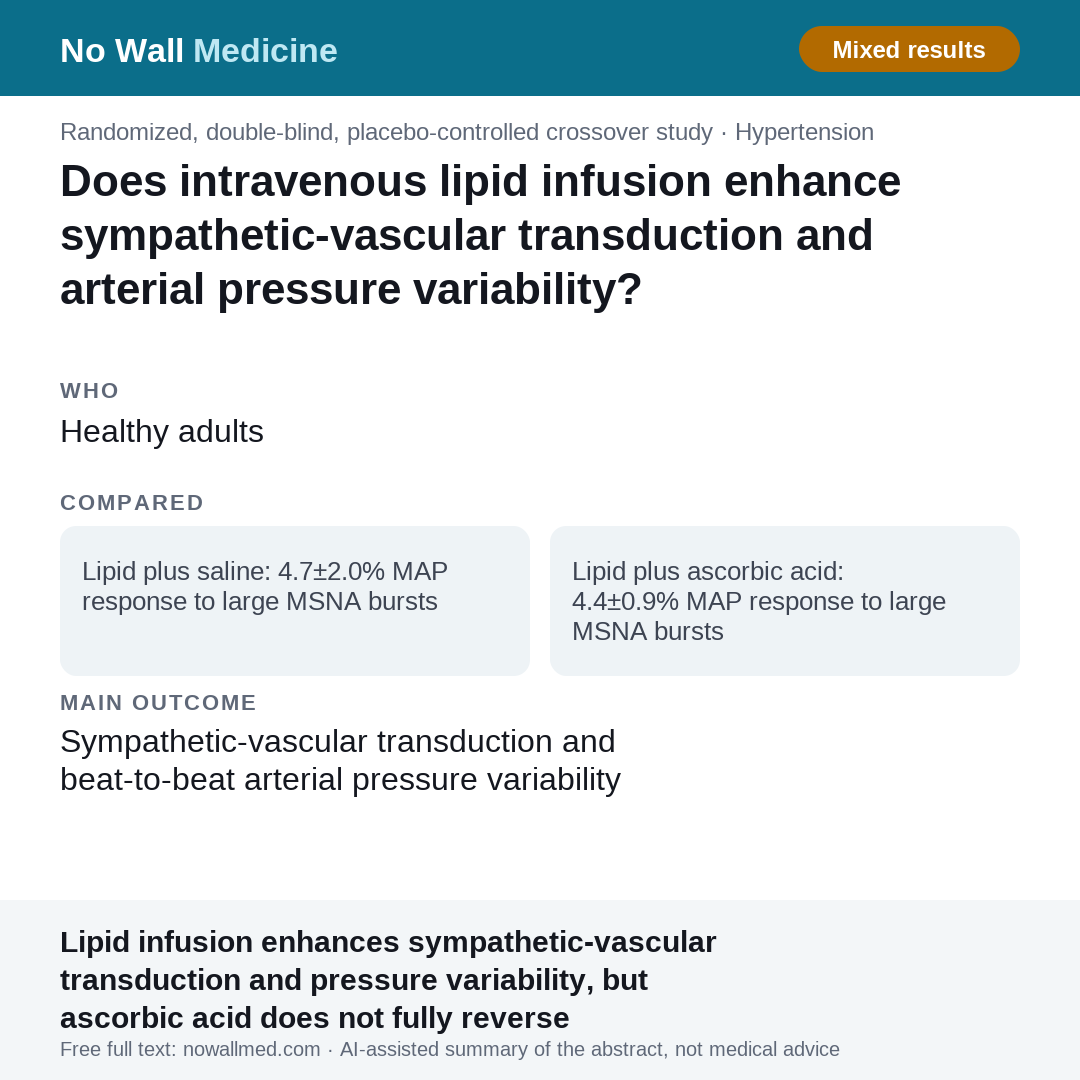
Clinical question: Does intravenous lipid infusion enhance sympathetic-vascular transduction and arterial pressure variability?
Why it matters: The effects of elevated circulating lipids on sympathetic-vascular control and oxidative stress in humans are not well understood.
Key points
- Healthy adults underwent a randomized, double-blind, placebo-controlled crossover study involving a 2 hour intravenous lipid infusion with either ascorbic acid or saline.
- Lipid infusion increased beat-to-beat mean arterial pressure variability from 1.5±0.4 to 1.7±0.5 mm Hg and reduced flow-mediated dilation from 6.8±3.2% to 4.1±2.7%.
- Ascorbic acid did not prevent the increase in mean arterial pressure variability or the augmented responses to muscle sympathetic nerve activity bursts.
Headline and key points written with AI from the paper’s abstract, with every number checked against it. Read the paper before relying on them.
Topics
Cite this article
Miller CG, Kovarik JC, Gangwish ME, Clonch DA, Bantis LE, Thyfault JP. Lipid Infusion Enhances Sympathetic Transduction via Redox-Sensitive Pathways. Hypertension. 2026. doi:10.1161/HYPERTENSIONAHA.126.27191
Spotted a mistake? Suggest a correction