Liraglutide reduced stroke recurrence in patients with high insulin resistance during a post hoc analysis
Liraglutide and Recurrent Stroke by Baseline Insulin Resistance: A Post Hoc Analysis of the LAMP Trial
Post hoc analysis of a randomized controlled trialBenefit found
Does insulin resistance influence liraglutide efficacy for recurrent stroke prevention?
Who
510
Patients with minor ischemic stroke or high-risk transient ischemic attack and type 2 diabetes · 27 hospitals in China
Compared
5.8%Liraglutide plus standard therapy (IR ≥2.5)
18.1%Standard therapy alone (IR ≥2.5)
Main outcome
Stroke recurrence
Result: absolute risk reduction 12.3% (95% CI 5.6%-19.0%)
Bottom line: Liraglutide reduces stroke recurrence in patients with high insulin resistance.
Stroke · 2026-05-18Download image
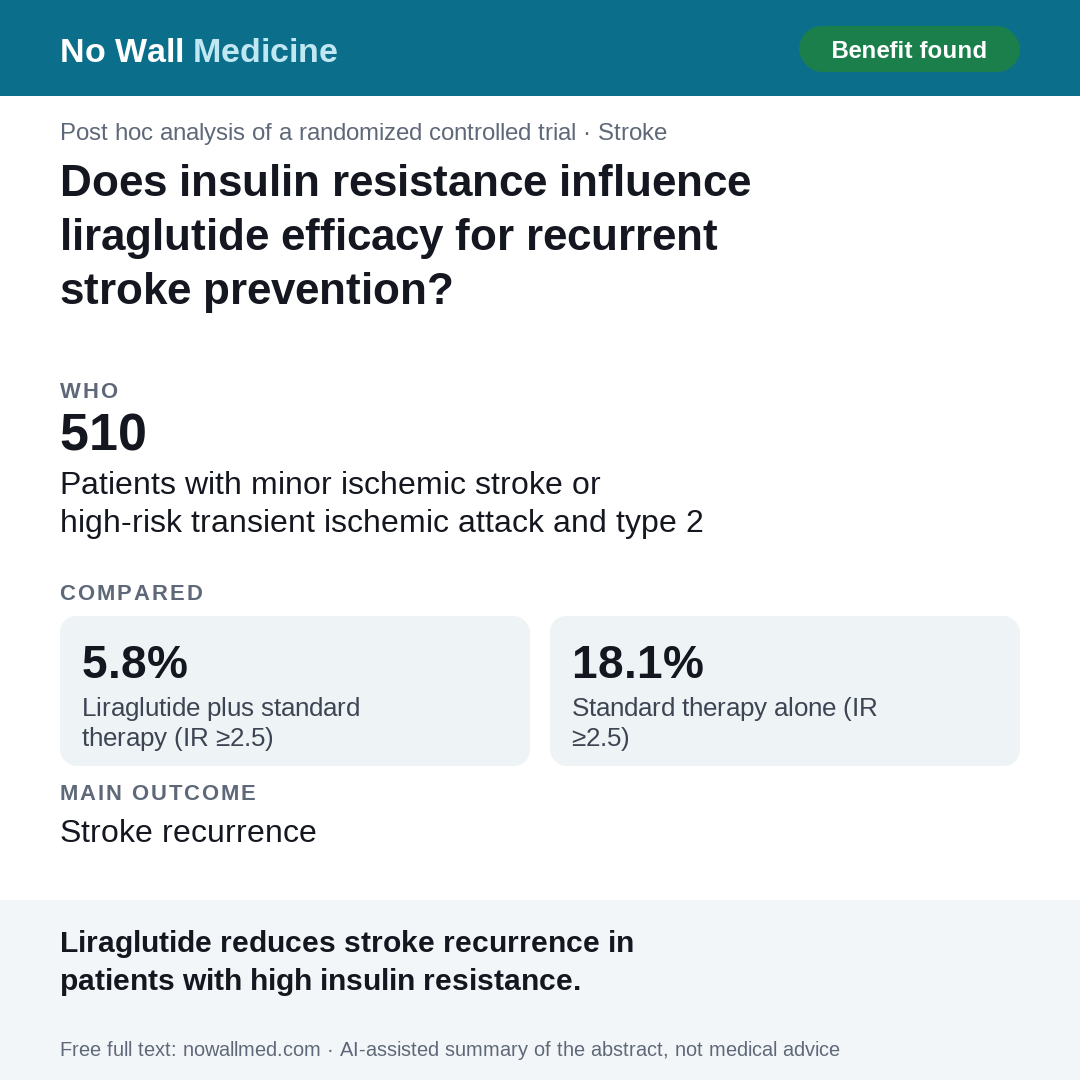
Clinical question: Does insulin resistance influence liraglutide efficacy for recurrent stroke prevention?
Why it matters: It remains unclear whether insulin resistance influences how well glucagon-like peptide-1 receptor agonists work to prevent cardiovascular events.
Key points
- Researchers analyzed 510 patients with minor ischemic stroke or high-risk transient ischemic attack and type 2 diabetes who were treated with liraglutide or standard therapy.
- In patients with high insulin resistance, liraglutide reduced stroke recurrence to 5.8% compared to 18.1% and reduced vascular events to 5.8% compared to 19.2%.
- No significant benefit from liraglutide was observed in patients with low insulin resistance levels.
Headline and key points written with AI from the paper’s abstract, with every number checked against it. Read the paper before relying on them.
Topics
Cite this article
Lu L, Yang B, Wang Y, Zhu C, Liu Z, Li F. Liraglutide and Recurrent Stroke by Baseline Insulin Resistance: A Post Hoc Analysis of the LAMP Trial. Stroke. 2026. doi:10.1161/STROKEAHA.125.056010
Spotted a mistake? Suggest a correction