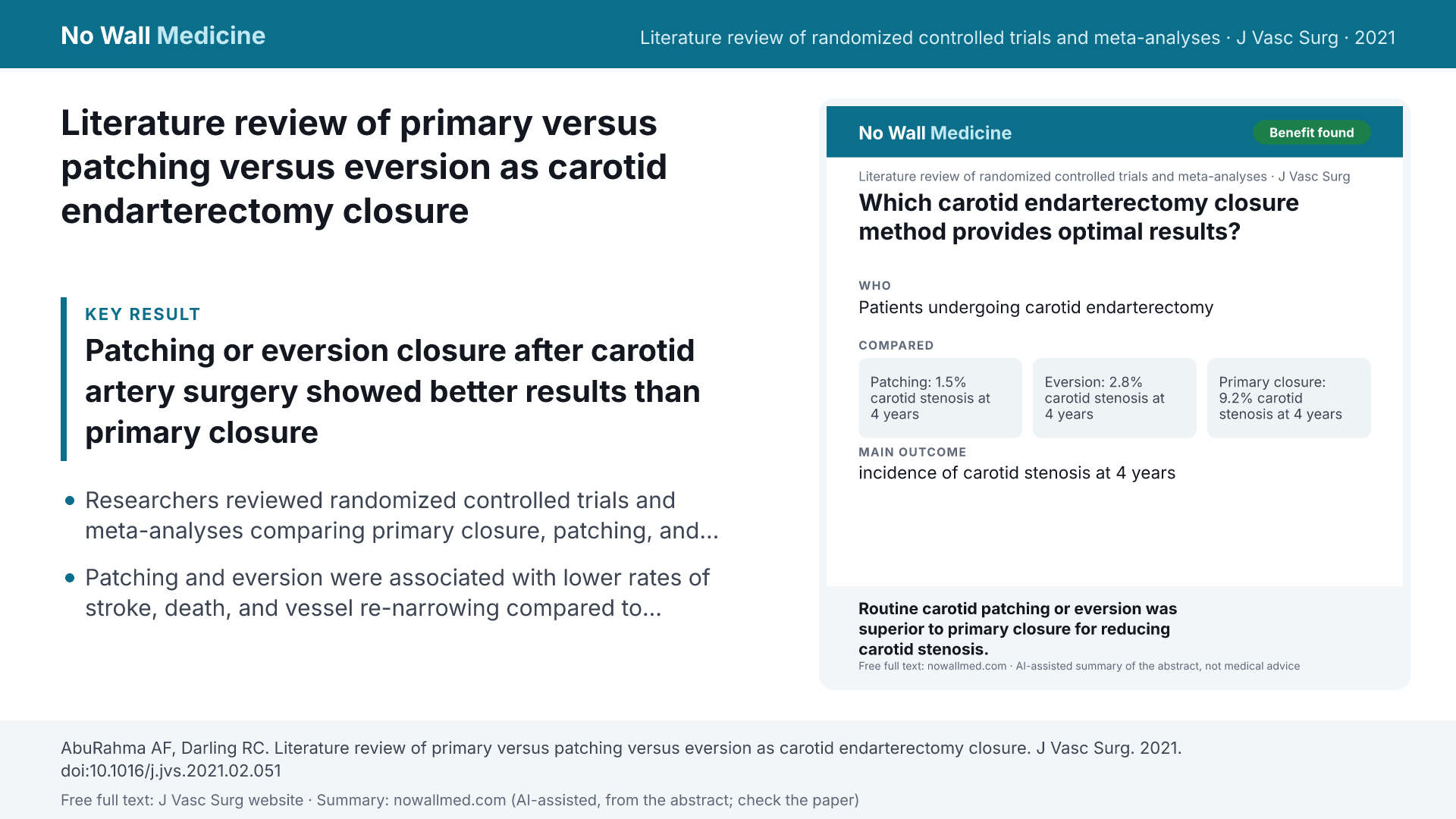
Literature review of primary versus patching versus eversion as carotid endarterectomy closure
Key result: Patching or eversion closure after carotid artery surgery showed better results than primary closure
Literature review of randomized controlled trials and meta-analysesBenefit found
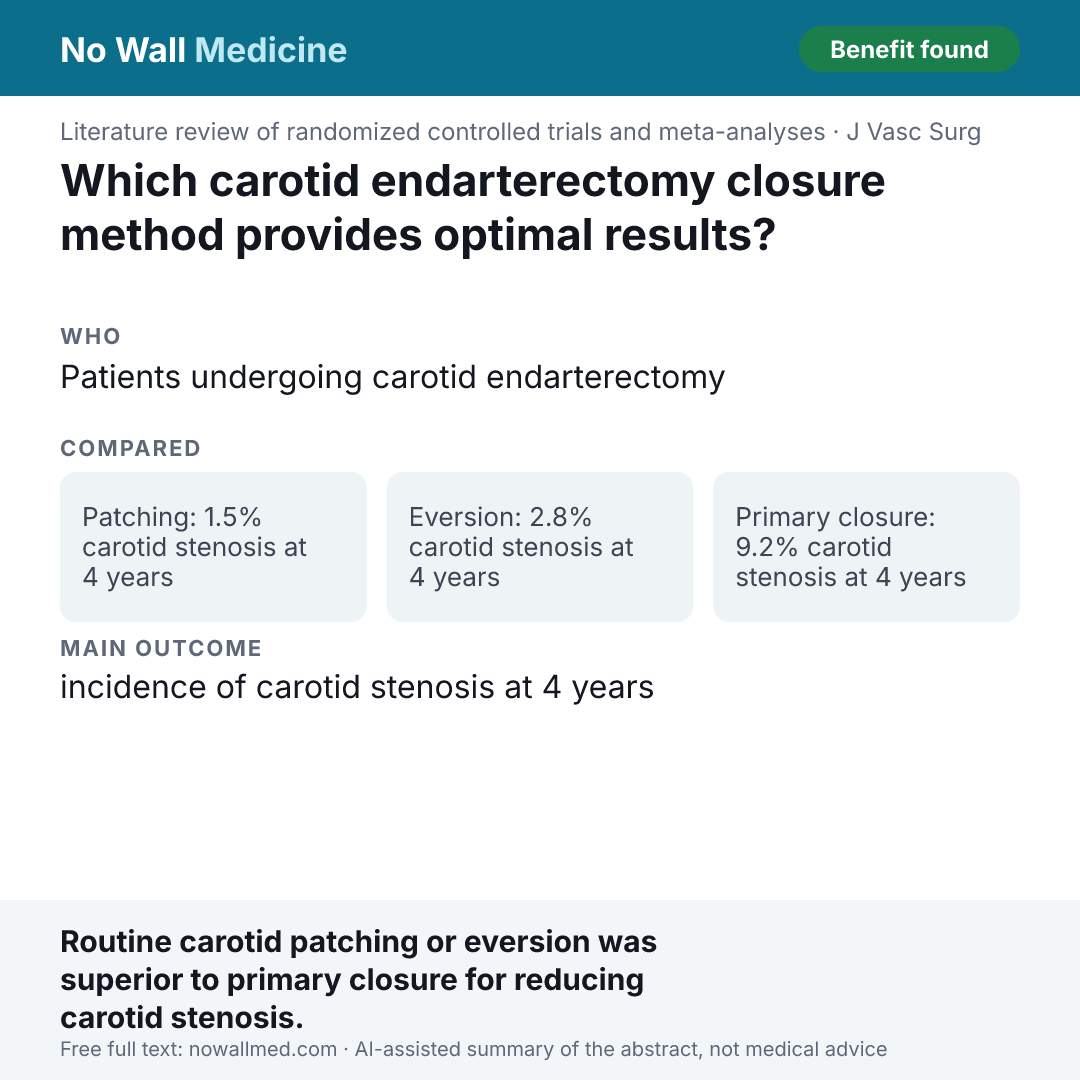
Which carotid endarterectomy closure method provides optimal results?
Who
Patients undergoing carotid endarterectomy
Compared
Patching: 1.5% carotid stenosis at 4 years
Eversion: 2.8% carotid stenosis at 4 years
Primary closure: 9.2% carotid stenosis at 4 years
Main outcome
incidence of carotid stenosis at 4 years
Bottom line: Routine carotid patching or eversion was superior to primary closure for reducing carotid stenosis.
J Vasc Surg · 2021-04-20 · Save PNG
Key points
- Researchers reviewed randomized controlled trials and meta-analyses comparing primary closure, patching, and eversion for carotid endarterectomy, a surgery to remove plaque from the carotid artery.
- Patching and eversion were associated with lower rates of stroke, death, and vessel re-narrowing compared to primary closure.
- At 4 years, the incidence of carotid stenosis was 3.6% for eversion versus 9.2% for primary closure, while patching was 1.5%.
Why it matters: It has remained controversial which method of closing the artery after plaque removal provides the most optimal results.
Discussion prompts
- Would these patients look like yours? Who was left out?
- Is the main outcome one that matters to patients?
- Is the difference large enough to change what you do?
Cite: AbuRahma AF, Darling RC. Literature review of primary versus patching versus eversion as carotid endarterectomy closure. J Vasc Surg. 2021. doi:10.1016/j.jvs.2021.02.051
Free full text: J Vasc Surg website · Summary and visual abstract: nowallmed.com/a/literature-review-of-primary-versus-patching-versus-eversion-as-5teu9d/ (AI-assisted from the abstract; check the paper before relying on it).