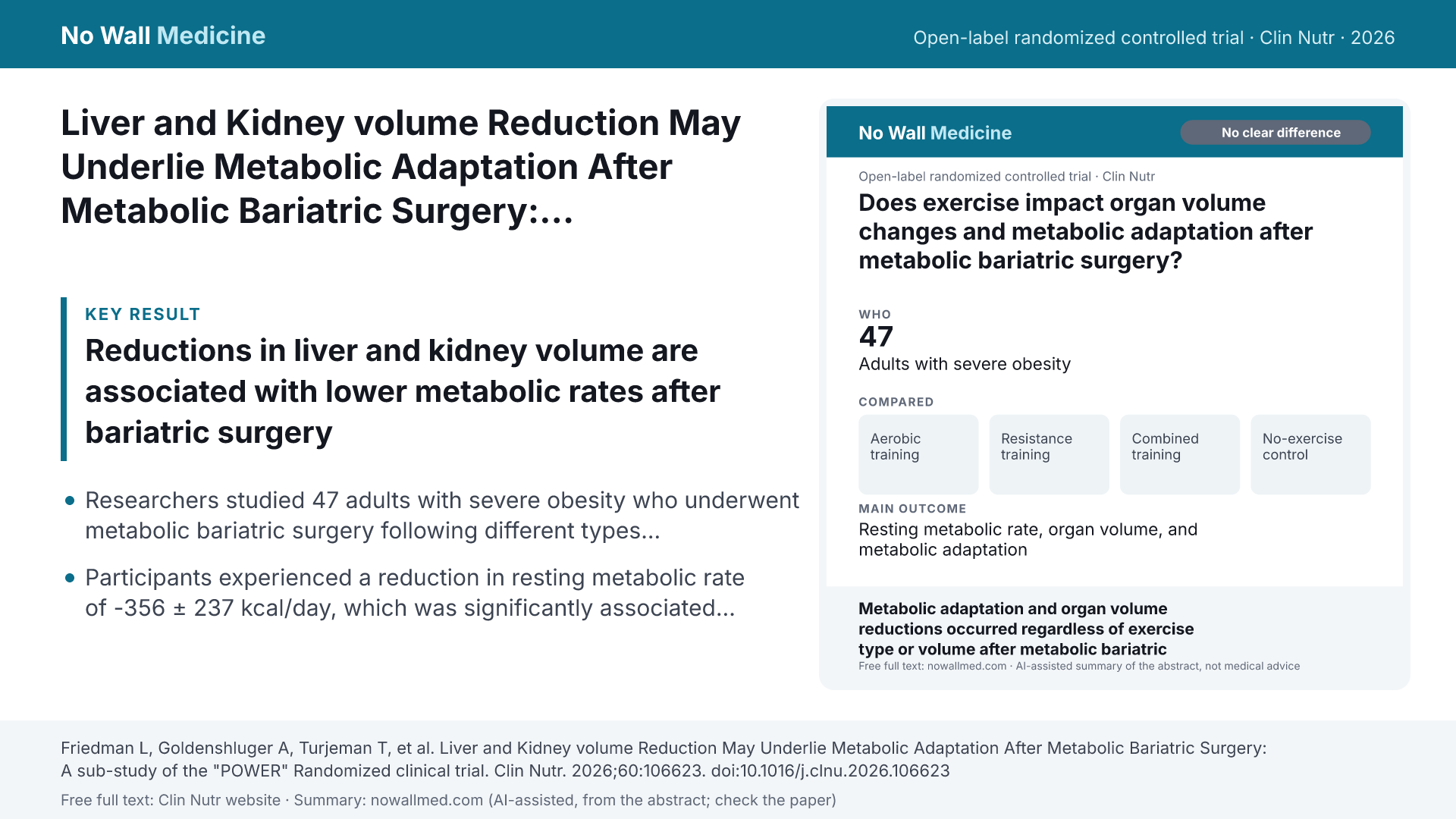
Liver and Kidney volume Reduction May Underlie Metabolic Adaptation After Metabolic Bariatric Surgery: A sub-study of the "POWER" Randomized clinical trial
Key result: Reductions in liver and kidney volume are associated with lower metabolic rates after bariatric surgery
Open-label randomized controlled trialNo clear difference
Does exercise impact organ volume changes and metabolic adaptation after metabolic bariatric surgery?
Who
47
Adults with severe obesity
Compared
Aerobic training
Resistance training
Combined training
No-exercise control
Main outcome
Resting metabolic rate, organ volume, and metabolic adaptation
Bottom line: Metabolic adaptation and organ volume reductions occurred regardless of exercise type or volume after metabolic bariatric surgery.
Clin Nutr · 2026-03-11
Key points
- Researchers studied 47 adults with severe obesity who underwent metabolic bariatric surgery following different types of exercise interventions.
- Participants experienced a reduction in resting metabolic rate of -356 ± 237 kcal/day, which was significantly associated with decreases in liver and kidney volume.
- Liver volume accounted for 32.1 % of metabolic adaptation, fat-free mass for 29.7 %, and kidney volume for 6.2 %.
Discussion prompts
- Would these patients look like yours? Who was left out?
- Is the main outcome one that matters to patients?
- Is the difference large enough to change what you do?
Cite: Friedman L, Goldenshluger A, Turjeman T, et al. Liver and Kidney volume Reduction May Underlie Metabolic Adaptation After Metabolic Bariatric Surgery: A sub-study of the "POWER" Randomized clinical trial. Clin Nutr. 2026;60:106623. doi:10.1016/j.clnu.2026.106623
Free full text: Clin Nutr website · Summary and visual abstract: nowallmed.com/a/liver-and-kidney-volume-reduction-may-underlie-metabolic-adaptation-1hdsdvz/ (AI-assisted from the abstract; check the paper before relying on it).