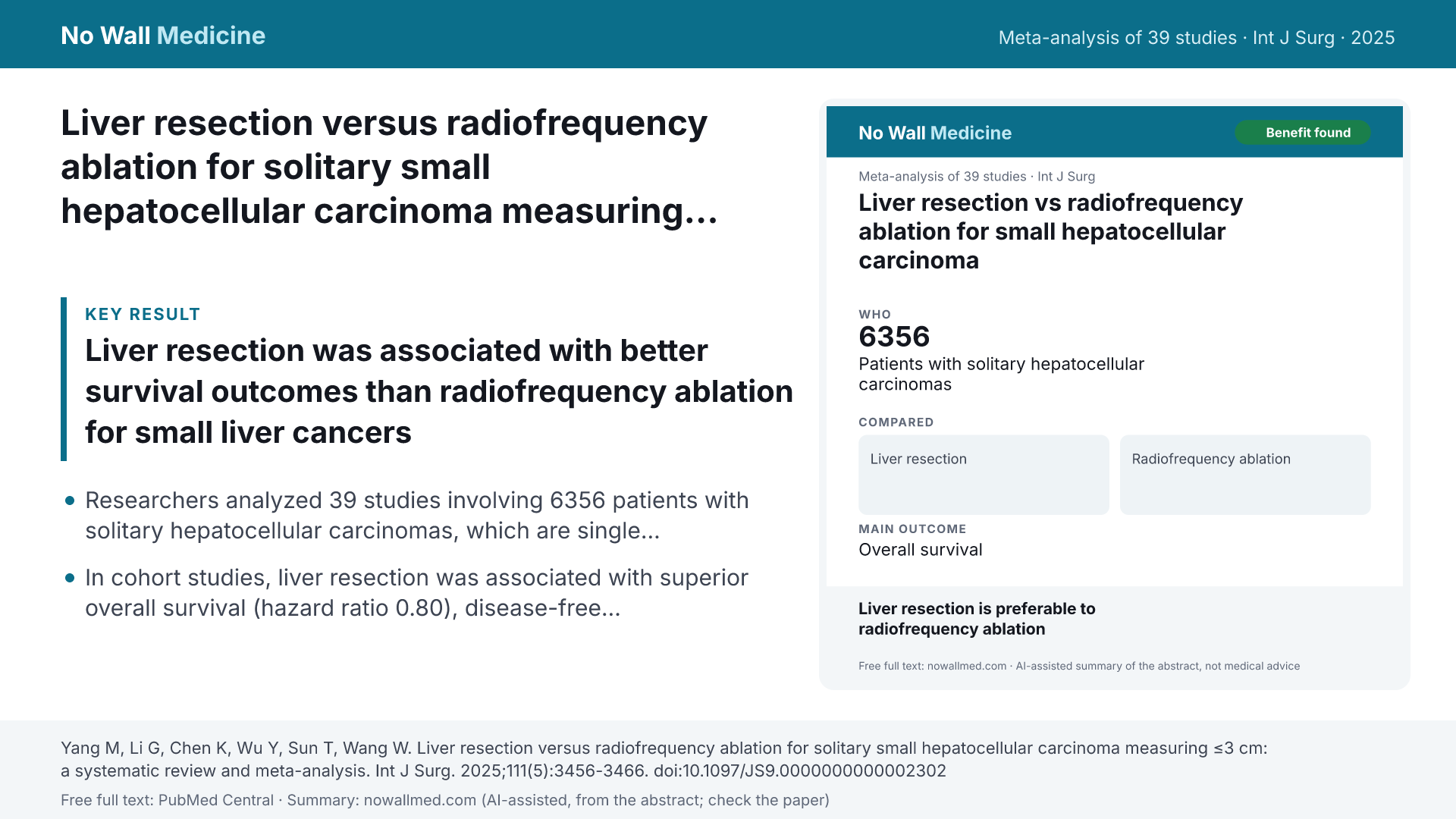
Liver resection was associated with better survival outcomes than radiofrequency ablation for small liver cancers
Liver resection versus radiofrequency ablation for solitary small hepatocellular carcinoma measuring ≤3 cm: a systematic review and meta-analysis
Meta-analysis of 39 studiesBenefit found
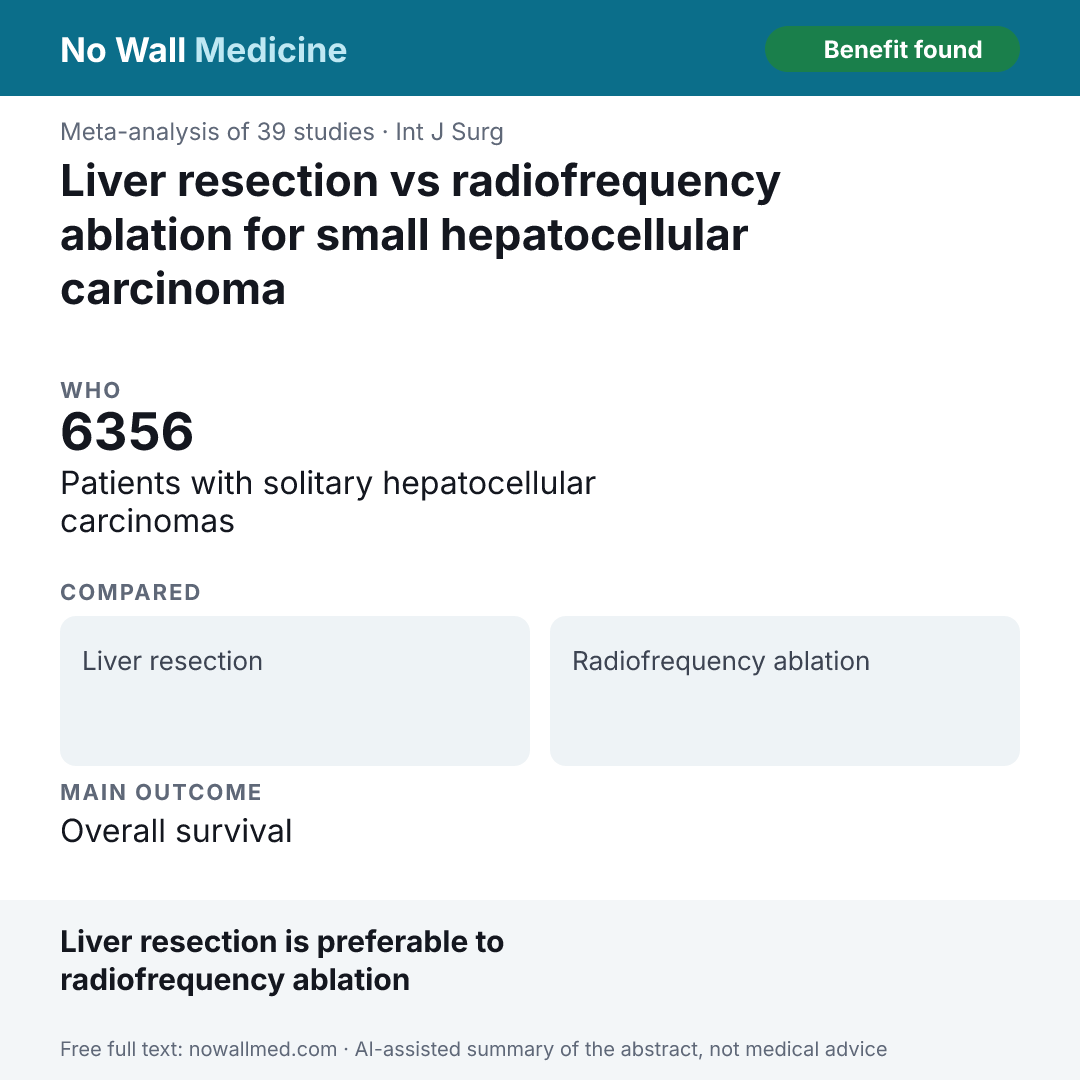
Liver resection vs radiofrequency ablation for small hepatocellular carcinoma
Who
6356
Patients with solitary hepatocellular carcinomas
Compared
Liver resection
Radiofrequency ablation
Main outcome
Overall survival
Result: hazard ratio 0.80 (95% CI: 0.68-0.93)
Bottom line: Liver resection is preferable to radiofrequency ablation
Limitation: Need for additional RCTs
Int J Surg · 2025-05-01 · Save PNG
Why it matters: Clinicians face controversy regarding whether liver resection or radiofrequency ablation provides a better prognosis for patients with a single liver cancer measuring 3 cm or less.
Key points
- Researchers analyzed 39 studies involving 6356 patients with solitary hepatocellular carcinomas, which are single liver cancer tumors, measuring 3 cm or less.
- In cohort studies, liver resection was associated with superior overall survival (hazard ratio 0.80), disease-free survival (hazard ratio 0.63), and recurrence-free survival (hazard ratio 0.65) compared to radiofrequency ablation.
- For patients with tumors measuring 2 cm or less, liver resection was associated with better overall survival (hazard ratio 0.73), disease-free survival (hazard ratio 0.74), and recurrence-free survival (hazard ratio 0.71).
Headline and key points written with AI from the paper’s abstract, with every number checked against it. Read the paper before relying on them.
Was this summary helpful?
Subject terms
Headline, design, result, key points, caveat and citation as plain text.
Cite this article
Yang M, Li G, Chen K, Wu Y, Sun T, Wang W. Liver resection versus radiofrequency ablation for solitary small hepatocellular carcinoma measuring ≤3 cm: a systematic review and meta-analysis. Int J Surg. 2025;111(5):3456-3466. doi:10.1097/JS9.0000000000002302
Spotted a mistake? Suggest a correction