Study protocol evaluates a palliative care intervention for patients with decompensated liver cirrhosis
LiverCare - a palliative care intervention for patients with liver cirrhosis: study protocol for a multi-center, pragmatic, non-randomised clinical trial
Multi-center, pragmatic, non-randomised clinical studyUnclear result
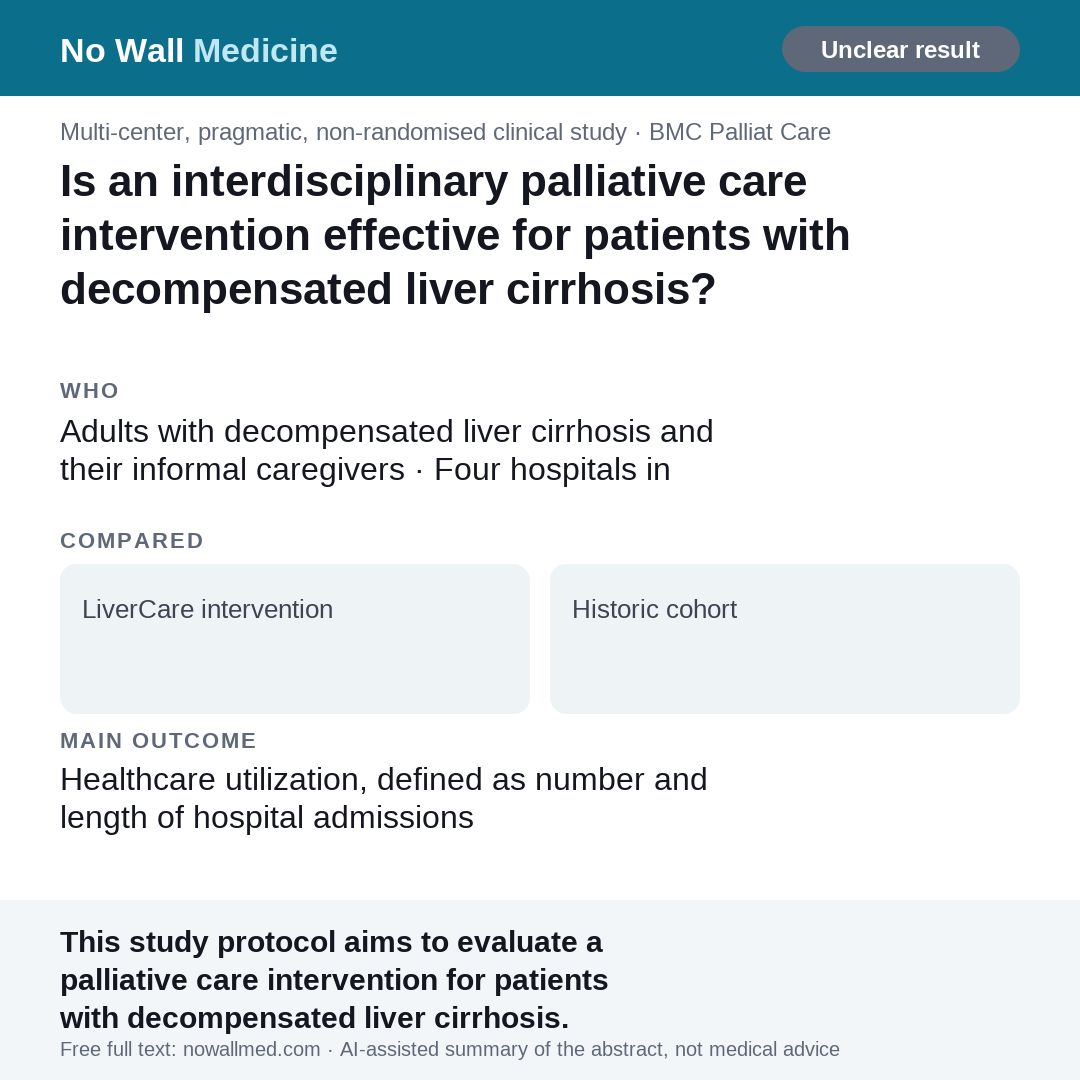
Is an interdisciplinary palliative care intervention effective for patients with decompensated liver cirrhosis?
Who
Adults with decompensated liver cirrhosis and their informal caregivers · Four hospitals in three of Denmark's five regions
Compared
LiverCare intervention
Historic cohort
Main outcome
Healthcare utilization, defined as number and length of hospital admissions
Bottom line: This study protocol aims to evaluate a palliative care intervention for patients with decompensated liver cirrhosis.
BMC Palliat Care · 2026-06-16Download image
Clinical question: Is an interdisciplinary palliative care intervention effective for patients with decompensated liver cirrhosis?
Why it matters: Palliative care is not routinely offered to patients with cirrhosis despite a decrease in median survival from 12 to two years during decompensation.
Key points
- Researchers are studying adults with decompensated liver cirrhosis and their informal caregivers across four hospitals in Denmark.
- The study compares an interdisciplinary palliative care intervention, involving specialized conversations, against a historic cohort to measure healthcare utilization.
- Secondary outcomes include measuring symptom burden, quality of life, outpatient contacts, and caregiver burden.
Headline and key points written with AI from the paper’s abstract, with every number checked against it. Read the paper before relying on them.
Topics
Cite this article
O'Connell MB, Jacobsen BG, Teisner AS, Bager P, Hamberg ML, Mendahl J. LiverCare - a palliative care intervention for patients with liver cirrhosis: study protocol for a multi-center, pragmatic, non-randomised clinical trial. BMC Palliat Care. 2026. doi:10.1186/s12904-026-02182-1
Spotted a mistake? Suggest a correction