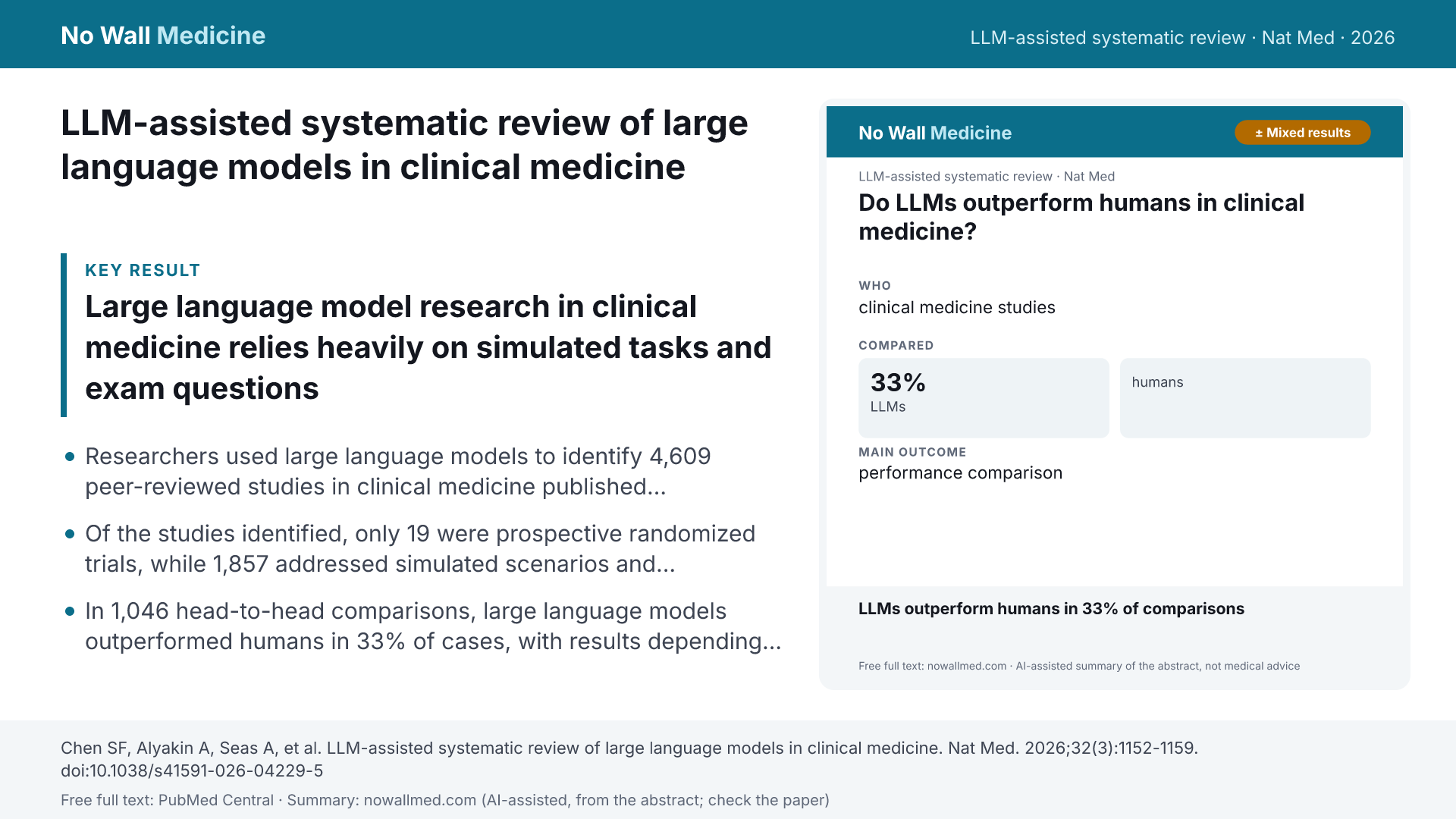
Large language model research in clinical medicine relies heavily on simulated tasks and exam questions
LLM-assisted systematic review of large language models in clinical medicine
LLM-assisted systematic reviewMixed results
Do LLMs outperform humans in clinical medicine?
Who
clinical medicine studies
Compared
33%LLMs
humans
Main outcome
performance comparison
Bottom line: LLMs outperform humans in 33% of comparisons
Limitation: small sample sizes in at least 25% of studies
Nat Med · 2026-03-03 · Save PNG
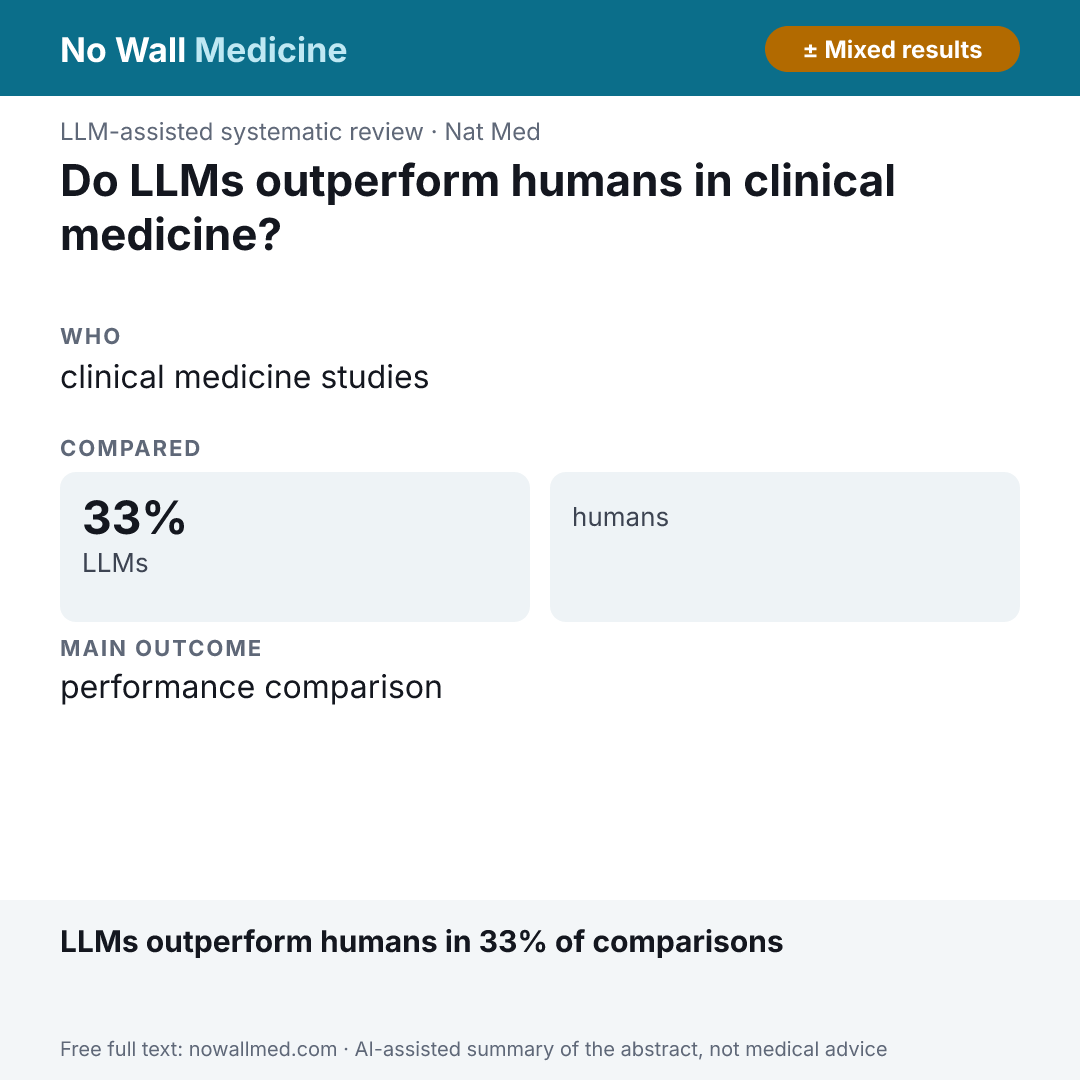
Clinical question: Do LLMs outperform humans in clinical medicine?
Why it matters: The rapid expansion of studies on large language models makes manual curation and review difficult for researchers.
Key points
- Researchers used large language models to identify 4,609 peer-reviewed studies in clinical medicine published between January 2022 and September 2025.
- Of the studies identified, only 19 were prospective randomized trials, while 1,857 addressed simulated scenarios and 1,704 focused on exam-style tasks.
- In 1,046 head-to-head comparisons, large language models outperformed humans in 33% of cases, with results depending on task realism and training levels.
Headline and key points written with AI from the paper’s abstract, with every number checked against it. Read the paper before relying on them.
Was this summary helpful?
Subject terms
Headline, design, result, key points, caveat and citation as plain text.
Cite this article
Chen SF, Alyakin A, Seas A, et al. LLM-assisted systematic review of large language models in clinical medicine. Nat Med. 2026;32(3):1152-1159. doi:10.1038/s41591-026-04229-5
Spotted a mistake? Suggest a correction