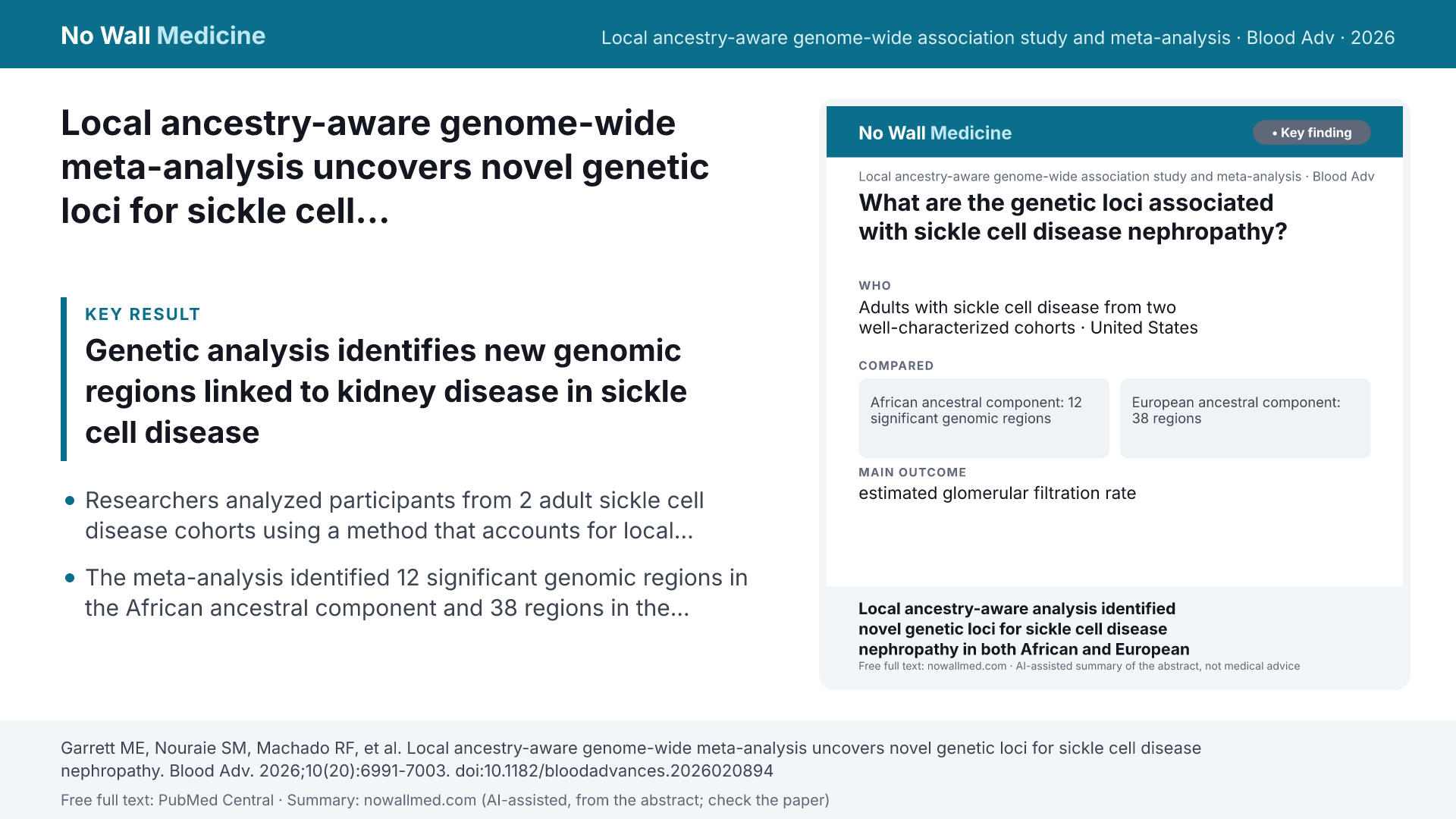
Genetic analysis identifies new genomic regions linked to kidney disease in sickle cell disease
Local ancestry-aware genome-wide meta-analysis uncovers novel genetic loci for sickle cell disease nephropathy
Local ancestry-aware genome-wide association study and meta-analysisKey finding
What are the genetic loci associated with sickle cell disease nephropathy?
Who
Adults with sickle cell disease from two well-characterized cohorts · United States
Compared
African ancestral component: 12 significant genomic regions
European ancestral component: 38 regions
Main outcome
estimated glomerular filtration rate
Bottom line: Local ancestry-aware analysis identified novel genetic loci for sickle cell disease nephropathy in both African and European ancestral components.
Blood Adv · 2026-08-19 · Save PNG
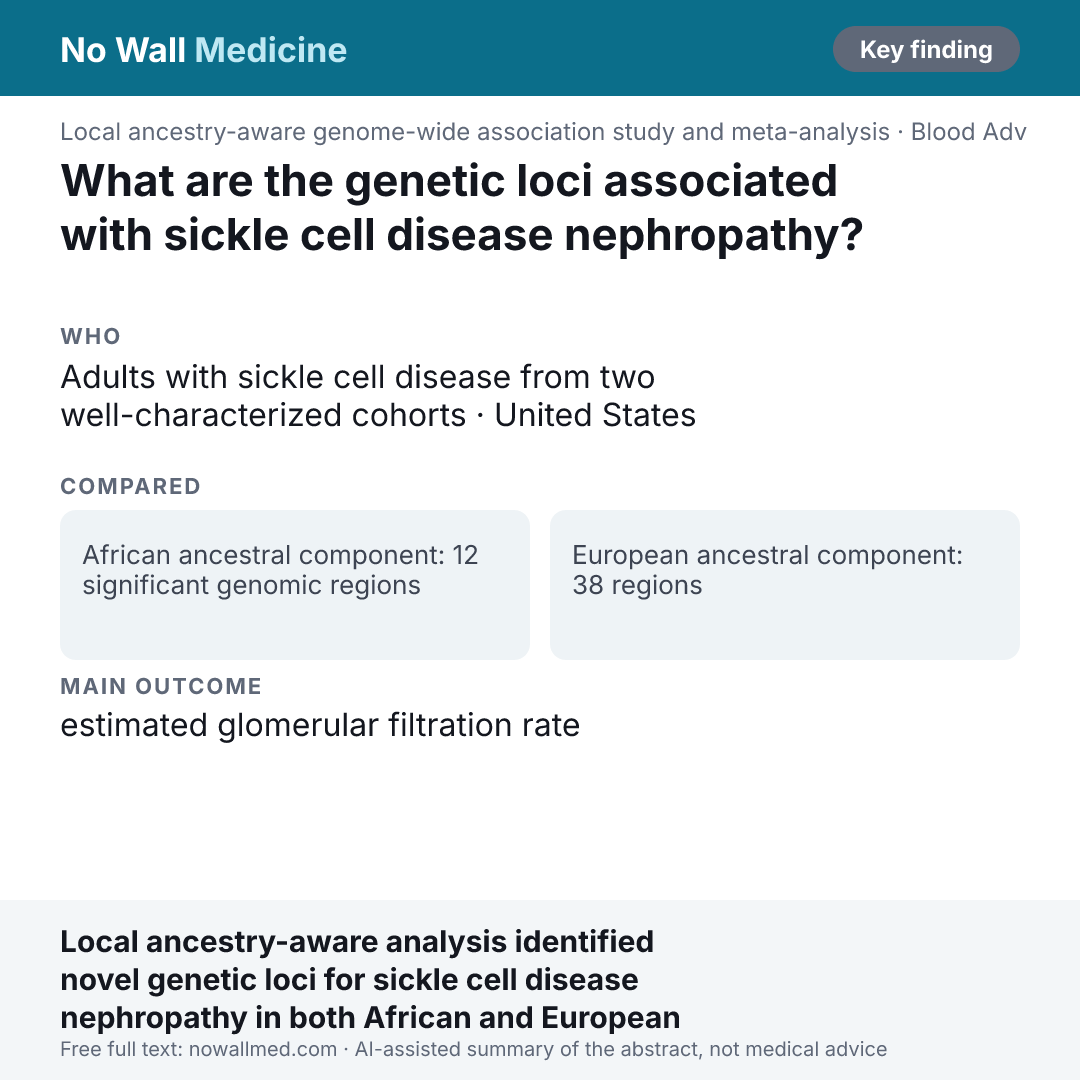
Clinical question: What are the genetic loci associated with sickle cell disease nephropathy?
Why it matters: Sickle cell disease nephropathy is a common complication associated with early mortality, but previous studies identified only a modest number of significant genetic locations.
Key points
- Researchers analyzed participants from 2 adult sickle cell disease cohorts using a method that accounts for local ancestry to study kidney function.
- The meta-analysis identified 12 significant genomic regions in the African ancestral component and 38 regions in the European ancestral component.
- The identified genes affect biological processes such as inflammation, iron metabolism, and magnesium ion homeostasis.
Headline and key points written with AI from the paper’s abstract, with every number checked against it. Read the paper before relying on them.
Was this summary helpful?
Abstract
In the United States, sickle cell disease (SCD) is a rare inherited hemoglobinopathy affecting ∼100 000 individuals, mostly with African ancestry. SCD causes damage to multiple organ systems, and SCD nephropathy (SCDN) is a common complication associated with early mortality. We previously performed a genome-wide association study (GWAS) for SCDN and identified a modest number of genome-wide significant loci. Here, we leveraged the ancestral composition of participants from 2 well-characterized adult SCD cohorts to boost statistical power and perform a local ancestry-aware GWAS for estimated glomerular filtration rate, resulting in the identification of novel genome-wide significant loci within the African and European ancestral components of participants. Meta-analysis identified 12 significant genomic regions in the African tract, including peptidylprolyl isomerase like 6, ARHGAP24, RAB11A, and STEAP3, and 38 regions in the European tract, including UBLCP1, a disintegrin and metalloproteinase with thrombospondin motifs 6, JAZF1, MYO7B, MYO1C, PDGFA, GPC5, LRP1B, KANK1, and TRPV5. The identified regions encompass genes affecting inflammation, extracellular matrix integrity, iron metabolism, magnesium ion homeostasis, B-cell apoptosis, tumor necrosis factor production, and estrogen signaling. Many of these genes and pathways are important not only for renal function but also for SCD biology, providing additional support for the hypothesis that SCDN pathophysiology is unique from other forms of kidney disease. This study represents the largest local ancestry-aware analysis of SCDN to date, furthers our understanding of the genetic risk factors underlying SCDN, and proposes new targets that could be useful for the early identification and treatment of kidney dysfunction in patients with SCD.
Abstract reproduced under the article’s CC BY NC ND licence.
Subject terms
Headline, design, result, key points, caveat and citation as plain text.
Cite this article
Garrett ME, Nouraie SM, Machado RF, et al. Local ancestry-aware genome-wide meta-analysis uncovers novel genetic loci for sickle cell disease nephropathy. Blood Adv. 2026;10(20):6991-7003. doi:10.1182/bloodadvances.2026020894
Spotted a mistake? Suggest a correction